“Pick up my train, you clumsy old bat,” my fiancée hissed after kicking my mother’s cane away—and she had no idea I was watching.
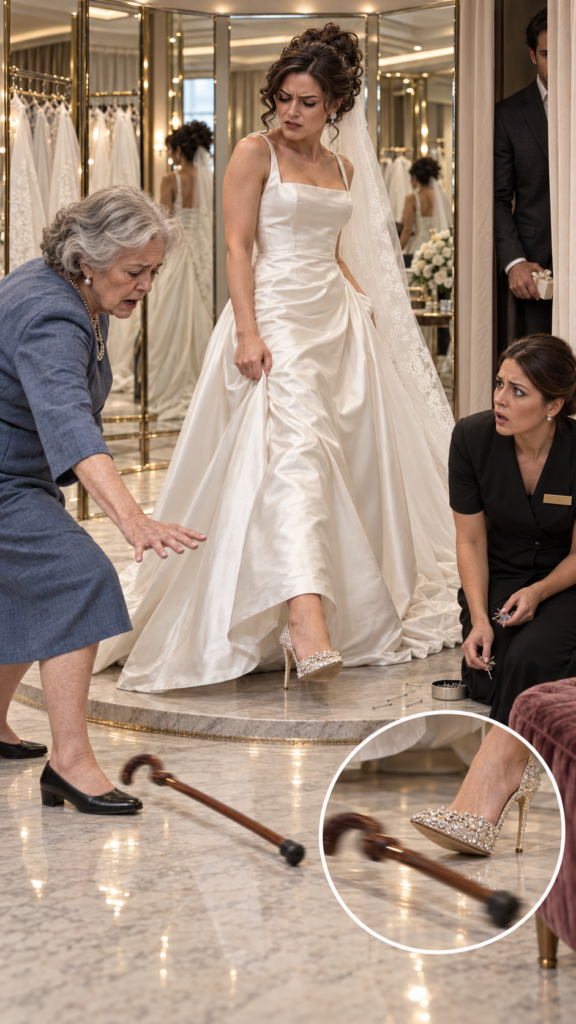
The bridal salon had the kind of silence only money could buy.
Soft instrumental music drifted through hidden speakers. Warm lights spilled over a raised fitting platform, turning the white satin of Vanessa’s wedding gown almost luminous. Mirrors covered three walls, multiplying her reflection until she seemed surrounded by an army of perfect brides.
A rack of veils stood beside a velvet bench.
Under my arm, I carried a small ivory box tied with ribbon—one final surprise I had planned to give Vanessa before she became my wife.
I had stepped behind a curtain only moments earlier, intending to wait until the consultant finished adjusting the cathedral-length train.
That was why Vanessa believed I had left the room.
My mother, Elena, stood near the edge of the platform with both hands wrapped around her cane.
She was not blocking anyone.
She was not complaining.
She was doing what she had always done in expensive rooms filled with polished strangers: making herself smaller than she needed to be.
Her shoulders curved inward. Her voice stayed low. Every movement was careful, as though simply existing might inconvenience someone wealthier than she was.
From across the suite, Vanessa looked flawless.
White satin hugged her body. Diamonds shimmered at her ears. Her dark curls had been pinned into the exact style she had saved in dozens of bridal magazines.
The consultant knelt beside the hem with several pins between her fingers, wearing the strained smile of someone trying not to offend a customer whose wedding budget could pay her yearly salary.
Then a fold of fabric slipped toward the platform’s edge.
My mother noticed it first.
She bent carefully, trying to lift the satin before it dragged across the marble.
Vanessa did not thank her.
She did not ask her to step away.
Her expression hardened.
Then she raised one glittering heel and kicked my mother’s cane out from beneath her.
The sound was small.
Wood scraped sharply across marble, spinning toward the mirrored wall.
Elena’s fingers reached for something that was no longer there.
She stumbled.
Her knees struck the floor hard enough to make the consultant gasp. The pins trembled between the woman’s fingers, but she did not move.
Nobody did.
For one unbearable second, the entire room seemed frozen around my mother’s fallen body.
Vanessa’s long white train slid over Elena’s shoulder like a wave, covering part of her faded blue dress.
My mother pressed one palm against the marble, trying to push herself upright.
Vanessa stared down at her.
There was no concern in her face.
No guilt.
Only irritation at the wrinkle forming in the satin.
“Pick up my train, you clumsy old bat,” she hissed.
My hand tightened around the ivory box.
The ribbon crushed beneath my thumb.
And suddenly, I was seventeen again.
I could smell sweat, cigarette smoke, and blood in the basement behind a closed-down gym. I could feel tape cutting into my knuckles and taste iron where someone’s glove had split my lip.
Back then, nobody knew my name.
I was just another desperate kid fighting in underground rings, counting every round I survived and calculating how many more punches I needed to take before I could afford Elena’s medicine.
The medicine that kept her standing.
The medicine she sometimes claimed she no longer needed because she knew we could not afford both her prescriptions and my food.
She had spent her whole life protecting me from hunger, fear, and the worst parts of myself.
Now she was on her knees beneath the wedding dress of the woman I had planned to marry.
Elena tried to rise before anyone could pity her.
One hand pressed against the floor.
One breath locked behind her teeth.
That single movement contained her entire life.
Hurt first.
Apologize second.
Vanessa turned toward the consultant without taking her eyes off the mirror.
“Don’t just stand there,” she snapped. “Help her before she wrinkles the dress.”
The consultant started to reach for Elena.
That was when I stepped out from behind the curtain.
The room did not become louder.
It became smaller.
The consultant froze with one hand extended.
My mother looked up.
Vanessa turned with irritation still exposed on her face—and the instant she saw me, it vanished.
Her eyes widened.
Her lips parted.
Then the mask returned so quickly that I almost hated myself for ever believing it.
“Adrian,” she purred.
One hand rose to her chest as if she had been startled in the middle of a romantic movie.
“Baby, thank God. Your mother slipped. I was just helping her balance.”
The lie settled between us.
Smooth.
Effortless.
Practiced.
My mother looked at me once.
There was no anger in her eyes.
No demand for justice.
Only fear.
Fear that I would lose control for her.
Fear that I would become the violent boy she had worked so hard to save.
I crossed the marble floor slowly.
Each step echoed through the suite.
Vanessa watched me approach, searching my face for the soft, privileged man she thought she knew—the quiet tech CEO who avoided public arguments, wore tailored suits, and solved problems with contracts instead of fists.
She had never understood what existed beneath the polish.
I bent and picked up the cane.
The wood felt cold in my hand.
I placed it carefully into Elena’s trembling fingers, then slipped my other arm around her waist and helped her stand.
“I’m fine,” she whispered immediately.
Of course she did.
Vanessa laughed softly.
“See? She’s fine. You know how dramatic older women can be.”
The consultant lowered her gaze toward the scattered pins.
I looked at Vanessa.
“Apologize to my mother.”
For the first time, uncertainty flickered behind her eyes.
But instead of looking at Elena, she glanced toward the consultant.
“Adrian,” she said through a strained smile, “don’t embarrass me in front of staff.”
That was the moment something inside me went completely still.
Not when she kicked the cane.
Not when she lied.
Not even when she called my mother an old bat.
It was the way she treated cruelty like a private privilege.
The way she treated the consultant like furniture.
The way she believed humiliation only mattered when it happened to her.
The old part of me knew exactly how rage wanted to enter that room.
It wanted fists.
Noise.
Fear.
It wanted to teach Vanessa the kind of lesson men in underground rings understood only after they stopped laughing.
But Elena had not sacrificed everything to keep me alive so I could become the worst thing I knew how to be.
So I smiled.
Vanessa’s shoulders loosened.
She thought she had won.
She mistook restraint for weakness.
She believed money had polished the violence out of my past and love had made me easy to control.
My mother knew better.
Her fingers tightened around the cane.
For the first time since she had fallen, Elena lifted her chin and stopped staring at the floor.
I guided her toward the velvet bench.
Then I placed the ivory-ribbon box beside her.
Vanessa’s eyes followed it immediately.
Expectation softened her expression.
She thought it contained jewelry.
Perhaps a necklace for the ceremony.
Perhaps some glittering proof that the wedding was still more important than what she had done.
She turned slightly toward the mirrors, smoothing the front of her gown.
“Can we please move past this?” she asked. “The dress needs to be finished.”
I looked at the perfect white satin.
At the diamonds in her ears.
At the woman I had nearly promised my entire life to.
Then I looked at my mother, still leaning against me because her knees had not stopped shaking.
My hand rested on the ivory box.
Vanessa smiled as if forgiveness already belonged to her.
I drew one slow breath, met my fiancée’s eyes, and said—
Nobody in that room was prepared for what came next.
“The wedding is over.”
Vanessa’s smile stayed on her face for almost three full seconds.
It did not disappear immediately. It simply stopped belonging to the rest of her expression, like someone had painted it there and forgotten to tell her eyes.
Then she laughed.
A small, breathless sound.
“Adrian.”
I did not move.
She looked at my mother, then at the consultant, then back at me as though the correct arrangement of witnesses might change what she had heard.
“You’re upset,” she said. “I understand. But don’t say something ridiculous because your mother lost her balance.”
The consultant’s fingers stopped moving over the pins.
Elena’s hand tightened around my sleeve.
I could feel the tremor she was trying to hide.
“She didn’t lose her balance,” I said.
Vanessa blinked once.
“I watched you kick her cane.”
The color drained from her face so quickly it seemed to expose every contour beneath the makeup.
For the first time since I had known her, Vanessa had no immediate answer.
The hidden speakers continued playing some soft piano arrangement meant to make brides feel beautiful. The melody suddenly sounded grotesque in the silence.
Vanessa’s eyes shifted toward the curtain.
Understanding arrived slowly.
“You were back there?”
“Yes.”
“How long?”
“Long enough.”
Her jaw tightened.
Then something almost impressive happened.
She tried to rebuild the lie anyway.
“I barely touched it.”
The consultant looked up.
Vanessa saw her and snapped, “Don’t.”
The single word was sharper than anything she had said to me.
The consultant went still again.
I looked at her.
“You don’t have to protect anybody in this room.”
She swallowed.
Vanessa stepped down from the platform so abruptly that satin whispered across the marble.
“Adrian, this is between us.”
“No,” the consultant said quietly.
Vanessa turned.
The woman’s face had gone pale, but her voice did not shake when she continued.
“It stopped being private when you kicked her cane.”
Vanessa stared at her.
The consultant took one breath.
“She was trying to keep your train off the floor. You kicked the cane away, and then you called her an old bat.”
Elena closed her eyes.
Not because she doubted what had happened.
Because hearing a stranger say it aloud made the humiliation real in a way silence had allowed her to avoid.
Vanessa’s face hardened.
“You work here.”
The consultant’s mouth tightened.
“Yes.”
“That means you should know when to stay out of a client’s personal business.”
The last fragile piece of doubt inside me disappeared.
Even now, with the wedding falling apart around her, Vanessa was not sorry she had hurt my mother.
She was furious that people she considered beneath her had witnessed it.
I reached for the ivory box.
Vanessa’s gaze dropped to my hand.
For half a second, hope returned to her face.
It was astonishing.
She actually believed the box might still save her.
I lifted it from the bench and held it at my side.
“Take off the ring.”
Her hand flew to the diamond on her left hand.
“What?”
“The engagement ring.”
Her fingers closed over it.
“You cannot be serious.”
“I have never been more serious.”
Elena touched my wrist.
“Adrian.”
Her voice held a warning I had heard hundreds of times when I was young.
Think first.
Do not destroy yourself because somebody else chose cruelty.
I covered her hand with mine.
“I’m all right.”
Vanessa stared at us.
Something in the tenderness of that gesture seemed to enrage her more than my words.
“So that’s it?” she demanded. “Your mother makes one scene and I’m disposable?”
My mother flinched.
I felt it through her hand.
I turned back to Vanessa.
“She was on the floor, and your first concern was your dress.”
“You’re twisting it.”
“I heard you.”
“I was stressed.”
“You kicked away a cane.”
“She was hovering over me all afternoon.”
“She was trying to help you.”
“I didn’t ask her to.”
Elena began to speak, but I shook my head gently.
She had spent enough of her life defending other people from the consequences of hurting her.
Vanessa stepped closer.
The white dress that had looked elegant from across the room now seemed enormous and inconvenient, yards of satin dragging behind her as she tried to follow me into an argument that was already finished.
“You know how much pressure I’m under,” she said. “The wedding, the guests, the press, your company people, your expectations—”
“My expectations?”
“You know what I mean.”
“No. Say it.”
Her lips parted.
The consultant slowly rose from the floor.
Vanessa glanced at her again, and that was enough.
I finally understood.
She had spent our entire relationship measuring rooms.
Who mattered.
Who did not.
Who could inconvenience her.
Who had to forgive her.
Who could be spoken to softly because they had power, and who could be spoken down to because they did not.
I had mistaken selective kindness for character.
“I expected you not to kick an elderly woman’s cane away,” I said. “Apparently that was too much.”
Vanessa’s eyes filled, but I had seen enough tears in fighting rings to know the difference between pain and panic.
She was panicking.
Not because Elena was hurt.
Because the future she had imagined was suddenly moving beyond her reach.
“You love me.”
“I did.”
The words seemed to hit harder than shouting would have.
Her face went still.
I felt Elena’s fingers tighten once around mine.
Vanessa lowered her voice.
“Did?”
I looked at the woman in front of me and searched for the person I had loved.
The woman who laughed with me over burned dinners.
The woman who claimed she admired how fiercely I protected my mother.
The woman who had once listened to the story of Elena skipping medicine so I could eat and cried into my shoulder.
Maybe those moments had been real.
That almost made it worse.
Because cruelty did not require someone to be cruel every minute.
It only required them to believe there were people who did not deserve the same humanity.
“I don’t know what part of you I loved anymore,” I said. “I only know I cannot marry what I saw today.”
Vanessa pulled the engagement ring from her finger.
For one moment I thought she might throw it.
The old version of me prepared automatically—the slight shift of weight, the calculation of distance, the instinct to intercept something before it reached Elena.
Vanessa noticed.
Maybe she saw, for the first time, a glimpse of the man I had once been.
But she did not throw it.
She set the ring on the velvet bench.
Her hand trembled as she released it.
“There,” she whispered. “Happy?”
“No.”
That answer confused her.
I took the ring and slipped it into my jacket pocket.
“I wanted to marry you. None of this makes me happy.”
The anger in her face faltered.
For the first time, pain reached her without performance.
She looked toward Elena.
My mother sat perfectly still.
Vanessa opened her mouth.
Nothing came out.
Then she made the worst choice available to her.
She looked at me and said, “If she hadn’t been here, none of this would have happened.”
Elena went very quiet.
The consultant looked away.
I felt something inside me close with a finality that surprised even me.
“No,” I said. “If she hadn’t been here, I might never have learned who you are.”
Vanessa recoiled.
I picked up Elena’s handbag from beside the bench and handed it to her.
Then I looked at the consultant.
“I’m sorry you were put in the middle of this.”
“You didn’t put me there,” she said.
Her eyes moved to Elena.
“I’m sorry I froze.”
My mother shook her head immediately.
“You were scared.”
The consultant’s face crumpled for just a second.
“So were you.”
Elena gave her the smallest smile.
“I’ve had practice.”
That nearly broke me.
Even now, with bruises already forming beneath her dress, my mother was comforting someone else.
I offered Elena my arm.
She took it.
Vanessa watched us turn away.
“Adrian.”
I stopped but did not turn around.
Her voice had changed.
No sharpness.
No polished sweetness.
Just fear.
“What am I supposed to tell everyone?”
There it was.
Not, Is your mother hurt?
Not, How do I fix what I did?
Not even, Can you forgive me?
What am I supposed to tell everyone?
I finally looked back.
“The truth would be a good place to start.”
We left her standing beneath the warm bridal lights in a dress that no longer had a wedding waiting for it.
Outside, the evening air was cold enough to sting.
Elena took one careful step onto the sidewalk and stopped.
Cars whispered past on the wet street. Somewhere down the block, someone laughed as a restaurant door opened and closed.
Ordinary sounds.
Ordinary life.
My mother stared ahead as though she had forgotten what ordinary felt like.
I opened the passenger door.
She did not get in.
Instead, she turned toward me.
“You wanted to hit her.”
It was not a question.
I looked away.
“Yes.”
Elena nodded.
The old shame rose into my throat.
“I wanted to hurt her for hurting you.”
“But you didn’t.”
“No.”
She touched my cheek with the same hand that had once pressed cold washcloths against my split lips when I was seventeen.
“You think I was afraid of Vanessa in there?”
I frowned.
“You looked terrified.”
“I was terrified of losing you.”
My chest tightened.
She glanced toward the salon windows behind us.
“I saw your face when you stepped out of that curtain. I knew that face.”
I remembered basements.
Blood.
Men shouting around a ring while I tried to stay conscious long enough to earn another envelope of cash.
“I’m not that kid anymore.”
“I know.”
Her thumb moved once against my cheek.
“That is why I was afraid.”
I looked at her.
She gave me a tired, almost irritated little smile.
“You still think strength means never wanting to do the wrong thing.”
I said nothing.
“Strength is wanting to do it,” she whispered, “and choosing not to.”
Something in me loosened.
I lowered my head until my forehead touched hers.
For several seconds, neither of us spoke.
Then Elena sighed.
“My knees hurt.”
I laughed before I could stop myself.
She did too.
The sound came out broken at first, halfway between laughter and tears.
I helped her into the car.
At her apartment, Elena insisted she could walk from the curb.
I ignored her.
She complained all the way to the elevator.
“You are not carrying me.”
“I wasn’t planning to.”
“You have the face.”
“What face?”
“The ridiculous heroic face.”
“I have one face.”
“That is unfortunately not true.”
By the time we reached her door, she was smiling.
It vanished when she saw the ivory box still in my hand.
She stopped.
“You brought that?”
I looked down at it.
The ribbon was crushed where my thumb had dug into it.
“I forgot I was holding it.”
Elena unlocked her door.
Inside, her apartment smelled faintly of tea and the lavender soap she had bought for as long as I could remember.
Nothing matched.
The couch was too old.
The lamp leaned slightly.
A stack of mail sat beneath a ceramic bowl full of keys and loose coins.
After the bridal salon, it felt more beautiful than any room I had entered in years.
Elena lowered herself onto the couch.
I set the box on the coffee table.
She stared at it.
“You should open it.”
“I know what’s inside.”
“I don’t.”
I looked at her.
She frowned.
“What?”
“You never showed me.”
A memory returned.
Three weeks earlier, I had asked Elena to come shopping with me because I wanted Vanessa’s wedding-morning gift to mean something more than another expensive thing.
Vanessa already had expensive things.
Elena had spent an hour looking through cases before choosing a pair of simple pearl-drop earrings.
Not because they were the most costly.
Because, she had said, “A bride should have something she can still wear when nobody is taking pictures.”
I untied what remained of the ribbon.
The lid lifted quietly.
Two pearl earrings rested against cream velvet.
Beneath them was a folded card.
I had forgotten the card.
Elena had written it herself.
I opened it.
Her handwriting was small and careful.
Welcome to our family. I hope you always feel safe being exactly who you are with us. Love, Elena.
I read it twice.
Then a third time.
My vision blurred.
Elena stared at the floor.
“I thought she might like them.”
I looked at my mother.
“You picked out a wedding gift for a woman who treated you like that.”
“I picked it before today.”
“Did she ever treat you badly before?”
Elena hesitated.
The pause answered enough.
My stomach tightened.
“Mom.”
“Nothing like today.”
“What does that mean?”
She rubbed one thumb across the handle of her cane.
“Little things.”
I waited.
“She corrected the way I pronounced the name of a restaurant once. She told me one of my dresses was ‘sweet’ in the voice people use when they mean cheap. At dinner she would sometimes answer questions you asked me before I could answer them.”
“Why didn’t you tell me?”
Elena’s eyes lifted.
“Because you loved her.”
“That isn’t an answer.”
“It is when you are someone’s mother.”
I sat down across from her.
“You protected her from me.”
“No.”
“You protected my relationship with her.”
“I tried not to become the mother who decided no woman was good enough for her son.”
The anger I had been holding shifted direction.
Not toward Vanessa.
Toward myself.
“How did I miss it?”
Elena shook her head.
“Because she loved you differently than she treated people she didn’t need.”
That sentence stayed in the room.
I leaned forward, elbows on my knees.
“I built an entire company by watching people. I negotiate for a living. I can tell when someone is lying before they finish a sentence.”
“Apparently not when they have pretty hair.”
I stared at her.
She raised one eyebrow.
I laughed despite myself.
Then my face folded.
The laugh disappeared.
“I almost married her.”
Elena reached across the coffee table.
Her fingers closed around mine.
“But you didn’t.”
The next morning, Vanessa was waiting outside my apartment building.
She wore dark sunglasses despite the gray sky.
No wedding dress.
No diamonds.
Just jeans, a camel coat, and the exhausted face of someone who had not slept.
I stopped several feet away.
She removed the glasses.
Her eyes were swollen.
“I need five minutes.”
“You have two.”
Pain crossed her face.
“Is your mother okay?”
I said nothing.
Vanessa looked down.
“I should have asked that yesterday.”
“Yes.”
“I’m sorry.”
I waited.
She took a breath.
“I was awful.”
The words sounded difficult.
“I was stressed and angry and I took it out on her. There is no excuse.”
For one dangerous second, hope moved inside me.
Not hope that we would marry.
Hope that somewhere beneath everything I had seen, she had finally looked directly at herself.
Then she continued.
“But ending our entire relationship over one terrible moment is insane.”
The hope disappeared.
“One moment?”
“I said it was terrible.”
“You still think the problem is the size of the incident.”
“What else am I supposed to think?”
“That you kicked away a cane because the person using it inconvenienced you.”
“I know.”
“You lied to my face.”
“I panicked.”
“You insulted the consultant when she told the truth.”
“She was interfering.”
Vanessa stopped.
She heard herself too late.
Silence opened between us.
I watched the realization move across her face.
She covered her mouth with one hand.
“Oh God.”
I nodded.
“That.”
Tears filled her eyes.
“I don’t know why I do that.”
Neither did I.
But for the first time, that was no longer my problem to solve.
She stepped toward me.
I stepped back.
The movement hurt her more than words could have.
“Adrian, please.”
“No.”
“I love you.”
“Maybe you do.”
Her face crumpled.
“That’s worse.”
“I know.”
I kept my voice gentle.
“Love is not a permission slip to mistreat everyone outside it.”
She cried then.
Not elegantly.
Not quietly.
I stood there and let her.
I did not rescue her from the consequence.
When she finally wiped her face, she looked years younger and somehow less familiar.
“What happens now?”
“The wedding is canceled.”
“The vendors?”
“My office will handle anything attached to my accounts. Anything you arranged personally is yours to manage.”
“Our guests?”
“I’m sending one message. The wedding is canceled. We ask for privacy. That’s all.”
“You’re not going to tell them?”
“I’m not going to humiliate you.”
She looked startled.
“Why?”
“Because what you did does not get to decide who I become.”
Vanessa closed her eyes.
For the first time, I think she understood the thing she had lost.
Not my money.
Not the wedding.
Not the photographs she had planned.
She had lost the version of me who trusted her with the most vulnerable person in my life.
There was no way back to that man.
She nodded once.
Then she turned and walked away.
I watched until she disappeared around the corner.
I did not follow.
Over the next week, the machinery of a canceled wedding moved with brutal efficiency.
Emails.
Refunds.
Deposits that could not be recovered.
Calls from confused relatives.
Messages from friends who sensed something ugly had happened and wanted details.
I gave them none.
The only person I contacted personally was the bridal consultant.
I sent a short note through the salon manager thanking her for telling the truth and making it clear that nothing about the canceled wedding was her fault.
Two days later, Elena received an envelope.
Inside was a handwritten card.
I froze because I was afraid, it said. You were kind to me anyway. I will remember that.
My mother read it at her kitchen table.
Then she folded it carefully and placed it beside the sugar bowl.
“She doesn’t need to remember me,” Elena said.
“Apparently she wants to.”
Elena touched the card once.
“Then I hope she remembers she spoke eventually.”
That was my mother.
Not interested in being anyone’s symbol.
Only interested in whether fear won next time.
The bruising on her knees faded slowly.
The deeper damage took longer.
For several weeks, whenever we entered a crowded place, Elena checked where her cane was before sitting down.
I noticed.
I never mentioned it.
Instead, I started doing something I should have done years earlier.
I slowed down.
Not dramatically.
I simply stopped walking three steps ahead.
If she took longer getting out of a car, I waited without reaching for her unless she asked.
If she paused on stairs, I paused too.
I began to understand that helping her was not the same as reminding her she needed help.
One Sunday, we went to lunch.
Elena wore a navy blouse and lipstick she had apparently owned since the previous century.
When she came out of her bedroom, I stared.
“What?”
“Nothing.”
“That face is never nothing.”
I pointed toward her ears.
The pearl drops from the ivory box swung gently beneath them.
My throat tightened.
Elena touched one.
“They were sitting in a drawer.”
“You kept them?”
“You could not return them.”
“I could have.”
“Well, now you cannot.”
I smiled.
She reached for her cane.
For a moment, the bridal salon flashed through my mind.
White satin.
Marble.
Wood scraping away.
Elena noticed my expression.
“Adrian.”
“I’m fine.”
She gave me a look.
I laughed.
“Apparently I learned that from you.”
We walked outside together.
At the restaurant, nobody knew who I was.
Nobody cared what company I ran.
Nobody knew Vanessa’s name or what had happened in the bridal salon.
Elena ordered soup and complained that it needed salt.
I told her it had plenty.
She accused me of having ruined my taste buds by eating protein bars.
It was the best meal I had eaten in months.
Halfway through lunch, she became quiet.
I looked up.
“What?”
She turned the spoon between her fingers.
“I need to tell you something.”
Every muscle in my body tightened.
She saw it and rolled her eyes.
“Nothing terrible.”
“Lead with that next time.”
She smiled.
Then her eyes softened.
“When you were seventeen, I knew about the fights.”
I stopped breathing for a second.
“No, you didn’t.”
“Yes.”
“I told you I was working nights.”
“You came home with your eyebrow split open and told me you bumped into shelving.”
I stared at her.
“You believed that.”
“Adrian, you were a terrible liar.”
The room seemed to tilt gently around me.
“You knew?”
“Not at first.”
“How long?”
“Long enough.”
I looked down at my hands.
Even now, the old scars crossed my knuckles like pale threads.
“Why didn’t you stop me?”
“I tried.”
“You never said anything.”
“I threw away your hand wraps twice.”
I looked at her.
“That was you?”
“Who did you think it was?”
“I thought I lost them.”
“You lost everything at seventeen.”
Despite myself, I laughed.
She did not.
“I knew why you were doing it.”
Her voice softened.
“You thought I needed medicine more than you needed to be safe.”
My eyes burned.
“You did.”
“No.”
“You did.”
“I needed my son.”
The words settled into a place nothing else had reached.
All those years, I had carried the story one way.
Elena sacrificed medicine.
I sacrificed my body.
We survived because I fought hard enough.
But she had been terrified every night too.
She had known.
She had watched me come home pretending not to limp because she understood exactly what I was trading for those envelopes of cash.
“I thought I was protecting you,” I whispered.
“So did I.”
She reached across the table.
Her hand covered mine.
“We were two stubborn people trying to save each other badly.”
A laugh escaped me through tears.
Elena smiled.
“That is our family talent.”
I looked at the pearl earrings.
At her lined face.
At the cane resting safely against the wall beside her chair.
Something about the ivory box finally made sense.
For weeks I had thought of it as the object Vanessa believed contained proof that she had won.
Something expensive.
Something sparkling.
A reward.
But Elena had chosen those earrings.
The woman Vanessa had treated as an inconvenience had been preparing to welcome her.
That was the part Vanessa never understood.
My mother had not entered that bridal salon trying to compete with her.
She had entered ready to make room.
Months passed.
The photographs from the engagement eventually disappeared from my apartment.
Not in one dramatic purge.
One frame at a time.
A picture moved into a drawer.
A dress left the closet.
A box was collected.
Silence stopped feeling empty.
It began feeling peaceful.
Vanessa sent one letter.
I read it once.
There was no begging in it.
No blame.
She wrote that she had started speaking to someone because she finally understood how many different versions of herself she had created depending on who stood in front of her.
She apologized to Elena by name.
She did not ask for forgiveness.
I gave the letter to my mother.
Elena read it quietly.
“Are you going to answer?”
She folded it.
“No.”
“Why not?”
“Because an apology can be accepted without reopening a door.”
I nodded.
She placed the letter back in the envelope.
“I hope she becomes kinder.”
“So do I.”
“That does not mean she gets you back.”
I smiled.
“I know.”
Elena studied me.
“You really know?”
“Yes.”
“Good. Because I am old, not stupid.”
“You are not old.”
She lifted her cane.
“Would you like to reconsider that sentence while I am holding a weapon?”
I laughed so hard the neighbor knocked on the wall.
By winter, the worst memory of the bridal salon no longer arrived first when I saw my mother with her cane.
Other images had replaced it.
Elena tapping the handle impatiently against my shoe because I was blocking the kitchen drawer.
Elena using it to pull a shopping bag closer when she refused to ask me for help.
Elena leaning it against the porch railing while she argued with me about whether the weather was cold enough for a scarf.
The cane became ordinary again.
That mattered more than I knew how to explain.
One evening, almost a year after the wedding that never happened, I arrived at Elena’s apartment carrying groceries.
She opened the door wearing the pearl earrings.
“Again?”
“They are mine.”
“I noticed.”
“You sound judgmental.”
“I paid for them.”
“You paid for Vanessa’s wedding gift. Vanessa did not marry you. Therefore the gift returned to the family.”
“That is impressively questionable logic.”
“I raised a technology CEO. Do not lecture me about creative accounting.”
I followed her into the kitchen.
A pot simmered on the stove.
Rain tapped softly against the windows.
Her cane rested beside the table.
Not hidden.
Not apologized for.
Simply there.
I unpacked the groceries while Elena complained that I had bought the wrong tomatoes.
“You said tomatoes.”
“I said good tomatoes.”
“There are classifications now?”
“There have always been classifications. You simply have money and no standards.”
I held up both hands.
She smiled.
For a while, we moved around each other in the tiny kitchen as though we had never lived any other life.
Then I noticed the ivory box on top of the cabinet.
The same box.
The ribbon was gone.
“What is that doing there?”
Elena glanced upward.
“Oh.”
“Oh?”
“I use it for things.”
“What things?”
She reached up, realized she could not reach it, and gave me a look that meant I was permitted to help without making a production of it.
I brought the box down.
Inside were small scraps of paper.
Receipts.
A movie ticket.
The consultant’s handwritten card.
A photograph of Elena and me at lunch, both laughing at something outside the frame.
And beneath everything, the crushed piece of ribbon from the bridal salon.
I touched it.
“You kept this?”
Elena shrugged.
“Why?”
She took the ribbon from my fingers.
For several seconds, she simply looked at it.
“I almost threw it away.”
“But you didn’t.”
“No.”
She tied it loosely around the handle of the ivory box.
“Some things should not be remembered because they hurt.”
Her fingers worked slowly.
“Some things should be remembered because they stopped hurting.”
I looked at her.
She closed the lid.
“That day used to be the day a woman kicked away my cane.”
Her eyes lifted to mine.
“Now it is the day I watched my son become the man I prayed he would survive long enough to become.”
I could not speak.
Elena did not rescue me from that either.
She simply reached out.
I took her hand.
Rain moved softly against the glass.
The soup simmered.
The pearl earrings caught the warm kitchen light every time she breathed.
And beside us, her cane remained exactly where she had placed it—steady, within reach, and no longer something either of us was afraid could be taken away.






