““My flight was canceled, so I came home early—and found my son at my front door with a metal tool, my daughter-in-law beside him with a screwdriver, and a moving truck already filled with pieces of my life.”
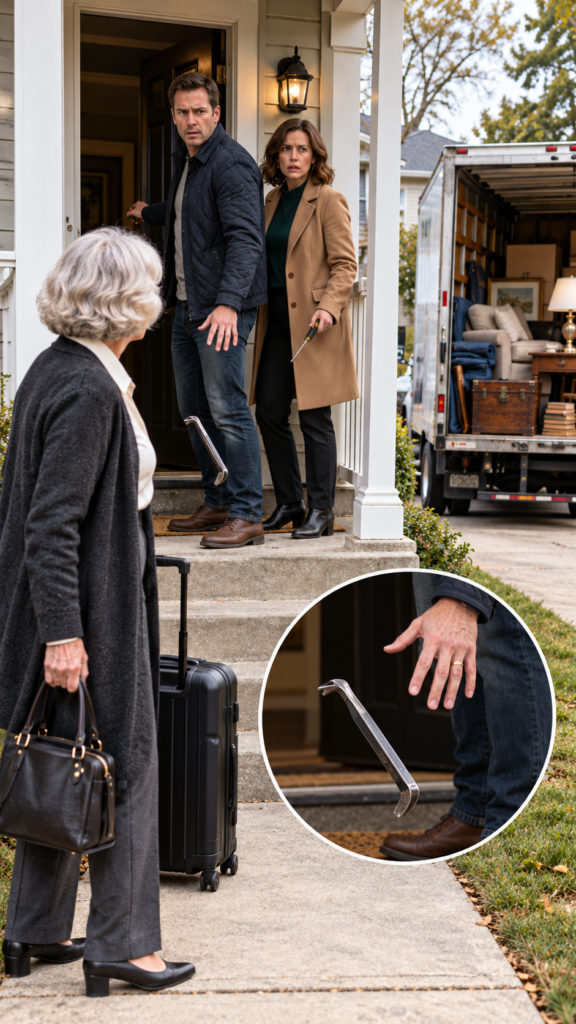
“Stop right there!”
My shout carried across the quiet street.
Tommy jerked around. The tool slipped from his hand and hit the concrete porch with a hard metallic clang.
Sandra stopped beside him, screwdriver still clenched in her fingers.
Neither of them spoke.
That porch had been part of my life for more than forty years. James and I had swept it together every Saturday morning. Tommy had sat on those steps as a little boy with his backpack between his knees, waiting for the school bus.
Now my sixty-nine-year-old self was standing at the bottom of it, staring at my own son as he tried to force open my front door.
Behind him, a moving truck sat in my driveway with its rear doors wide open.
I could see my couch inside.
My kitchen table.
Boxes I had never packed.
“Mom,” Tommy finally said.
The color had drained from his face.
“You’re supposed to be on vacation.”
Of everything he could have said, those words hurt the most.
Not, What happened?
Not, Are you okay?
Not even, Why are you back?
You’re supposed to be on vacation.
As though my absence had been necessary.
Sandra glanced toward the truck.
“We were only trying to…”
She stopped.
“Trying to what?” I asked.
Her eyes dropped.
That morning, I had believed I was leaving for two peaceful weeks in Oregon.
Four years had passed since I buried James, my husband of forty-five years. After his death, our house became more than a place to live. Every room still held some small piece of him.
The kitchen where he burned toast every Sunday.
The dining room where Tommy blew out birthday candles.
The living room where Christmas mornings disappeared beneath wrapping paper.
Even silence felt different there because it was a silence James had once filled.
My best friend Martha had spent months persuading me to visit her.
“You need to get out of that house for a little while, Dorothy,” she kept saying. “Come see Oregon. Let yourself enjoy something again.”
Eventually, I agreed.
Tommy knew exactly when I was leaving.
He had even visited the night before.
He hugged me, asked if I had packed everything, and told me to have fun.
At the time, I thought he was being thoughtful.
Now I wondered whether he had been studying the rooms.
At the airport, my ten o’clock flight was canceled because of a mechanical problem. The airline offered to put me on another flight the next morning.
I sat near the gate for a few minutes, staring at my suitcase.
Then a strange feeling settled over me.
Go home.
So I did.
Thirty minutes later, my taxi turned onto my street, and I saw the moving truck.
At first, I assumed it belonged to a neighbor.
Then I noticed the tires on my grass.
And Tommy at my door.
I paid the driver, dragged my suitcase toward the house, and saw what was already loaded inside the truck.
My grandmother’s wooden chest.
James’s anniversary lamp.
Paintings we had bought together.
Books.
Blankets.
My furniture.
My memories.
Now I walked past Tommy and Sandra and climbed into the truck.
My hands trembled as I touched the edge of my old tea set, the one James had given me for our twentieth anniversary.
Then I spotted my mother’s music box packed carefully between two boxes.
Something inside me gave way.
Tommy climbed up behind me.
“Mom…”
“How much?”
He stopped.
I turned to face him.
“How much money did you think you could get for all this?”
His eyes filled with tears.
“Please. It’s not what you think.”
Sandra stepped closer to the truck.
“Things have been difficult for us,” she said.
“Difficult?”
My voice sounded unfamiliar even to me.
“So you break into my house?”
“We weren’t taking from you,” Sandra replied. Her fear was fading now, replaced by something defensive. “We’re family. We thought you could help us.”
I stared at her.
“Help you?”
I gestured at the truck.
“This is what help looks like?”
Tommy rubbed a hand across his face.
“Mom, please. Just let me explain.”
He moved toward me.
I stepped away.
That stopped him.
Because suddenly the furniture was no longer the worst part.
They had known when I would leave.
They knew where my valuable things were.
They had brought boxes.
Blankets.
Tools.
A truck.
This had not been panic.
It had been preparation.
And once I understood that, another thought entered my mind.
A colder one.
I remembered little things I had dismissed over the past year. Objects I could not find. Drawers that seemed different after visits. Moments when I wondered whether grief was making me forgetful.
I looked at Tommy.
His gaze shifted toward Sandra.
She stared at the pavement.
That tiny exchange made my stomach turn.
I wiped a tear from my cheek.
“I want the truth, Tommy.”
He said nothing.
I stepped closer.
“Is this the first time?”
His expression changed instantly.
Not confusion.
Not outrage.
Fear.
And in that second, I knew I had finally asked the question my son had been hoping would never occur to me.”
Tommy’s eyes closed.
Only for a second.
But it was enough.
Sandra turned toward him so sharply that the screwdriver in her hand caught the light.
“Don’t,” she said.
I heard the word clearly.
Not don’t accuse us.
Not don’t misunderstand.
Just don’t.
Tommy opened his eyes again and looked at me.
“No.”
The street seemed to disappear.
The truck.
The house.
The lawn.
Even Sandra.
All I could see was the face of the boy I had once waited for at this same front door when he came home from school.
“No what?” I asked.
His throat moved.
“No, Mom. This isn’t the first time.”
My fingers tightened around the side of the truck until the metal edge pressed into my palm.
Sandra stepped forward.
“He doesn’t know what he’s saying.”
Tommy looked at her.
For the first time since I had arrived, something in his face hardened.
“Yes, I do.”
“Tommy.”
“You asked me to tell her it was the first time.”
Sandra’s mouth opened.
Nothing came out.
My knees felt weak, but I refused to sit.
“What did you take?”
Tommy looked down at the boxes between us.
“Small things at first.”
The sentence landed almost gently.
That made it worse.
“What things?”
“Things we thought you wouldn’t notice right away.”
A sound escaped me. Not quite a laugh. Not quite a sob.
“You thought I wouldn’t notice.”
Sandra folded her arms.
“We were going to replace things.”
I looked at her.
“With what?”
She said nothing.
Tommy’s face crumpled.
“The things you couldn’t find this past year,” he said. “Some of them were us.”
I remembered standing in my bedroom with a drawer open, certain I had put something there.
I remembered searching the hall cabinet twice.
I remembered calling Martha once and joking that old age had finally caught up with me.
She had laughed and told me I was sharper than anyone she knew.
I had laughed too.
Now shame burned through me, but it wasn’t mine.
“You let me think I was forgetting things.”
Tommy’s eyes filled again.
“I know.”
“No. You don’t.”
My voice stayed quiet.
“That is the part you do not get to say.”
Sandra took another step toward me.
“We were under pressure.”
I turned toward her.
“You keep saying that as though pressure changes the name of what you did.”
Her jaw tightened.
“You have this house. Savings. Furniture you don’t use. Things sitting in drawers for decades.”
There it was.
Not regret.
Resentment.
I felt something inside me become still.
“You decided that because I had something, you were entitled to take it.”
“That’s not what I said.”
“It is exactly what you said.”
Tommy whispered my name.
I looked at him.
“How long?”
He hesitated.
“Almost a year.”
The words hit harder than the tool striking the porch.
Sandra shut her eyes.
Tommy kept going.
“Things got bad. We fell behind. We were moving money around, trying to catch up. Sandra started selling some things online. Then I…”
He stopped.
“Then you what?”
“I gave her things from here.”
His voice broke.
I stared at him.
He had not merely watched.
He had chosen.
“How did you get in?”
He glanced toward the front door.
“You gave me the spare key years ago.”
I remembered.
After James died, I had handed Tommy a key because he said he wanted to make sure I was never alone if I needed him.
My stomach twisted.
“You used the key I gave you for emergencies to steal from me.”
He covered his mouth with one hand.
Sandra said, “We never took anything she needed.”
Tommy swung toward her.
“Stop saying that.”
She stared at him.
“You said the same thing.”
“I know.”
“No, apparently now you’re going to stand there and pretend this was all me.”
“I’m not pretending anything.”
Their voices rose.
I watched my son and his wife begin tearing at each other beside a truck filled with my belongings, and suddenly I understood something with absolute clarity.
I did not need to mediate.
I did not need to calm them.
I did not need to rescue Tommy from the consequences of his own choices.
I reached into my handbag and took out my phone.
Sandra noticed first.
“What are you doing?”
“Calling the police.”
Her face changed.
“Dorothy.”
I pressed the numbers.
“Don’t do this,” she said.
I looked at her.
“You already did it.”
Tommy lowered his head.
Sandra moved toward me.
Tommy caught her arm.
“Don’t.”
She yanked free.
“This is family business.”
“No,” I said. “It stopped being family business when you brought tools to my front door.”
The dispatcher answered.
My voice shook during the first sentence.
By the third, it did not.
I gave my address.
I explained that I had returned home unexpectedly and found two people attempting to enter my house while a moving truck containing my possessions sat in my driveway.
The dispatcher asked whether I knew them.
I looked directly at Tommy.
“Yes.”
That single word almost broke me.
“They’re my son and daughter-in-law.”
The silence afterward felt enormous.
The dispatcher told me officers were on the way and asked me to remain somewhere safe.
I stepped back toward the sidewalk.
Tommy stayed where he was.
Sandra paced once across the porch, then stopped.
“You’re actually going to have us arrested?”
I looked at the screwdriver still in her hand.
“You came to my home with tools and a truck.”
“We’re your family.”
“You keep using that word as though it means I owe you permission.”
She stared at me.
I had never seen such anger directed at me before.
What frightened me was how little it moved me.
A patrol car turned onto the street six minutes later.
Then another.
The officers separated us.
One spoke with me near the sidewalk while the other stayed with Tommy and Sandra.
I answered every question.
I told them about the canceled flight.
The truck.
The front door.
The belongings.
The missing objects over the previous year.
I did not exaggerate.
I did not soften anything either.
When the officer asked whether Tommy had permission to remove anything from my house, I said no.
When he asked whether Sandra had permission, I said no.
When he asked whether anyone had permission to enter while I was away, I said no.
Sandra began talking loudly from the porch.
She said there had been a misunderstanding.
She said I had always intended for Tommy to inherit everything.
She said they believed they were helping me organize.
Then the officer opened the back of the truck.
My furniture sat there wrapped in blankets.
Boxes had been labeled by room.
LIVING ROOM.
BEDROOM.
KITCHEN.
GARAGE.
The neatness of it made my skin crawl.
This wasn’t a misunderstanding.
It was an evacuation.
One officer asked whose handwriting was on the labels.
Nobody answered.
Then Tommy did something I did not expect.
He reached into his pocket and handed over his phone.
“Sandra made the list,” he said.
She turned white.
“What are you doing?”
“Stopping.”
“Stopping what?”
“This.”
He gestured toward the truck, the house, me.
“All of it.”
Sandra laughed once, sharply.
“You think handing them your phone makes you innocent?”
“No.”
His answer came immediately.
“It doesn’t.”
For the first time all day, Tommy sounded like the son I remembered.
Not innocent.
But honest.
Sandra’s face twisted.
“You agreed to everything.”
“I know.”
“You loaded the truck.”
“I know.”
“You took things before I ever did.”
Tommy looked at me.
“I know.”
Every admission hurt.
But each one also took away a little of the fog.
There would be no more wondering whether grief had confused me.
No more questioning my memory.
No more standing in front of an open drawer and blaming myself.
The truth was uglier.
But it was solid.
The officers spent nearly two hours documenting what was inside the truck.
One of them photographed the damage around the front door.
Another photographed the tool Tommy had dropped and the screwdriver Sandra had been holding.
Sandra eventually stopped speaking.
Tommy answered everything.
When an officer asked about the earlier missing property, Tommy said some items had been sold through an online resale account Sandra operated.
Sandra exploded.
“You were the one bringing them to me!”
Tommy flinched.
“I said I was part of it.”
“You’re making me look like some criminal mastermind.”
“No,” I said quietly.
Both of them looked at me.
“You’re doing that yourselves.”
Nobody answered.
By late afternoon, the truck had been secured.
My belongings would not leave the property.
Tommy and Sandra left with the officers for further questioning.
I stood on the lawn watching the patrol car disappear.
I had imagined many versions of losing my son.
Illness.
Distance.
An argument that lasted too long.
I had never imagined losing the version of him I believed existed while the real one stood three feet away.
When the street finally went quiet, I walked back toward the house.
The front door had scratches around the lock.
I touched them with two fingers.
Then I sat down on the porch step.
The same step Tommy had sat on with his backpack forty years earlier.
That was where Martha found me.
I had called her once the police arrived.
She did not ask whether she should come.
She booked the first flight she could find.
By the time her taxi pulled up, the sky had begun turning gold.
She climbed out before the driver had fully stopped.
“Dorothy.”
I stood.
She crossed the lawn and wrapped both arms around me.
That was when I finally cried.
Not delicately.
Not one cinematic tear.
I folded against my oldest friend and sobbed until breathing hurt.
Martha said nothing.
She held me.
When I finally pulled away, she looked at the damaged door and the moving truck.
“Oh, Dorothy.”
“I thought I was losing my mind.”
Her eyes filled.
“You were not.”
“I thought I was forgetting things.”
“You were not.”
“I laughed about it.”
She took my face gently between her hands.
“Listen to me. Their dishonesty does not become your shame.”
I closed my eyes.
For the first time that day, I let myself believe her.
That night we slept in my house.
Martha in the guest room.
Me in the bedroom I had shared with James.
Before bed, I walked through every room.
The house looked wounded.
Empty spaces marked where furniture had been removed before being carried to the truck.
Cabinet doors stood open.
A closet had been disturbed.
A framed photograph of James and me lay facedown on a side table.
I picked it up.
It had been taken on our thirty-fifth anniversary.
James was laughing because the wind kept blowing my hair across my face.
I sat on the edge of the bed holding the photograph against my chest.
“I didn’t know,” I whispered.
The room stayed quiet.
But the silence no longer accused me.
The next morning, Martha made coffee while I called a locksmith.
Then my bank.
Then my attorney.
Every spare key was accounted for.
The locks were changed.
Passwords were changed.
Tommy was removed from every account where I had once placed him as an emergency contact.
I changed my medical release.
My estate documents.
Everything.
Not because I wanted revenge.
Because trust had become something I would no longer confuse with access.
Over the next three weeks, investigators traced the online sales.
The missing objects had not been figments of my imagination.
There were records.
Photographs.
Messages.
Dates.
Some of the listings had been created within hours of visits to my house.
Seeing that evidence made me physically sick.
Tommy had sometimes come for coffee, hugged me goodbye, then carried something of mine to his car.
Sandra had photographed items against a blank wall and listed them for sale.
Several buyers cooperated when contacted.
A few objects were recovered.
Others were gone.
The prosecutor explained that the current attempted removal, the earlier sales, the messages between Tommy and Sandra, and the damage to my door created a pattern neither of them could explain away.
Sandra had also signed my name on paperwork connected to the planned sale of several larger pieces.
That detail silenced even Tommy.
He claimed he had not known she had done it.
The messages on his phone supported him on that one point.
It did not erase everything else.
I did not let it.
Four months later, Tommy pleaded guilty to theft-related charges and accepted restitution, probation, mandatory counseling, and every condition the court imposed.
Sandra fought longer.
She insisted the possessions would someday have belonged to Tommy anyway.
That argument failed for the same reason it had failed on my porch.
Someday was not today.
Inheritance was not ownership.
Family was not permission.
The forged paperwork made her position worse.
Eventually she accepted a plea that included restitution, a criminal record, and an order barring her from contacting me.
By then, she and Tommy were living separately.
Their marriage had not survived the investigation.
I took no satisfaction in that.
But I did not take responsibility for it either.
The hardest moment came after the hearing when Tommy saw me in the courthouse hallway.
He stopped about ten feet away.
He had lost weight.
There were gray strands in his hair I did not remember noticing before.
“Mom.”
Martha stood beside me.
I looked at him.
He did not come closer.
“I’m sorry,” he said.
I had imagined that sentence for months.
In some versions, I slapped him.
In others, I embraced him.
The truth was quieter.
“I believe you’re sorry now.”
He lowered his eyes.
“But I don’t know yet what your apology is worth.”
His face tightened.
“I understand.”
“No,” I said gently. “You’re beginning to.”
He nodded.
Tears slipped down his cheeks.
I let him cry.
I did not rescue him from that either.
He wrote to me every month.
At first, I put the letters in a drawer unopened.
Then one rainy afternoon, nearly six months after the truck appeared in my driveway, I read the first one.
There were no excuses.
No mention of Sandra forcing him.
No request that I forgive him.
He wrote about the spare key.
He said he remembered the day I gave it to him.
He remembered telling me, “Now you never have to worry.”
He wrote that the memory had become unbearable because he had turned the thing meant to make me feel safe into the thing that allowed him to violate that safety.
I read that paragraph three times.
The next letter was harder.
He admitted that the first object he took had been so small he convinced himself it did not count.
Then the second became easier.
Then, after enough time, he stopped thinking of the house as mine and began thinking of everything inside it as something he would eventually receive.
“I turned your future death into permission in the present,” he wrote. “I don’t know how to forgive myself for that, and I am not asking you to.”
I cried after reading that line.
But I kept reading.
A year after the afternoon at the truck, I agreed to meet Tommy for coffee.
Public place.
One hour.
No key.
No request for money.
No discussion of inheritance.
Those were my conditions.
He agreed before I finished listing them.
When he arrived, he looked nervous enough to be twelve again.
We sat across from each other near a window.
For several minutes neither of us touched our coffee.
Then he said, “I used to think being your son meant there would always be another chance.”
I waited.
“I think that’s why I kept crossing lines. Somewhere in my head, I thought mothers had to keep opening the door.”
My chest tightened.
“I am your mother,” I said. “I am not a door you can force open.”
He nodded.
“I know.”
This time, when he said it, I believed he might.
We did not repair forty years in an hour.
We did not try.
But when we stood to leave, he asked if he could hug me.
Asked.
That mattered.
I said yes.
His arms closed around me carefully.
He did not hold too tightly.
I did not promise anything.
But I hugged him back.
Sandra never contacted me again.
Through the court, restitution arrived in small payments.
It did not replace James’s memories.
Money could not do that.
But the payments mattered because they required the people who had taken from me to acknowledge, month after month, that what they took had never been theirs.
I began changing the house too.
Not because Tommy and Sandra had emptied parts of it.
Because I realized I had spent four years preserving rooms as though James might walk back into them if I kept everything exactly where he left it.
I moved the chair by the window.
I painted the guest room.
I gave away clothes I had kept because I could still remember the shape of his shoulders inside them.
I cried while doing it.
Then I kept going.
I chose what stayed.
That was the difference.
My grandmother’s chest stayed.
My mother’s music box stayed.
The anniversary tea set stayed.
James’s lamp stayed beside my chair.
Other things went to people who wanted them, charities that needed them, and families starting homes of their own.
Every object that left crossed my threshold because I decided it would.
That small fact restored something inside me.
Then, almost eighteen months after the canceled flight, Martha asked me a question over breakfast.
“So,” she said, buttering toast, “are you ever going to make it to Oregon?”
I stared at her.
She raised one eyebrow.
I laughed.
It surprised me how easily the sound came.
Three weeks later, I packed the same black suitcase.
When I rolled it toward the front door, I stopped.
For one second, I was back on the sidewalk looking at the moving truck.
My hand froze on the suitcase handle.
Martha noticed.
She did not tell me not to be afraid.
She simply stood beside me.
I looked around the living room.
James’s lamp.
My books.
The photographs.
The music box.
Then I looked at the new lock on the front door.
I locked it myself.
Tested it once.
And left.
Oregon was greener than I expected.
Martha drove me along roads bordered by fir trees and water that seemed to hold the sky.
We ate chowder near the coast.
Walked until my knees complained.
Sat wrapped in blankets one evening watching the Pacific disappear into darkness.
On our fourth night, Martha brought two cups of tea onto the porch of the little cottage we had rented.
She was unusually quiet.
“What?” I asked.
She looked toward the ocean.
“There’s something I’ve kept from you.”
My heart gave one hard beat.
Apparently she saw it in my face because she immediately reached across the table.
“Nothing bad.”
I let out a breath.
“After the last year, you really should lead with that.”
She smiled.
Then her eyes filled.
“James asked me to keep inviting you here.”
I stared at her.
“What?”
“Before he died.”
The sound of the ocean seemed to move farther away.
Martha reached into her handbag and took out a small envelope.
I knew the handwriting before she placed it on the table.
DOROTHY.
James.
My fingers began trembling.
“He gave this to me about two weeks before he died,” Martha said. “He told me not to give it to you while you were still trying to survive losing him.”
I could not take my eyes off the envelope.
“What did he say?”
“He said you would turn that house into a museum if everyone let you.”
A laugh broke through my tears.
“That sounds like him.”
“He said you would confuse loving him with refusing to move anything.”
I covered my mouth.
Martha’s voice softened.
“He made me promise that someday I would get you out of the house long enough to remember you were still alive.”
For months she had said, Come to Oregon.
For months I thought she was simply worried.
Now I understood why she had never stopped asking.
I opened the envelope.
There was one sheet of paper.
James’s handwriting wandered more than it had when he was younger.
Dorothy,
If Martha has finally gotten you out of that house, then she has kept her promise and you have broken one of your stubborn habits.
I laughed through tears.
Martha did too.
I kept reading.
I know you. You will keep my mug because I touched it. You will keep a lamp because we argued over where to put it. You will keep old coats because they still look like me from the doorway.
Keep some things.
Not all of them.
Home was never the furniture.
It was you walking into a room.
It was Tommy running down the stairs.
It was Sunday toast burning because I never learned patience.
It was forty-five years of ordinary mornings.
Do not spend whatever time you have left guarding objects because you are afraid letting them go means letting me go.
I am not in the objects.
I am in what they taught you to remember.
Go somewhere.
Laugh loudly.
Move the chair.
Buy something I would hate.
Let people love you.
And if our boy ever loses his way, remember that loving him and saving him from every consequence are not the same thing.
That line stopped me.
I looked at Martha.
She was crying openly now.
“Did he know?”
“No,” she said immediately. “Not about this. Not what Tommy would do. James worried about him sometimes. About how easily he expected you two to fix things for him. That’s all.”
I looked back at the letter.
The sentence no longer felt like prophecy.
It felt like James.
Practical.
Tender.
Infuriatingly clear.
For a year and a half, I had believed the canceled flight had brought me home to discover everything I was about to lose.
Sitting above the Pacific with James’s letter in my hands, I suddenly understood the stranger truth.
Coming home early had saved my house.
But leaving it again was saving me.
I pressed the paper against my chest.
Martha reached across the table.
I took her hand.
We sat there until the tea went cold.
When I returned home from Oregon, Tommy came by the following Saturday.
By invitation.
He stood on the porch.
He did not try the door.
He knocked.
I opened it.
For a second, neither of us spoke.
Then he held up a paper bag.
“I brought breakfast.”
I looked inside.
Toast.
Burned around the edges.
I stared at him.
His mouth twitched.
“Dad’s recipe.”
I laughed before I could stop myself.
Tommy’s eyes filled.
Mine did too.
I stepped aside.
“Come in.”
He entered slowly.
No key in his pocket.
No entitlement in his step.
Just my son, carrying burned toast into the kitchen where his father had burned it every Sunday for forty-five years.
Forgiveness did not arrive all at once.
Trust did not either.
But over the months that followed, Tommy kept doing the unremarkable things that repair is actually made of.
He arrived when he said he would.
He never asked for money.
He never touched a drawer without asking.
He continued counseling.
He paid restitution.
When something was hard, he told the truth before the truth was forced out of him.
Sometimes I still watched him too closely.
Sometimes he noticed.
Neither of us pretended otherwise.
One afternoon, while helping me replace a loose board on the porch, he stopped and looked at the steps.
“I used to wait for the bus right there.”
“I remember.”
“You used to stand inside the window until I got on.”
“I thought you didn’t know.”
“I always knew.”
He sat down.
For a moment, he was forty-three and eight years old at the same time.
“I’m sorry I made this place unsafe for you.”
I sat beside him.
“You did.”
He swallowed.
“I know.”
I looked at the street.
Then at the repaired front door.
Then at my son.
“But it is safe again.”
His face folded.
He looked away quickly.
I rested my hand over his.
That was all.
It was enough.
The following Christmas, Martha came to stay.
Tommy joined us for dinner.
There were only three places set at the table.
No performance.
No pretending.
Sandra’s name did not need to be spoken for the room to feel honest.
After dinner, Tommy washed the dishes without being asked.
Martha leaned toward me.
“Should we check the silver before he leaves?”
I stared at her.
She kept a perfectly straight face for two seconds.
Then I burst out laughing.
Tommy turned from the sink.
“What?”
“Nothing,” I said.
Martha was laughing too hard to answer.
Eventually Tommy understood.
To my surprise, he laughed with us.
There was pain in it.
But also relief.
The kind that comes when something terrible has finally become part of the past instead of a threat still waiting in the room.
Before bed, I wound my mother’s music box.
The old melody filled the living room.
James’s lamp cast a warm circle beside my chair.
My grandmother’s wooden chest stood beneath the window.
The house still held memories.
But it no longer held me captive.
The next morning, sunlight fell across the porch steps.
My suitcase stood near the door again because Martha and I were leaving after breakfast for a small trip up the coast.
Tommy carried it outside.
Then he stopped at the threshold and looked back at me.
“Want me to lock up?”
I smiled.
“No.”
I took the key from his open palm.
“I’ve got it.”
He nodded.
I closed the door behind us and turned the lock myself.
The click was small.
Ordinary.
Safe.
Then I slipped the key into my handbag beside James’s letter, took my son’s arm with one hand and Martha’s with the other, and walked down the porch steps into the morning.”






