My future daughter-in-law shaved my head while I slept on the morning of her wedding to my son—and expected me to show up smiling with twenty-two million dollars.
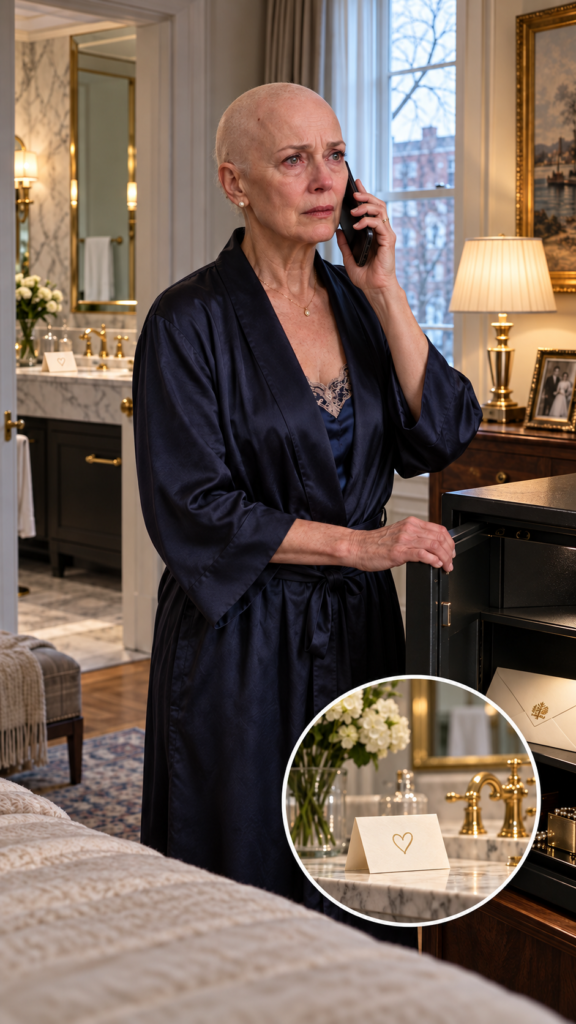
I woke with my scalp on fire.
For one disoriented second, I reached for the silver hair that had brushed past my shoulders the night before.
My fingers found nothing.
No uneven cut. No loose strands.
Just bare, tender skin.
I lurched out of bed and crossed the room toward the bathroom, one hand pressed to my head. Before I turned on the light, I caught the smell of antiseptic.
Clean. Sharp. Intentional.
Then the mirror showed me what someone had done.
My scalp was flushed raw, with a few scraps of silver hair still clinging near my ear. I stared at my own reflection, unable to move.
Someone had come into my bedroom while I slept.
Someone had stood over me.
Someone had shaved my head.
A note was taped to the center of the mirror.
“Congratulations—you finally have a hairstyle that suits your age.”
A tiny heart sat beneath the words.
The handwriting was neat. The cruelty was almost cheerful.
When I pulled the note from the glass, expensive floral perfume lifted from the paper.
Sabrina.
My future daughter-in-law.
In a few hours, she would walk down the aisle to marry my son, Michael.
She wanted tears. She wanted panic. She wanted me to call Michael and beg him to defend me. More than that, she wanted Beatrice Langford—the widow who had clawed her way from debt and grief into Boston real estate—to be too ashamed to attend her own son’s wedding.
I didn’t give her any of it.
I folded the note and set it beside the sink.
Then I walked back into my bedroom and opened the safe.
Inside was an ivory envelope I had prepared the night before. It contained the authorization for a twenty-two-million-dollar wedding gift: a penthouse, investments, security, a life Michael and Sabrina would never have to struggle for.
For years, I had used money as an apology.
An apology for working too much after Richard died. For grieving too long. For not always knowing how to be the mother Michael needed after his father was gone.
Michael never had to ask directly. He mentioned a condo, and I bought it. He talked about Europe, and I paid for the trip. He sighed over a bill, and somehow a check arrived.
I gave because I loved him.
Then I kept giving because I was afraid that if I stopped, he might stop loving me.
That morning, the envelope didn’t look like a gift anymore.
It looked like a weapon I had nearly handed Sabrina.
I slid it back into the safe and turned the dial until the lock clicked shut.
Then I called Avery Whitman, our family attorney.
“Beatrice,” he said when he answered. “Ready to finalize the transfer?”
“No.”
The word landed with a steadiness that surprised me.
Avery paused. “Has something happened?”
I looked at the note on the sink. At my raw reflection.
“Put everything on hold,” I said. “No transfer. No access. No exceptions.”
“Beatrice—”
“At the reception tonight, come to my house,” I told him. “We’re rewriting my will.”
There was a long silence.
“Is something wrong?”
“One thing,” I said quietly. “I finally woke up.”
Lucia, my hairstylist for twenty years, arrived before noon. The moment she saw my scalp, her hand rose to her mouth.
She didn’t ask who had done it.
Maybe she saw the answer in my face. Maybe she understood that naming the horror would only give it more room to breathe.
Instead, she opened her case and fitted me with a soft gray-silver wig, shaping it carefully around my face until no one could see what lay beneath it.
By the time she helped me into my navy silk dress and gray coat, the woman in the mirror looked composed again.
Elegant.
Controlled.
But no longer willing to be afraid.
At St. Andrew’s Church, sunlight spilled through stained glass and painted shifting colors across the polished pews. The organ played. Guests whispered about the flowers, the gown, the family fortune.
No one knew what Sabrina had done.
As I watched Michael wait at the altar, memories came back with brutal clarity.
Richard’s death certificate shaking in my hands.
Twelve-year-old Michael asking why his father couldn’t come home.
The nights I skipped dinner so he could have books, shoes, everything a boy should have had.
One duplex became three. Three properties became buildings. Deal by deal, I built an empire from the wreckage of our life.
I built it for my son.
Somewhere along the way, he forgot what it had cost.
Sabrina had never hidden her contempt very well. Her insults came dressed as jokes: my clothes, my age, the way I spoke, the way I held a fork. She looked at me like old furniture in a house she planned to renovate.
And Michael never stopped her.
Sometimes he smiled.
Sometimes he laughed.
At the reception, Sabrina sat beside him beneath crystal chandeliers, flawless in her glittering gown. When her eyes found mine, satisfaction flickered there.
She thought the wig meant I had accepted the humiliation.
I smiled back.
Inside my purse, her note rested beside the recorder. For years, fear had ruled every decision I made where Michael was concerned.
That fear was gone.
The emcee lifted his microphone.
“And now, a special moment from the groom’s mother, Mrs. Beatrice Langford.”
Applause rolled through the ballroom.
I stood.
Sabrina’s smile tightened when I walked toward the podium. Michael watched me with faint confusion, as if he couldn’t imagine why his mother might have something to say that wasn’t a blessing.
I placed the folded note on the podium.
Across the room, Sabrina saw it.
Her expression changed.
I looked at my son, raised a hand to the edge of my silver hair, and said, “Before I give you my wedding gift, Michael, there’s something your bride needs to explain.”
For a heartbeat, nobody moved.
Then Sabrina’s eyes dropped to the folded note on the podium.
The color left her face so quickly that even from across the ballroom, I saw it happen. Michael followed her gaze. His brow tightened, not with understanding yet, but with the first faint instinct that the evening had shifted beneath his feet.
“What is that?” he asked.
I kept my eyes on Sabrina.
She tried to recover. Her shoulders straightened. One hand smoothed the front of her gown, a small reflex I had seen before whenever she was buying herself time.
“Beatrice,” she said with a strained laugh, “this really isn’t the place.”
The room changed at those words.
No one gasped. No glass shattered. But conversation had already died, and now the silence became attentive. Somewhere near the back of the ballroom, a fork touched a plate with a tiny silver click.
I unfolded the note.
I did not read it.
I simply held it between two fingers and looked at my son.
“This was taped to my bathroom mirror when I woke up this morning.”
Michael stared at me.
I lifted one hand to the silver hair Lucia had arranged so carefully around my face.
Then I removed the wig.
The air seemed to leave the room.
My scalp felt suddenly cold beneath the chandeliers. Tender skin caught the warm light. Near my left ear, the few remaining scraps of silver hair looked almost absurdly fragile.
Michael’s mouth opened.
Nothing came out.
Sabrina took one step backward.
I watched my son’s face as the truth reached him in pieces. Confusion first. Then disbelief. Then a horror so naked that for one moment I saw the twelve-year-old boy who used to search my face when he was afraid.
“Mom,” he whispered.
I turned the note so he could see the handwriting.
“Someone came into my bedroom while I slept,” I said. “Someone shaved my head. Then she left this.”
Michael looked at Sabrina.
She shook her head immediately.
“No.”
It was too fast.
Too sharp.
Michael’s eyes narrowed.
“Sabrina?”
She looked around the ballroom as if searching for an exit that would not look like an exit. “This is insane. She’s trying to ruin our wedding.”
I placed the note back on the podium.
“Read it,” I said.
Sabrina’s jaw tightened.
“I’m not participating in this.”
“Then tell Michael it isn’t yours.”
“It isn’t mine.”
Michael stepped closer and picked up the note.
I saw recognition before he said anything.
“You write your sevens like this,” he said softly.
Sabrina stared at him.
Michael pointed to one line with a trembling finger. “You always cross them twice.”
“It proves nothing.”
“And the heart.”
Her expression hardened.
“You put that heart on every note you leave me.”
For the first time all evening, Sabrina looked afraid.
She reached for his hand.
He moved it away.
The movement was small.
It landed harder than a shout.
“Tell me you didn’t do this,” he said.
Sabrina’s eyes filled, but the tears came with anger rather than grief. “You have no idea what she’s been doing to me.”
“What has she been doing to you?”
“She judges me. Constantly. She makes me feel like I’m some gold digger who wandered in off the street.”
I said nothing.
Sabrina looked at me, and the polished bride vanished for a second.
“You were never going to accept me.”
“That gave you the right to enter my bedroom?”
“I wanted you to understand what it feels like to be humiliated.”
There it was.
The room did not erupt.
It became quieter.
Michael went completely still.
Sabrina seemed to hear her own words only after they were out.
“I didn’t mean—”
“You shaved her head?” Michael asked.
His voice cracked on the last word.
Sabrina folded her arms.
“I barely touched her. Hair grows back.”
Somewhere behind me, a woman inhaled sharply.
Michael closed his eyes.
I had imagined this confrontation all morning. In some versions, I thought I might feel triumphant when Sabrina finally exposed herself.
I did not.
I felt tired.
Deeply, painfully tired.
Michael opened his eyes and looked at me.
“Did you know?” I asked him.
His face changed.
“Know what?”
“That she despised me.”
He swallowed.
“Mom…”
“Did you know?”
His gaze dropped.
That was answer enough.
I waited.
“I knew you two didn’t get along,” he said.
“She mocked my age in front of you.”
He said nothing.
“She mocked the way I dressed. The way I spoke. The way I held a fork.”
“I thought she was joking.”
“And when I stopped laughing?”
His eyes closed again.
For years, I had feared one terrible possibility: that Michael would stop loving me if I stopped providing for him.
Standing there, I saw a different truth.
He had not stopped loving me.
He had simply grown comfortable letting me pay the price for keeping peace in his life.
Sabrina stepped toward him.
“Michael, don’t let her do this. She’s manipulating you.”
His head turned slowly.
“Manipulating me into what?”
“Choosing her.”
The words hung between them.
Michael stared at his wife.
Then he looked at me.
“This was never supposed to be a choice,” he said.
“She made it one.”
“No,” Michael said. “You did.”
Sabrina’s face hardened completely.
“She controls everything with money. The condo. The trips. The wedding. Every time you need something, she writes a check and gets to act like a saint.”
Michael flinched.
Because that part was not entirely false.
I felt it too.
The truth had arrived from the wrong mouth, but it was still truth.
“I did use money badly,” I said.
Both of them looked at me.
“I used it when I was tired. I used it when I didn’t know how to reach my son. I used it because giving was easier than asking whether he was angry with me.”
Michael’s eyes shone.
“But money did not shave my head.”
Sabrina’s lips pressed together.
“And money did not write that note.”
I reached into my purse and took out the recorder.
Sabrina stared at it.
“This has been running since before I walked to the podium.”
Her face changed.
“I didn’t bring it to trap anyone,” I said. “I brought it because for once, I wanted a record of what was said when I stopped pretending.”
Sabrina’s breathing became shallow.
“You can’t use that.”
“I don’t need to.”
I set it beside the note.
“Everyone already heard you.”
She looked around the room.
For the first time, she saw the guests not as an audience, but as witnesses.
Her mother stood near one of the floral arrangements with one hand pressed to her throat. Two bridesmaids stared at the floor. The emcee had gone pale.
No one moved toward Sabrina.
Her power did not disappear because I destroyed her.
It disappeared because the room finally knew what she had done.
Michael removed his wedding ring.
Sabrina’s eyes locked onto his hand.
“No.”
He held the ring between his fingers, staring at it as though he did not recognize it.
“We got married two hours ago,” she said.
“I know.”
“You can’t humiliate me like this.”
He looked at her.
Pain moved through his face.
Then recognition.
“Hair grows back, right?”
She recoiled.
Michael looked sickened by his own words the moment he said them.
He set the ring on the table.
“I’m not going home with you tonight.”
“Because of her?”
“Because of you.”
She turned on me.
“This is what you wanted.”
“No.”
My voice surprised me with how calm it sounded.
“What I wanted was to survive my son’s wedding without becoming entertainment.”
I looked at Michael.
“There is no wedding gift.”
His lips parted.
Sabrina froze.
“The transfer was stopped this morning.”
“You can’t.”
It came out as a whisper.
“The money is mine,” I said. “The decision is mine.”
She looked at Michael with sudden panic.
“You said it was done.”
Michael’s head snapped toward her.
“I said she had planned something generous.”
“You said she never says no to you.”
The words hit him like a door slamming.
No one needed an explanation.
Michael looked at me.
The shame on his face deepened as he remembered every condo, every trip, every bill, every time he had sighed and waited for me to rescue him.
Sabrina kept talking.
“We made plans based on that money.”
Michael went still.
“We?”
“The penthouse. The investments. The move.”
“You told me you wanted a life with me.”
“I do.”
“Then why does every sentence start with her money?”
Sabrina stared at him.
There was no answer that could save her.
Michael turned toward me.
I wanted to step away from him.
I wanted to step toward him.
Instead, I stayed where I was.
He stopped several feet from the podium.
“Mom,” he said.
I lifted one hand.
“Not tonight.”
His face folded.
“Not because I don’t love you,” I said. “Because I do. And I need to learn what loving you looks like when I’m not paying for the privilege.”
His eyes filled.
He nodded once.
Then he walked out of the ballroom alone.
I watched my son leave his own wedding reception without following him.
That may have been the hardest thing I did all day.
Avery arrived at my house a little after ten that night.
Lucia was still there.
She sat at my kitchen island with a mug of tea between both hands. When I came in, she stood and crossed the room without asking what happened.
She did not touch my head.
She simply wrapped her arms around me.
I stayed rigid for three seconds.
Then I broke.
Not loudly.
My knees weakened, and a sound came out of me that felt older than that morning.
Lucia held me until it passed.
Avery waited in the study.
When I joined him, the ivory envelope sat on the desk between us.
Twenty-two million dollars.
A number large enough to distort almost any relationship.
He removed his glasses.
“Are you sure?”
“Yes.”
“We can rewrite the will tonight. We can also wait.”
“I don’t want to wait.”
He studied me.
“I’m not disinheriting Michael.”
Avery’s eyebrows rose.
“I’m ending the machinery.”
The automatic rescues. The silent transfers. The money arriving before anyone had to be honest.
I instructed Avery to remove all assumptions of immediate unrestricted inheritance. Michael would still be treated fairly, but future distributions would be structured and deliberate. The canceled wedding gift would remain mine.
Then I asked him to pull the file on the first duplex I had ever bought.
He looked surprised.
“You still think about that place?”
“Every day.”
The duplex stood in Dorchester, far less glamorous than anything bearing the Langford name now. I had bought it after Richard died with borrowed money, stubbornness, and fear. I repaired cabinet doors myself. I painted walls at midnight after Michael went to sleep. I learned leases beside his schoolbooks.
That building had not been the beginning of my fortune.
It had been the beginning of my belief that we might survive.
“I want to keep it out of the estate,” I said.
“For what purpose?”
I looked toward the kitchen where Lucia was quietly washing cups.
“I don’t know yet.”
But for the first time in years, not knowing did not frighten me.
Michael did not call the next morning.
He sent one message.
I’m safe. I’m sorry. I’ll wait until you’re ready.
I read it three times.
Then I put the phone down.
Sabrina moved into a hotel. Through attorneys, she and Michael began formally separating. Their marriage had lasted hours before the break became irreversible, though the legal ending would take longer.
She sent me one message.
You ruined my life.
I did not answer.
Three weeks later, Michael asked if he could see me.
I told him Sunday at two.
He arrived early carrying no flowers, no gift, no apology written by a lawyer.
We sat in the living room.
For several minutes, neither of us spoke.
Then Michael leaned forward.
“I laughed.”
My throat tightened.
“When she mocked you,” he said. “I laughed.”
I said nothing.
“I told myself it was easier than starting a fight. I told myself you were strong enough not to care.”
His hands clasped together.
“That was convenient.”
“Yes.”
He nodded.
“I let you absorb discomfort so I didn’t have to.”
I looked at my son and saw no little boy.
I saw a grown man who had hurt me.
That mattered.
“I was wrong too,” I said.
He looked up.
“I made it too easy for you never to grow uncomfortable.”
“That doesn’t make what I did your fault.”
“No.”
The word sat cleanly between us.
He inhaled.
“I’m selling the condo.”
“Why?”
“Because you bought it.”
“That doesn’t mean you owe me a performance.”
“I know. I want to know what my life costs when you aren’t quietly paying part of it.”
For the first time, I almost smiled.
“That sounds expensive.”
A broken laugh escaped him.
Then his eyes filled.
“I think I started believing you didn’t need anything from me.”
The sentence went through me slowly.
For years, I had translated my guilt into checks.
He had translated those checks into invulnerability.
I had tried so hard not to burden my son with my grief that I had taught him I could not be wounded.
“We were both cowards,” I said.
Michael nodded.
“Yeah.”
Healing did not happen that afternoon.
But honesty did.
Over the next six months, Michael kept his promises in small ways.
He sold the condo and moved into an apartment he could afford. He stopped calling Avery with financial questions. He paid for his own therapy. When he invited me to dinner, he chose places where he could take the check without making a joke about it.
Sometimes our conversations ended badly.
Sometimes we went weeks without speaking.
But he kept coming back without asking me to rescue him.
By spring, his divorce from Sabrina was final.
She never received the penthouse because it had never been transferred. She never received the investments because they had never become hers. Whatever she and Michael divided belonged to their brief marriage, not to me.
She never apologized.
Eventually, I stopped needing her to.
Lucia trimmed the first soft growth on my scalp in March.
By then my hair had returned as a silver-white fuzz.
She turned me toward the mirror.
“Well?”
I touched the new growth.
For a second, I remembered waking in the dark and finding nothing beneath my fingers.
Then I looked at myself now.
“I think I’ll keep it short.”
Lucia smiled.
“Good.”
That summer, I took Michael to Dorchester.
He stood on the sidewalk in front of the first duplex and stared up at the weathered brick.
“You still own this?”
“I do.”
“I thought you sold it years ago.”
“Never.”
We walked inside.
The place smelled of dust, old wood, and fresh plaster. I had begun repairs, though nothing luxurious. Strong floors. Safe wiring. Clean kitchens. Windows that locked.
Michael ran his hand along the kitchen doorway.
“I remember this.”
“You were twelve.”
“You made me hold the flashlight while you fixed that hinge.”
“You complained for forty minutes.”
“I was twelve.”
“You were dramatic.”
He laughed.
Then he noticed the small brass plaque still screwed inside the pantry door.
B.L. — 1998.
My initials.
My first repair.
My first proof that broken things could sometimes be made useful again.
“What are you doing with the place?” he asked.
I handed him a folder.
The first page described a small housing program for widowed parents with children—temporary below-market apartments, practical financial counseling, childcare support, and help returning to stable work.
Michael read silently.
When he reached the name, he stopped.
Richard Langford House.
His eyes closed.
“Dad would hate having a building named after him.”
“I know.”
“He’d say it sounded pretentious.”
“He absolutely would.”
Michael pressed the folder to his chest.
Then his expression changed.
“There’s something I need to show you.”
He returned from his car with a battered cardboard box.
I recognized my handwriting on one side.
MICHAEL — SCHOOL.
“You kept that?”
“For years.”
Inside were old report cards, photographs, a cracked baseball trophy, and three books with worn spines.
One was the history book I had skipped dinner to buy when he was thirteen.
I remembered the price.
Thirty-eight dollars.
At the time, it had felt like three hundred.
Michael opened the cover.
“You wrote this.”
On the inside, in faded blue ink, was a sentence in my handwriting.
For every door I can’t open for you, I hope this opens one.
I stopped breathing.
I had forgotten writing it.
Michael had not.
“I used to read that whenever I thought you were working because you’d rather be somewhere else.”
My eyes burned.
“All these years,” he said, “I thought the money was how you loved me.”
He touched the page.
“But it wasn’t.”
The room blurred.
“This was.”
Not the book.
The sentence.
The hope behind it.
The exhausted woman I had been, trying to give her son one more door.
For years, I had believed my fortune began with property.
Standing in that old kitchen, I understood it had begun earlier—with a thirty-eight-dollar book, a missed dinner, and the stubborn belief that my child deserved a future.
Michael held the book toward me.
I shook my head.
“Keep it.”
He looked down at the folder.
“Can I help?”
“With money?”
His mouth twitched.
“No.”
“Good answer.”
“With work.”
He was not asking for a building.
He was asking for a place beside me.
“Yes,” I said.
By autumn, the first family moved into the downstairs apartment.
A widowed mother arrived with two children, three suitcases, and the stunned expression of someone who had spent too long being told stability was a luxury.
Michael carried boxes.
I made sandwiches.
Lucia brought towels.
Avery complained that none of us understood liability and then spent two hours assembling a crib.
No one wore formal clothes.
No chandeliers hung overhead.
There was no applause.
It was one of the happiest days of my life.
That evening, Michael and I sat on the front steps.
My hair had grown into a short silver crop.
He looked at it.
“You really like it that way?”
“I do.”
He smiled.
“I’m not going to say it suits your age.”
I turned toward him.
He winced.
“Too soon?”
“Much.”
We both laughed.
Then Michael grew quiet.
“I’m sorry,” he said.
This time, the words did not ask me to erase anything.
They simply existed.
“I know.”
“I don’t expect you to forget.”
“I won’t.”
He nodded.
Then I reached over and took his hand.
Forgiveness, I had learned, was not pretending the wound had never happened.
It was deciding the wound did not get to own every room afterward.
A year after the wedding, Richard Langford House had four families in stable apartments and a waiting list we wished did not exist.
Michael volunteered whenever he was in town.
He never touched the financial accounts.
That was his idea.
On the anniversary of the morning I lost my hair, I woke before dawn.
For a moment, lying in the quiet, I remembered the antiseptic smell.
The mirror.
The note.
Then sunlight began to gather against the curtains.
I got up and walked to the bathroom.
My reflection looked back at me.
Short silver hair.
Lines around my eyes.
A face I recognized.
On the counter sat no cruel note.
Only the old history book Michael had left after dinner, open to the inside cover.
For every door I can’t open for you, I hope this opens one.
I ran my fingers over the faded blue ink.
Downstairs, the front door opened.
“Mom?”
Michael.
He had promised to help me carry donated furniture to the duplex.
I closed the book and went downstairs.
He stood in the hall wearing jeans and an old sweatshirt, holding two coffees.
No envelope.
No request.
No fear.
He handed me one cup.
“Ready?”
I looked at my son.
Then I picked up my coat.
Outside, the morning was cold and bright.
Michael held the door for me, and together we stepped into it.
For the first time in years, neither of us was trying to buy back the past.
We were simply going home.






