“Mom isn’t allowed to pick up her own prescriptions anymore.”
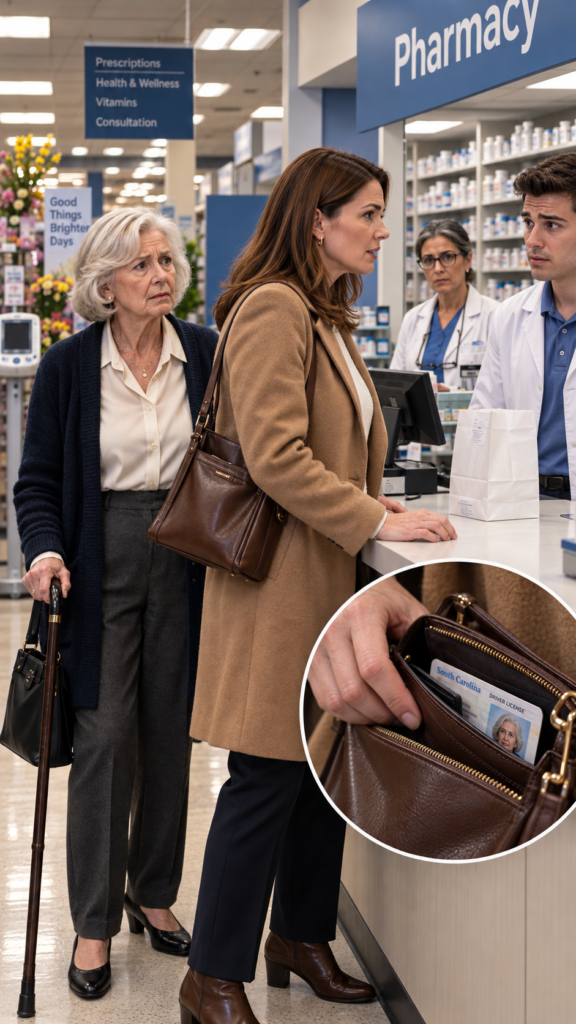
Rebecca said it with a smile.
Not a cruel smile. Not openly. The kind meant to make strangers think she was being patient with me.
The young clerk behind the pharmacy counter looked from my daughter to me, uncertain. My arthritis medication sat in a white paper bag behind him, my name stapled across the front.
“I’m the patient,” I said.
Rebecca’s smile held, but something sharpened behind it. “She doesn’t understand the new arrangement.”
There was no new arrangement.
My name is Eleanor Hayes. I’m seventy-one years old, and until that Tuesday afternoon, I had never needed anyone’s permission to collect a bag with my own name on it.
The pharmacy was inside the grocery store three miles from my house. I’d been coming there for twelve years, past the flowers and greeting cards, past the dusty blood-pressure machine no one ever cleaned. They knew I preferred easy-open caps. They knew my insurance always rejected one refill before approving it ten minutes later.
And they knew Rebecca.
For six months, my daughter had been “helping.”
That was her word.
Helping after my knee surgery. Helping organize my pill bottles. Helping reset my passwords because I was, as she liked to say, “getting a little mixed up lately.”
I wasn’t mixed up.
I had simply asked why two prescriptions had been refilled early.
Rebecca had laughed, bent down, kissed my forehead, and told me, “You worry too much, Mom.”
After that, I started worrying about everything.
A payment appeared on my bank statement that I didn’t recognize. My doctor’s office suddenly called Rebecca instead of me. An insurance letter disappeared from the table beside my recliner before I could read it.
At Sunday dinners, she turned my questions into a performance.
“Mom’s becoming such a handful,” she’d say, with that same soft smile.
Her husband would squeeze her shoulder, proud of her. “You’re a saint for dealing with all this.”
Nobody asked why I’d missed appointments Rebecca had rescheduled without telling me.
Nobody asked why she kept repeating the story about me leaving the stove on, as if it had happened yesterday instead of once, eleven years ago, during a storm blackout.
That’s how someone takes your life away.
Not by yelling.
By correcting you gently in front of witnesses until everyone begins trusting their version of you more than your own.
That Tuesday, Rebecca had said she was too busy to drive me anywhere.
So I walked.
Slowly, but steadily, my cane clicking across the grocery store tile.
I had barely reached the counter when Rebecca came hurrying around the corner, keys still in her hand, her purse swinging against her hip.
“Mom,” she said brightly, though she was breathing too fast. “Why didn’t you wait for me?”
“I came for my prescription.”
Then she turned to the clerk before I could say another word.
“My mother is not authorized to collect her medications alone anymore.”
The clerk’s eyes flickered toward me.
“I am Eleanor Hayes,” I said. “That medication is for me.”
Rebecca sighed as though I had forced her into something painful. “Mom, please. Don’t make this difficult.”
A voice cut in from behind the counter.
“Mrs. Hayes?”
Denise, the pharmacist, stepped closer. She had silver threaded through her dark hair, reading glasses hanging from a blue cord, and the calm, exhausted expression of someone who had spent years watching families bring their worst behavior into a brightly lit pharmacy.
“May I see your driver’s license?” she asked me.
Before I could reach for my purse, Rebecca did.
“I keep that for her now,” she said.
I looked at my daughter.
“You keep my license?”
“For safekeeping,” she whispered, as if I had embarrassed her.
Denise said nothing. She turned to her computer and began typing.
Click.
Pause.
Another click.
Her face changed so slightly that most people would have missed it. But I didn’t.
“Mrs. Hayes,” Denise said, looking directly at me, “did you personally authorize anyone to change the pickup permissions on this account?”
“Yes,” Rebecca answered at once.
Denise didn’t look at her.
“I asked Mrs. Hayes.”
The grocery store noise seemed to pull farther away. Even the man waiting behind us stopped pretending to study the cough syrup display.
“No,” I said.
Rebecca let out a small laugh, but it broke at the end. “Denise, my mother has memory issues. Her doctor knows that.”
Denise’s fingers rested on the keyboard.
“That’s interesting,” she said quietly. “Because there is no competency restriction on Mrs. Hayes’s file.”
Rebecca’s hand closed around her purse strap.
Denise looked at the screen again.
“There is, however, a fraud warning attached to the person who attempted to restrict her access.”
For the first time, Rebecca didn’t have an answer ready.
Denise reached beneath the counter and set a sealed white envelope beside my prescription bag. My name was printed across the front in bold black letters.
Rebecca moved fast, reaching for it.
Denise placed her hand over the envelope.
“No,” she said. “This belongs to your mother.”
Rebecca’s eyes found mine then, and the frightened look inside them was nothing like concern.
I picked up the envelope.
In the upper-right corner was a date from three weeks earlier.
The same day Rebecca had taken me to lunch, slid a paper across the table, and asked me to sign it for what she called “an insurance form.”
My hands began to shake as I turned the envelope over.
Inside wasn’t just a pharmacy request.
It was a copy of a notarized document I had never seen before.
The paper trembled between my fingers, not because of the arthritis this time.
Across the top, in language so formal it almost looked harmless, were the words Durable General Power of Attorney. Below them, my name appeared as the principal. Rebecca’s appeared as my agent. The document gave her authority over my bank accounts, my insurance, my property, and anything else that could be folded under the phrase “financial affairs.”
I turned the first page.
Then the second.
By the time I reached the signature page, my mouth had gone dry.
The signature was mine.
I knew the shape of it—the way the E in Eleanor leaned too far forward, the little hook at the end of Hayes. I had signed something that afternoon at lunch. Rebecca had turned the page toward me, covered half of it with her hand, and said the restaurant light was terrible.
“Just the insurance authorization, Mom.”
I had signed because she was my daughter.
That was the part that hurt more than seeing my name on the page.
Rebecca’s voice came carefully from beside me.
“Mom, I can explain.”
I looked up.
For months, she had trained everyone around us to watch my face for confusion. Now I watched hers.
Her eyes kept moving from the document to Denise, then to the clerk, then back to me. She was calculating. Searching for the version of this moment she could still control.
Denise broke the silence.
“Mrs. Hayes, would you like to step into the consultation room?”
“Yes.”
Rebecca moved with me.
Denise raised one hand.
“I’m asking Mrs. Hayes.”
The sentence was quiet. It landed harder than anything shouted could have.
I picked up my prescription bag and the envelope. Then I held out my other hand.
“My license.”
Rebecca stared at me.
For one long second, nothing happened.
Then she reached into her purse and placed my driver’s license in my palm.
I slid it into my wallet myself.
The consultation room was barely large enough for two chairs and a narrow counter. Denise closed the door behind us, leaving Rebecca outside. Through the frosted glass I could see the blurred shape of my daughter standing motionless.
Denise sat across from me.
“I need to be careful about what I tell you,” she said. “But I can tell you what happened here.”
I nodded.
“Someone using that document tried to change your profile so only an authorized caregiver could collect certain prescriptions.”
“Rebecca.”
Denise did not answer the accusation for me.
“The request was flagged because it conflicted with your existing history and because the person making the request could not verify information we required.”
My hands tightened around the envelope.
“Can she do this?”
“Not here. Not now. I’ve restored your account to direct patient access while this is reviewed.”
She paused.
Denise slid the phone on the counter toward me.
“You can call your bank from here.”
I almost said I could do it later.
Instead, I opened my wallet, found the number on the back of my debit card, and called.
The first person transferred me to fraud services.
The second asked me security questions Rebecca did not know.
The third went very quiet.
“Mrs. Hayes,” the woman said, “a power of attorney was added to your account three weeks ago.”
I closed my eyes.
The same day as lunch.
“There has also been a change to your mailing preferences and one payment made from your checking account to an outside credit card.”
My eyes opened.
“The payment I asked about.”
“Yes, ma’am.”
“Whose credit card?”
There was a pause while she checked.
“I can only tell you the account holder name associated with the payment.”
I gripped the edge of the little counter.
“Tell me.”
“Rebecca Hayes.”
For several seconds, I heard only the hum of the pharmacy lights.
Rebecca had told me that payment was probably an annual insurance fee.
I had apologized for questioning her.
I had actually apologized.
The bank froze the power-of-attorney access while the document was reviewed and opened a fraud claim on the payment. The woman told me not to sign anything else and to contact an attorney immediately about revocation.
Before we hung up, I asked one more question.
“Has she tried to move anything else?”
“Not successfully.”
The word successfully stayed with me.
It meant there had been attempts.
When I lowered the phone, Denise did not say she was sorry.
I was grateful for that.
Pity would have broken me.
Instead she asked, “Would you like to call your doctor next?”
I did.
The office manager recognized my voice immediately.
When I asked why they had started calling Rebecca instead of me, there was a long silence on the line.
“Mrs. Hayes, we received a signed authorization naming your daughter as the preferred medical contact.”
“I never signed that knowingly.”
Another silence.
Then I asked the question Rebecca had forced into every family dinner.
“Has my doctor diagnosed me with memory problems?”
“No.”
“Has he said I’m incompetent?”
“Absolutely not.”
I looked through the frosted glass.
Rebecca’s blurred figure had not moved.
The office manager’s voice dropped.
“There is something else you should know.”
My fingers went cold again.
“Your daughter called several times asking whether the doctor would write a letter stating that you were no longer able to manage your own affairs.”
I could not speak.
“He refused,” she continued. “He told her he had no medical basis for that statement.”
Outside the room, Rebecca shifted.
I could see the shadow of her hand rise toward her face.
Because suddenly the missing appointments made sense.
The rescheduling.
The stories at dinner.
The stove from eleven years ago.
The constant corrections.
It had not been enough for Rebecca to take control.
She had needed everyone else to believe I should not have it.
When I stepped out of the consultation room, she rushed toward me.
“Mom, please. You’re making this sound terrible.”
I stopped.
Denise remained behind the counter. The young clerk stared down at his keyboard, giving us the dignity of pretending not to listen.
“You asked my doctor to say I couldn’t manage my own affairs.”
Rebecca’s face drained.
“It wasn’t like that.”
“You paid your credit card from my checking account.”
“I was going to put it back.”
The sentence came too quickly.
It answered more than she realized.
My daughter covered her mouth.
Then she started crying.
Not loudly. Rebecca never did anything loudly.
“Mom, I was trying to get things organized before something happened.”
“Something happened.”
She looked at me.
“You happened.”
Her shoulders folded.
For half a second, the sight of her crying reached the oldest part of me—the part that remembered scraped knees, fevers, school plays, the little girl who used to crawl into my bed during thunderstorms.
I almost reached for her.
Then I remembered how many times she had kissed my forehead while lying to me.
I let my hand stay at my side.
“I need you to give me my house key.”
Her head snapped up.
“Mom—”
“My key.”
People were watching now.
I did not care.
Rebecca took the key from her ring with trembling fingers and put it in my hand.
I closed my fist around it.
Then I called her husband.
He arrived twenty minutes later, confused and pale, still wearing the navy quarter-zip he had worn to work that morning. Rebecca tried to meet him near the entrance before he reached me.
I watched her begin talking fast.
He looked over her shoulder at me.
Then at the envelope.
Then at Denise.
His expression changed.
Inside the consultation room, I told him what the bank had said. What the doctor’s office had said. I showed him the document.
He read it twice.
When he finally looked at Rebecca, his face held something worse than anger.
Shame.
“You told me she asked you to take over.”
Rebecca flinched.
“I thought she needed help.”
“You told me the doctor wanted it.”
“He was being cautious.”
“He refused to write the letter.”
Rebecca said nothing.
Her husband sat back as if someone had taken the strength out of his spine.
At Sunday dinners, he had called her a saint.
Now he looked at me.
“I’m sorry.”
I believed he meant it.
That did not make it enough.
“You helped her make me smaller,” I said.
His eyes filled.
“Yes.”
No excuses.
Just yes.
It was the first clean thing anyone had said to me all day.
That afternoon, I did not go home alone.
Rebecca’s husband drove me there. Rebecca followed in her own car because there were documents in my house that I needed to find, and I wanted witnesses when I looked.
I made one rule before we went inside.
“No one touches anything unless I ask.”
Rebecca nodded.
My own living room felt unfamiliar when I entered it.
Not because anything had changed.
Because I was seeing it differently.
The insurance letter that had disappeared was gone from the table beside my recliner. My desk drawer had been rearranged. A folder containing bank statements had been moved from the bottom drawer to the top.
Rebecca stood in the doorway, crying silently.
I opened the drawer where I kept old tax documents.
Behind them was a new folder.
Inside were copies of the power of attorney, the medical contact authorization, printouts from my bank, and a half-completed form requesting online access to another account.
Rebecca’s husband made a sound under his breath.
I kept turning pages.
Then I found the credit-card statement.
Her credit-card statement.
The payment from my checking account was printed on it.
I held it up.
Rebecca looked away.
“How long?”
She shook her head.
“How long have you been planning this?”
“I wasn’t planning to steal from you.”
“You already did.”
“I was going to pay it back.”
“With what?”
She pressed both hands against her face.
“I don’t know.”
There it was.
Not a grand motive.
Not some complicated conspiracy.
Just entitlement wrapped in concern until even she could call it love.
“I was scared,” she said. “You were getting older. You kept asking questions. You didn’t trust me.”
I almost laughed.
“You gave me reasons not to.”
Her husband turned toward her.
“Why the doctor letter?”
Rebecca dropped her hands.
For once, there was no soft smile left.
“Because if something happened later, I didn’t want anyone fighting me.”
The room went still.
She had not said if Mom got sick.
She had said if something happened.
The difference was small.
It was also everything.
I looked at the folder in my lap.
“You wanted proof I couldn’t object.”
Rebecca began shaking her head.
“No.”
“Yes.”
“Mom—”
“You needed me to look confused.”
She stopped.
That silence was the confession.
The next morning, I met with an elder-law attorney recommended by my bank. I signed a revocation of the power of attorney and sent certified copies to every institution Rebecca had contacted.
My bank restored my mailing address and removed her access.
My doctor’s office changed the contact instructions so no one could alter appointments without speaking directly to me.
The pharmacy added a permanent note requiring my direct authorization for profile changes.
I changed every password Rebecca had “helped” me reset.
I changed the locks.
For the first time in months, each small task felt less like administration and more like taking back pieces of my own name.
The bank reversed the credit-card payment.
Its fraud department opened a formal investigation.
The pharmacy documented the attempted restriction.
My doctor’s office preserved the calls in which Rebecca had asked for a competency letter.
The notary who had stamped the power of attorney was contacted because I had never been told what I was signing.
None of those things happened dramatically.
There were no flashing lights outside my house. No shouting in the street.
Just records.
Dates.
Signatures.
Phone logs.
The quiet trail left behind by someone who had believed I would be too embarrassed to follow it.
Rebecca stopped calling after the attorney sent notice that all communication about my finances or medical care had to go through me.
A week later, she wrote me a letter.
I read it once.
She said she loved me.
She said she had convinced herself she was protecting me.
She said the payment had been temporary.
She said she had panicked when I started questioning the early refills because she knew I might look more closely at everything else.
That sentence hurt the most.
Not because it surprised me.
Because it confirmed that my memory had never been the problem.
My questions were.
The investigation took months.
Rebecca was required to repay everything that could be traced to my accounts, including fees created by the unauthorized changes. The power of attorney was formally voided. She was prohibited from acting on my behalf with the bank, pharmacy, doctor, insurer, or any other institution.
When the matter was finally resolved, the legal consequences were less cinematic than people imagine justice should be.
But they were permanent.
Her access was gone.
Her authority was gone.
The story that I was incompetent was gone.
And for the first time, Rebecca had to live inside the truth without being allowed to edit it for anyone else.
Three months after the pharmacy incident, Denise asked if she could speak to me privately.
My first reaction was fear.
Old habits leave slowly.
But she smiled and led me to the consultation room.
“I thought you might want this.”
She handed me a printed copy of an internal note from six months earlier.
I recognized the date.
It was the week I had first asked why two prescriptions had been refilled early.
I read the note twice.
Patient requested direct confirmation before future early refills or profile changes. Patient clearly identified medications, dosage schedule, prior refill dates, and concerns. Do not modify access without direct patient verification.
I stared at it.
“You wrote this?”
Denise nodded.
“You were very specific that day.”
“I thought everyone believed I was confused.”
“I didn’t.”
My throat tightened.
She continued.
“That note is one reason the later restriction request was flagged.”
For a moment, I could not breathe.
Six months earlier, before the missing letter, before the bank payment, before Rebecca turned my questions into jokes at Sunday dinner, I had walked into that pharmacy and said something felt wrong.
And someone had written down that I made sense.
My own voice had been waiting for me in the system the entire time.
Denise touched the edge of the paper.
“You protected yourself sooner than you think.”
That was the beautiful part.
Not that someone rescued me.
Not that a pharmacist had saved my life with one dramatic act.
The truth was quieter.
I had noticed.
I had asked.
I had kept asking.
The very thing Rebecca had used as evidence that I was becoming difficult—my questions—was what eventually stopped her.
I laughed then.
A real laugh.
It surprised both of us.
Denise laughed too.
When I left the pharmacy that afternoon, the automatic doors opened onto cold sunlight. I stood there for a second with my prescription bag in one hand and my cane in the other, letting the air touch my face.
Nobody was waiting to tell me where to go.
Nobody had my license.
Nobody was holding my keys.
By spring, my knee was stronger.
On the first warm Sunday in April, I invited a few family members to my house for lunch.
Not everyone.
That mattered.
The table was smaller than our old Sunday dinners. Quieter too.
My niece brought salad. Rebecca’s husband—still separated from her—brought bread and asked before putting anything in my refrigerator. Two cousins came early and helped me move chairs only after I told them where I wanted them.
There were no jokes about my age.
No stories told at my expense.
No one called anybody a saint.
Near the end of lunch, my niece noticed the old blood-pressure cuff I had bought after surgery sitting on a shelf.
“Do you want me to help you check it?” she asked.
I looked at her.
She caught herself.
“Or not.”
I smiled.
“Not today.”
“Okay.”
One word.
No argument.
I had not known how beautiful okay could sound.
Rebecca was not there.
I missed her.
That was another truth I had stopped being ashamed of.
You can love someone and still lock the door.
You can remember who they were before they hurt you and still refuse to hand them the key.
Months later, after enough time had passed for actions to become more meaningful than apologies, I agreed to meet her in a counselor’s office.
She looked older.
Not ruined.
Just stripped of the polished certainty she used to wear so easily.
She sat across from me and kept both hands in her lap.
“I’m not going to ask you to trust me,” she said.
“Good.”
Her eyes filled, but she did not look away.
“I wanted to tell you something anyway.”
I waited.
“When you started asking about the prescriptions, I knew you were right.”
The room became very quiet.
“That’s when you started telling everyone I was confused.”
“Yes.”
The word shook.
I looked at my daughter for a long time.
Then I asked the only question that still mattered.
“Why didn’t you stop?”
She pressed her lips together.
“Because by then, admitting you were right meant admitting what I was becoming.”
There was no excuse hidden inside it.
That was why I could finally hear her.
I did not forgive her that day.
But when we stood to leave, I let her hug me.
Briefly.
Her arms trembled around my shoulders.
Mine stayed at my sides for one breath.
Then I placed one hand against her back.
Not restoration.
Not permission.
Just recognition.
We were still mother and daughter.
And for the first time in a long time, neither of us pretended that fact erased everything else.
Healing came slowly after that.
In inches.
A birthday card.
A supervised cup of coffee.
A phone call that ended when I said I was tired, with no guilt afterward.
Rebecca learned to ask, “Do you want help?” instead of announcing what she had already decided.
Sometimes I said yes.
More often, I said no.
Both answers survived.
A year after the day at the pharmacy, I went back for my arthritis refill.
The same blood-pressure machine was still dusty near the aisle.
The greeting cards were crooked.
My insurance rejected the refill once before approving it nine minutes later.
Some things, apparently, were eternal.
The young clerk who had been there that day recognized me and smiled.
Denise came from behind the counter carrying the familiar white paper bag.
“Easy-open cap,” she said.
“You remembered.”
“I usually do.”
I handed her my driver’s license.
She checked it and gave it straight back.
Such a small motion.
For years before Rebecca, it would have meant nothing.
Now I slipped the card into my own wallet and felt the click of the snap closing beneath my thumb.
Denise placed the prescription in my hand.
“No changes to your account,” she said.
“I know.”
And I did.
Outside, late-afternoon sunlight spilled across the grocery-store windows. I walked slowly toward the exit, cane tapping against the tile in the same steady rhythm it had made the year before.
But this time, I was not trying to prove I could get there alone.
I simply knew I could.
At home, I set my prescription on the kitchen counter and hung my keys on the small brass hook beside the door.
My wallet went into the top drawer where I had always kept it.
Then I opened the window over the sink.
Warm spring air moved through the room, lifting the corner of Rebecca’s second letter where it rested beneath a ceramic bowl.
I placed my hand over it, not to hide it.
Just to keep it from blowing away.
Outside, someone was mowing a lawn. A dog barked two houses down. Somewhere farther off, a child laughed.
Ordinary sounds.
My sounds.
My house.
My life.
I stood there until the breeze settled, one hand resting on the letter and the other beside my own keys, and for the first time in more than a year, nothing in the room needed to be defended.






