The slap cracked beneath the crystal chandeliers like a gunshot.
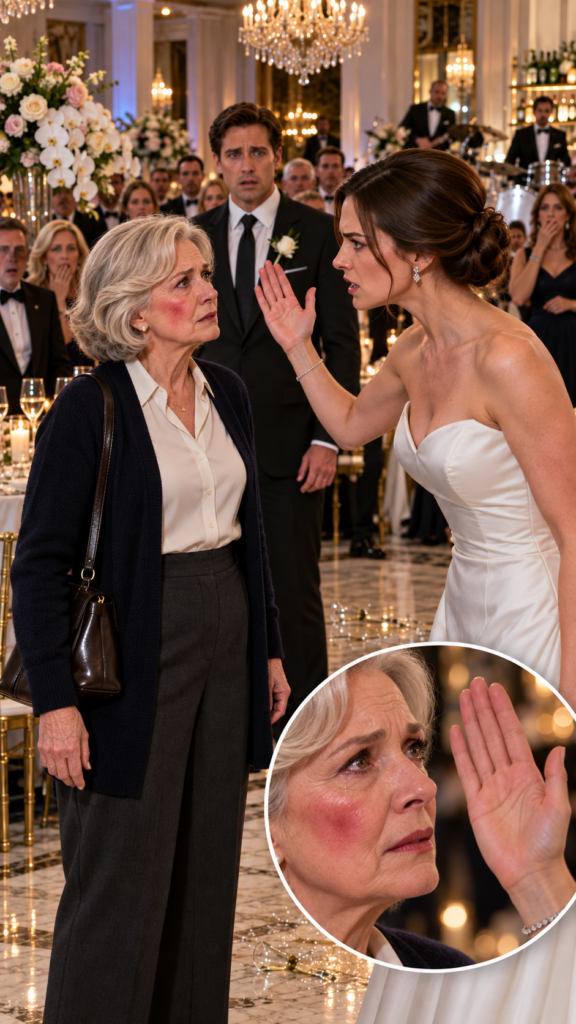
Two hundred and fifty wedding guests went silent.
My head snapped to the side.
Heat spread instantly across my cheek.
Somewhere behind me, a champagne flute hit the marble floor and shattered.
The band stopped in the middle of a love song.
And when I slowly turned back around, my daughter-in-law Tiffany was still standing over me in her white satin reception gown.
One hand remained raised.
Diamonds glittered at her wrist.
The chandeliers above her glowed beautifully.
I knew exactly how beautiful.
I had paid for them.
Tiffany did not look horrified by what she had done.
She looked annoyed.
As though I had inconvenienced her by making her slap me.
“You need to leave,” she said coldly.
“You’re ruining the mood.”
For several seconds, I just stared at her.
And that was the moment I finally understood something I should have understood months earlier.
Tiffany had never confused my generosity with love.
She had confused it with unlimited access.
My name is Margaret Bennett.
I was sixty-two years old.
Widowed.
And until that night, I believed sacrifice was one of the purest ways a mother could love her child.
By the time my son Daniel’s wedding reception began, I had spent more than $45,000.
It had not started that way.
The original plan was reasonable.
Eighty guests.
A family dinner.
A local quartet.
Simple flowers.
Something warm and elegant.
Then Tiffany became involved.
Eighty guests became 250.
The restaurant became a private estate.
The local quartet became a full band.
Simple centerpieces became imported roses and orchids.
Then came luxury transportation.
Premium wine.
A designer cake.
Personalized favors.
Professional lighting.
A farewell brunch.
Every week seemed to create another expense.
And whenever I tried to say no, Daniel came to find me privately.
“Mom, please.”
“It’s just one day.”
“She’s stressed.”
“She only gets married once.”
And always:
“Can you let this one go too?”
So I did.
Again.
And again.
Until “one day” began consuming years of savings.
I emptied accounts I had spent decades building.
Then I canceled the trip to Scotland that my late husband Thomas and I had dreamed about taking.
We had talked about it for years.
Edinburgh.
The Highlands.
A train journey north.
Thomas used to keep a little folded brochure in his desk drawer.
“We’ll go when things slow down,” he always said.
Things never slowed down.
Then he died.
I kept the brochure.
And when Tiffany’s wedding budget increased again, I canceled the trip I had finally planned to take alone.
I told myself Thomas would understand.
Then came the land.
Six acres.
Inherited by Thomas from his father.
The Bennett family had owned it for four generations.
Nothing spectacular.
Rolling grass.
A line of mature oak trees.
A small creek.
But Thomas loved it.
When Daniel was young, they used to walk there together.
The day I signed the sale documents, I sat in my car afterward and cried until the windows fogged.
Still, I told myself:
This is for Daniel.
That sentence became the excuse for almost everything.
The reception itself was perfect.
At least visually.
Crystal chandeliers floated above white linen tables.
Imported flowers rose from glass centerpieces.
Candles flickered across polished silver.
Guests drank champagne that cost more per bottle than I normally spent on groceries in a week.
Tiffany moved through the room like someone hosting a magazine spread.
Every detail had been arranged.
Every photo angle considered.
Everything beautiful.
Then she discovered the bar was not serving Laurent Reserve.
A rare imported champagne.
Nearly $2,000 for the additional order.
She wanted it specifically for her father’s toast.
Richard Sterling.
A man who had spent most of the engagement treating the wedding like a networking event.
I had removed the champagne from the final order.
I was done.
I had paid enough.
More than enough.
I was not spending another $2,000 so Richard could impress his business associates.
The bar manager apparently told Tiffany.
She came straight toward me.
Her parents followed.
Richard wore a dark tuxedo.
Her mother carried a champagne glass.
Neither looked embarrassed.
If anything, they looked entertained.
Tiffany stopped directly in front of me.
“The bar manager says the Laurent Reserve isn’t being served.”
“That’s correct.”
Her smile disappeared.
“Why?”
“Because I removed it.”
“You removed it?”
“Yes.”
She glanced toward her father.
Then back at me.
“I specifically requested it.”
“I know.”
“It’s for Dad’s toast.”
“I know.”
“And you canceled it without asking me?”
I almost laughed.
“Asking you?”
Her eyes narrowed.
“Yes.”
“Tiffany, I’m paying for it.”
“That doesn’t mean you can change things.”
For a moment, I genuinely did not know what to say.
I had reached a place where the person spending my money believed my ownership of that money was merely administrative.
Richard stepped closer.
“This is already embarrassing.”
I looked at him.
“What is?”
“The bar situation.”
“No one would have known if Tiffany hadn’t announced it.”
His face tightened.
Tiffany lowered her voice.
“You’re embarrassing my family.”
I looked around the reception.
At the estate.
The flowers.
The lights.
The band.
The wine.
The 250 people eating food I had paid for.
“No.”
I turned back toward her.
“I decided not to spend another $2,000.”
Her eyes hardened.
“It’s my wedding.”
“Yes.”
“And I should get what I asked for.”
That sentence did something to me.
Not because it was shocking.
Because it summarized the last year perfectly.
I should get what I asked for.
No matter who paid.
No matter what it cost.
No matter what someone else sacrificed.
I said quietly:
“No.”
Tiffany stared at me.
“What?”
“I said no.”
Maybe she had never heard the word from me before.
Not one that stayed no.
Daniel appeared nearby.
He had seen the confrontation building.
“Mom.”
I looked at him.
“Please.”
There it was again.
His favorite word whenever someone else wanted something from me.
Tiffany pointed toward the bar.
“Tell her to fix it.”
Daniel rubbed his forehead.
“Mom, can you just add the champagne?”
“No.”
“It’s one bottle.”
“It is nearly two thousand dollars.”
Richard scoffed.
“At an event this size, that is hardly significant.”
I turned toward him.
“Then you pay for it.”
Silence.
He looked almost offended.
Tiffany’s mother gave a small laugh.
“This really isn’t the time to become cheap.”
Cheap.
That was almost impressive.
I had spent more than $45,000.
Sold family land.
Canceled a trip I had postponed for years.
And now I was cheap because I would not add another $2,000 bottle.
I looked at Daniel.
He avoided my eyes.
That hurt more than anything Tiffany had said.
Then Tiffany stepped closer.
“You always do this.”
“Do what?”
“Make everything about you.”
I stared at her.
“I am standing quietly at the reception I paid for.”
“And now you’re causing drama.”
“No.”
“You’re ruining my wedding.”
“No.”
Then she slapped me.
Hard.
The room went silent.
The band stopped.
A glass shattered.
My cheek burned.
I slowly turned back toward her.
Tiffany was breathing heavily.
Then she said:
“You need to leave.”
Her voice was cold.
“You’re ruining the mood.”
For one second, I saw Daniel’s face.
Shock.
But not movement.
He did not step between us.
Did not tell his wife she had crossed a line.
He just stood there.
Waiting.
Probably hoping I would do what I had done all year.
Let it go.
I reached into my handbag.
Tiffany’s shoulders relaxed slightly.
Perhaps she thought I was leaving.
Instead, I took out my phone.
Then I called the event coordinator.
She answered almost immediately.
“Mrs. Bennett?”
“Yes.”
I kept my eyes on Tiffany.
“I need you to confirm something.”
The room was quiet enough that several nearby guests could hear.
“Of course.”
“Which remaining services tonight are still under my name and have not been fully settled?”
Tiffany’s expression changed.
Daniel looked at me.
“Mom…”
I raised one hand.
The coordinator began listing them.
Late-night catering.
Additional bar service.
The farewell brunch.
Transportation upgrades.
Several floral additions.
The photography overtime package.
I nodded.
“Cancel everything that can still legally be canceled under my authorization.”
Tiffany went pale.
“What?”
I continued.
“And no additional charges are to be placed on my card.”
“Mom, stop.”
I looked at Daniel.
“No.”
That word felt different now.
Easy.
Final.
Tiffany stepped forward.
“You can’t cancel my wedding.”
“I’m not.”
I slipped my phone back into my handbag.
“I’m stopping payment for the parts that haven’t happened yet.”
Her mother gasped.
Richard’s face hardened.
“This is vindictive.”
I looked at him.
“No.”
Then at Tiffany.
“I am simply no longer financing people who believe they can hit me and still send me the bill.”
No one spoke.
I looked at Daniel one last time.
“If you want the rest of tonight exactly as planned, you can pay for it.”
His face drained.
“How much is left?”
I almost smiled.
For the first time, he was asking.
Not requesting that I handle it.
Not assuming.
Asking.
“I suggest you speak to the coordinator.”
Then I walked toward the exit.
Behind me, voices erupted.
Tiffany demanding answers.
Richard arguing with staff.
Daniel calling my name.
But I did not stop.
Ten minutes later, the first vendor cancellation reached the reception team.
Then another.
The premium bar extension disappeared.
Transportation upgrades were suspended.
The brunch coordinator requested a new payment method.
The photographer refused additional hours without authorization.
And suddenly, the perfect wedding began revealing exactly how much of its perfection had been resting on one woman nobody thought deserved basic respect.
Me.
The cold night air touched my burning cheek before the front doors had fully closed behind me.
I had taken three steps across the stone terrace when I heard Daniel running.
“Mom.”
I kept walking.
“Mom, please wait.”
That word again.
Please.
For a second, something almost bitter rose in my throat.
I stopped beneath the estate’s front portico but did not turn around.
Daniel came to a halt several feet behind me, breathing hard.
The music inside had started again, uncertainly this time, a few notes drifting through the closed doors like people trying to pretend a disaster had not just happened.
“Are you okay?”
I turned then.
He saw my cheek.
Really saw it.
A red mark had already spread along the left side of my face.
His mouth opened.
Nothing came out.
I watched him look at the mark his wife had made, and something inside me went very still.
“You stood there,” I said.
He flinched.
“Mom, I was shocked.”
“So was I.”
“I didn’t know what to do.”
“You knew enough to ask me to stop.”
His eyes dropped.
The silence between us was colder than the air.
“I’m sorry.”
I looked through the tall glass doors behind him.
Inside, waiters were moving between tables.
Guests were whispering.
Tiffany stood near the bar with her parents, furious and beautiful beneath chandeliers I had paid to hang over her perfect evening.
Then Daniel said, “Why did you cancel everything?”
I looked at him.
For one suspended second, I could not decide whether to laugh or cry.
“Because your wife hit me.”
“I know.”
“No, Daniel. I don’t think you do.”
He pressed his lips together.
I could see the boy he had once been underneath the expensive suit.
The little boy who used to walk beside Thomas through six acres of summer grass, collecting acorns in his pockets because his father told him oak trees began as things small enough to lose in your hand.
That memory hurt.
“Do you remember the land?” I asked.
His brow tightened.
“What land?”
“Your grandfather’s six acres.”
He stared at me.
“The property by Mill Creek?”
“Yes.”
“Of course I remember.”
I waited.
A car rolled slowly along the circular driveway behind us.
Its headlights washed over Daniel’s face and disappeared.
“I sold it,” I said.
He did not move.
“What?”
“I sold it.”
His eyes searched mine as though he had misheard me.
“Why?”
I said nothing.
Understanding arrived anyway.
I watched it happen.
His face changed first.
Then his shoulders.
Then something in his eyes seemed to collapse.
“No.”
“Yes.”
“For the wedding?”
“For this wedding.”
He took one step backward.
“Dad’s land?”
“Yes.”
“Mom…”
“I needed the money.”
“You told me you had savings.”
“I did.”
My voice remained quiet.
“I spent those too.”
He dragged a hand over his mouth.
I had imagined telling him about the land many times.
In every imagined version, he was grateful.
Maybe ashamed.
Maybe moved.
I had never imagined telling him while my cheek still carried his wife’s handprint.
Daniel looked toward the estate.
“How much did you spend?”
“You know how much.”
“No.”
His voice cracked.
“I mean really.”
“More than forty-five thousand dollars.”
He closed his eyes.
I continued before I could stop myself.
“I canceled Scotland.”
His eyes opened again.
“What?”
“The trip your father and I planned for years.”
He stared at me.
“You booked that.”
“Yes.”
“You told me you were finally going.”
“I was.”
“Why would you cancel it?”
I looked toward the glowing windows.
“Because every week there was one more thing.”
His breathing changed.
One more thing.
Those were the words he had brought to me over and over.
One more thing.
One more favor.
One more bill.
One more sacrifice.
Daniel lowered his head.
“I didn’t know.”
And there it was.
The sentence people use when they have benefited from something they never bothered to examine.
“You didn’t ask.”
His face tightened.
“No.”
“No, you didn’t.”
He looked at me with wet eyes.
“I should have.”
“Yes.”
The door behind him opened.
Tiffany stepped outside.
Her satin dress caught the amber light spilling from the entrance.
Richard and her mother followed several steps behind her.
The anger on Tiffany’s face sharpened when she saw Daniel standing beside me.
“There you are.”
Daniel turned.
Tiffany walked toward him.
“We have a disaster inside.”
He stared at her.
She seemed not to notice.
“The coordinator is telling people the brunch is canceled. Dad is trying to sort out the bar. The photographer says he’s leaving at ten. You need to go back in there and fix this.”
Daniel said nothing.
Tiffany glanced at me.
“And she needs to call everyone back.”
My cheek throbbed.
Daniel looked at his wife for a long moment.
Then he said, “You hit my mother.”
Tiffany blinked.
“She was humiliating me.”
“You hit her.”
“She was deliberately destroying my wedding.”
“No.”
His voice was low.
Tiffany stared at him.
Daniel took one step toward her.
“She said no to champagne.”
Richard exhaled sharply.
“This is not the time for a family argument.”
Daniel turned toward him.
“No, I think it is.”
Richard’s expression hardened.
“There are two hundred and fifty people inside.”
“And my mother paid for them.”
“That was her choice.”
I saw Daniel absorb that sentence.
The same logic.
Different mouth.
Tiffany folded her arms.
“She offered to help.”
“She sold my father’s land.”
That stopped everyone.
Richard’s face changed.
Tiffany’s mother looked at me.
Tiffany stared at Daniel.
“What?”
Daniel’s voice shook.
“She sold six acres that belonged to my family for four generations.”
Tiffany looked at me.
For one second, I hoped.
Not for an apology.
Something smaller.
A flicker of shame.
Recognition.
Anything.
Instead she said, “Why would you do that without telling us?”
Daniel went completely still.
I almost admired the clarity of it.
Even now, she believed the problem was that I had failed to disclose the source of the money.
Not that she had taken it.
Not that Daniel had asked.
Not that I had surrendered pieces of my life until almost nothing remained that belonged only to me.
Daniel stared at her.
“You’re asking why she didn’t tell us?”
Tiffany lifted both hands.
“I’m saying this could have been handled differently.”
“You slapped her.”
“She pushed me.”
“I never touched you,” I said.
Tiffany looked at me with irritation.
“Emotionally.”
No one spoke.
The estate door opened again.
The event coordinator stepped onto the terrace holding a tablet against her chest.
She hesitated when she saw us.
“I’m sorry to interrupt.”
Richard turned immediately.
“What is the remaining balance?”
The coordinator looked at me first.
I appreciated that.
“Mrs. Bennett’s card has been removed from all pending authorizations.”
Richard’s jaw tightened.
“I asked what is owed.”
She named several remaining services and gave him the total.
I watched his expression change.
It was not ruinous.
It was simply enough to make visible the hypocrisy of a man who had called two thousand dollars insignificant when someone else was paying.
Richard cleared his throat.
“There must be some flexibility.”
The coordinator’s expression remained professional.
“The vendors were flexible with Mrs. Bennett because she was the contracted payer. If the services are reinstated, they require immediate payment from the new payer.”
Tiffany looked at Daniel.
He looked back at her.
“Do you have it?” she asked.
The question was soft.
That somehow made it worse.
Daniel’s face emptied.
“You mean me.”
“Well, we’re married.”
He almost laughed.
A terrible sound.
Not amusement.
Recognition.
Tiffany reached for his arm.
He stepped back.
Her hand fell.
“Daniel.”
He looked at her.
“Apologize to my mother.”
Tiffany’s eyes widened.
“What?”
“Apologize.”
“Right now?”
“Yes.”
She glanced toward her parents.
Then at me.
The silence stretched.
Finally she said, “I’m sorry things got out of hand.”
Daniel shook his head once.
“That’s not an apology.”
Tiffany’s face hardened.
“I am standing outside my own wedding reception being interrogated because your mother decided to punish everyone.”
Daniel looked at the mark on my cheek again.
Then back at his wife.
“Say you’re sorry you hit her.”
Tiffany said nothing.
“Say it.”
Her chin lifted.
“She should never have embarrassed me in front of everyone.”
Something passed across Daniel’s face.
Not anger.
Grief.
The kind that arrives when reality destroys something you were still trying to believe in.
He took off his wedding ring.
Tiffany’s breath caught.
“Don’t.”
Daniel held the ring in his palm.
“I can’t go back in there and pretend this didn’t happen.”
“You’re choosing her?”
“No.”
He looked at me.
Then at Tiffany.
“I’m choosing not to become the man I was five minutes ago.”
Tiffany’s face went white.
Richard stepped forward.
“You are emotional. Put the ring back on and deal with this tomorrow.”
Daniel closed his fingers around it.
“For a year, every time Tiffany wanted something, I asked my mother to give it.”
His voice was uneven.
“I didn’t ask what it cost her. I didn’t ask what she was giving up. I just kept saying please because it was easier than saying no to Tiffany.”
Nobody interrupted him.
He swallowed.
“And tonight, my wife hit my mother in front of two hundred and fifty people, and my first instinct was still to ask my mother to stop.”
His eyes filled.
“That is who I became.”
Tiffany shook her head.
“You’re making this dramatic.”
Daniel looked at her for several seconds.
Then he turned to the coordinator.
“Keep everything my mother canceled canceled.”
Tiffany gasped.
“Daniel.”
He continued.
“If there are charges we legally owe because they already occurred, give them to me and Tiffany.”
Richard stepped forward.
“You are not putting this on my daughter.”
Daniel looked at him.
“It’s her wedding too.”
“Your family offered to pay.”
“My mother offered to help.”
His voice hardened.
“We turned help into obligation.”
Tiffany’s mother spoke for the first time.
“Daniel, people are watching.”
He looked through the glass doors.
“Yes.”
Then he said quietly, “Maybe they should.”
The reception ended early.
Not dramatically.
That surprised me.
There was no screaming announcement.
No overturned tables.
No great public collapse.
Just a slow dismantling of expectation.
The band played its contracted final set and left.
The premium bar extension never happened.
The late-night food did not arrive.
Guests began leaving when transportation plans changed.
The photographer packed away his equipment at the time already paid for.
The farewell brunch disappeared from the next morning.
Perfection did not explode.
It simply stopped being subsidized.
I went home alone.
In my bathroom mirror, the mark on my cheek looked darker beneath ordinary light.
I pressed a cold cloth against it and stood there in the quiet.
No chandeliers.
No imported flowers.
No audience.
Just me.
For the first time all day, my hands started shaking.
I sat on the edge of the bathtub.
The cloth slipped from my fingers.
And I cried.
Not because Tiffany had hit me.
Not only because of that.
I cried for the land.
For Scotland.
For every private withdrawal.
Every transfer.
Every time I had told myself Thomas would understand.
Every time Daniel had said, “Mom, please,” and I had mistaken surrender for love.
At some point, I went into Thomas’s study.
I had changed almost nothing since he died.
His wooden desk still carried the faint scratch near the corner where Daniel had once dropped a toy truck.
I opened the second drawer.
The Scotland brochure was there.
Folded.
Waiting.
I touched it but did not open it.
Not yet.
The doorbell rang the next morning at 8:17.
Daniel stood on the porch.
He was wearing yesterday’s trousers and a wrinkled white shirt.
No jacket.
No tie.
No wedding ring.
He looked as though he had not slept.
I did not invite him in immediately.
That hurt him.
I could see it.
Good, I thought.
Then felt ashamed for thinking it.
Then decided I was allowed to feel both things.
“What do you need?” I asked.
His eyes lowered.
“Nothing.”
That was new.
He held out a folder.
“These are copies of the remaining invoices.”
I did not take it.
“I’m not paying them.”
“I know.”
He swallowed.
“I am.”
I looked at him.
“Tiffany?”
“She’s at her parents’ house.”
“And you?”
“I stayed at a hotel.”
I opened the door wider.
Daniel stepped inside but did not move past the entryway until I gestured toward the kitchen.
He sat at the table where he had eaten cereal as a child.
For several minutes, neither of us spoke.
Then he said, “I called an attorney this morning.”
My fingers stopped around my coffee mug.
“I’m not asking you what to do.”
He looked at me.
“I just want you to know I’m not going back and pretending it was one bad moment.”
I said nothing.
He breathed in slowly.
“Tiffany texted me all night.”
“Did she apologize?”
His silence answered.
“What did she say?”
“She said you ruined the reception. She said I humiliated her by leaving. She said her parents think I need to fix things before people start talking.”
He rubbed his hands together.
“Then around four this morning she said she was sorry you got hurt.”
I looked at him.
“You got hurt.”
“Yes.”
Not I hurt you.
Not I hit you.
You got hurt.
Daniel nodded.
“I noticed too.”
Something in me loosened.
Not forgiveness.
Not yet.
But recognition that he had finally begun listening to language instead of intention.
He opened the folder.
“I went through everything.”
Receipts.
Contracts.
Payment confirmations.
Pages and pages of proof that generosity could be itemized.
“I’m going to repay you.”
“No.”
His head lifted.
“Yes.”
“Daniel, you cannot buy forgiveness.”
“I know.”
“Then don’t try.”
“I’m not.”
His voice shook.
“I owe you the money whether you forgive me or not.”
That silenced me.
He looked down.
“I can’t give you Dad’s land back.”
My throat tightened.
“I know.”
“I called the buyer.”
I stared at him.
Daniel raised one hand quickly.
“I didn’t ask them to reverse anything. I know that isn’t realistic. I just wanted to know whether there was some way—”
“Daniel.”
He stopped.
“Don’t turn guilt into another emergency.”
His eyes filled.
That landed.
I continued.
“You have spent a year trying to fix discomfort immediately. Tiffany was upset, so you came to me. She wanted something, so you came to me. There was tension, so you came to me.”
He looked down.
“You are going to have to learn that some things hurt for a while.”
He nodded.
“And some things cannot be repaired by making another person carry them.”
Another nod.
I pushed the folder back toward him.
“If you want to repay me, make a plan you can actually afford. Do not destroy your own life trying to erase what happened.”
He looked at me.
“And do not ask me to make you feel better about it.”
“I won’t.”
“You probably will.”
A tiny, broken smile appeared.
“Then tell me no.”
For the first time, I smiled too.
“Apparently I’m getting good at that.”
The separation became permanent.
Three weeks later, Daniel filed for divorce.
Tiffany fought it.
Not because she suddenly became crueler.
Because she seemed honestly incapable of understanding why one moment should outweigh everything else.
She called the slap “a mistake.”
Daniel called it “the moment I finally saw everything around it.”
That distinction ended their marriage.
Richard contacted Daniel twice about wedding expenses.
Daniel sent him copies of the contracts.
Richard never contacted me.
Tiffany’s mother mailed a handwritten apology.
It was brief.
She admitted that calling me cheap after accepting months of generosity had been ugly and indefensible.
I read it twice.
Then placed it in a drawer.
I did not answer.
Not every apology creates a relationship.
Sometimes it simply closes a door without slamming it.
Tiffany came to my house once.
Daniel had warned me she might.
She stood on the porch in a camel coat, her hair loose around her shoulders, looking smaller than she had beneath the chandeliers.
I kept the chain on the door.
“I want to talk.”
“I’m listening.”
Her eyes flicked toward the chain.
“You think I’m dangerous?”
“No.”
“Then open the door.”
“No.”
The old Tiffany surfaced for half a second.
Her jaw tightened.
Then she caught herself.
“I shouldn’t have hit you.”
I waited.
She looked down.
“I was angry.”
Still I waited.
“You embarrassed me.”
There it was.
I almost closed the door.
She saw it.
“No. Wait.”
Her eyes filled.
“I know that’s not an excuse.”
I said quietly, “It is still the first thing you needed me to know.”
She stared at me.
“You hit me because I would not buy champagne.”
Her face crumpled.
“It wasn’t about champagne.”
“No.”
I nodded.
“It was about hearing no.”
She covered her mouth.
For a moment, she looked very young.
I felt compassion.
That surprised me.
Compassion did not make me open the door.
“I hope you learn from this,” I said.
“Can you forgive me?”
“Maybe one day.”
She started crying.
I did not reach through the gap.
“And even if I do,” I continued, “forgiveness will not put you back into my life.”
Her eyes closed.
That was the moment she understood.
Consequences were not punishment.
They were simply what remained after choices could not be taken back.
Six months passed.
Daniel moved into a small apartment fifteen minutes from my house.
He started therapy.
I knew because he told me once.
Only once.
He did not use it as evidence that he had changed.
That mattered.
Every month, a payment appeared in my account.
Not enormous.
Not dramatic.
A fixed amount we had agreed he could actually afford.
The first time it arrived, I almost sent it back.
Then I remembered what I had told him.
Let the consequence belong to the person who created it.
So I kept it.
We rebuilt slowly.
There were no grand speeches.
Daniel came by on Sundays sometimes.
He brought groceries.
Not flowers.
Not gifts.
Groceries.
He cooked.
He washed the dishes.
He learned to sit in silence without trying to repair it.
One evening, as he dried a plate, he looked through the kitchen window and said, “I keep thinking about Dad’s land.”
I did not answer.
“I remember the creek.”
“So do I.”
“He used to pretend the water was freezing even in July.”
I laughed before I could stop myself.
Daniel smiled.
“He’d put one foot in and yell like he’d fallen into the Arctic.”
“He was a terrible actor.”
“The worst.”
We stood there laughing.
Then Daniel’s face changed.
“I miss him.”
“I know.”
“I wish he were here to tell me what he thinks of me.”
I took the plate from his hand.
“Your father loved you.”
“That isn’t what I asked.”
“No.”
I placed the plate in the cupboard.
“He would have been disappointed.”
Daniel’s eyes filled.
I did not soften it.
“He would have been disappointed that you watched someone mistreat me and kept asking me to make peace.”
Daniel looked at the floor.
“But he would also have noticed what you did afterward.”
He looked up.
“And?”
“And he would have told you that becoming better is more useful than becoming ashamed.”
Daniel pressed his lips together.
I touched his arm.
“Then he would have made some terrible joke because serious conversations made him uncomfortable.”
Daniel laughed through the tears.
That night, after he left, I went into Thomas’s study.
The Scotland brochure was still in the drawer.
I took it out.
For the first time since the wedding, I unfolded it completely.
Something slipped from inside.
A small piece of paper landed on the desk.
I stared at it.
Thomas’s handwriting.
For several seconds, I could not breathe.
The paper had yellowed slightly along one edge.
I picked it up.
Margaret—
If we keep waiting until life stops asking things from us, we may never go.
If I get there first, you go anyway.
Take the train north for both of us.
Love, T.
I sat down.
Then I laughed.
One helpless sound.
Then another.
And suddenly I was crying so hard I had to put the note on the desk because I was afraid my tears would blur the ink.
All those months, I had told myself Thomas would understand why I canceled Scotland.
He would have understood.
That was the beautiful part.
He also would have told me not to.
The note had been sitting inside the brochure for years.
Waiting for me to stop giving my life away long enough to read it.
I booked the trip the next morning.
Daniel came over when I told him.
“You’re really going?”
“Yes.”
His whole face changed.
“When?”
“October.”
“For how long?”
“Two weeks.”
He smiled.
Then hesitated.
“Do you want company?”
I looked at him.
He immediately lifted both hands.
“No pressure.”
I laughed.
“I’m going alone.”
He nodded.
“Good.”
That answer surprised me.
He smiled.
“I think you should.”
October arrived cold and bright.
Edinburgh was everything Thomas had imagined.
Gray stone.
Narrow streets.
Wind that found every gap in my coat.
I walked until my feet hurt.
I drank coffee alone without feeling lonely.
I stood beneath the castle and thought of a man who had spent years promising that one day life would slow down.
Then I boarded the train north.
The Highlands opened beyond the window in long stretches of green, stone, water, and sky.
I kept Thomas’s note inside the brochure on my lap.
At one point, sunlight broke through the clouds and moved across the hills.
I touched the paper.
“We made it,” I whispered.
Nobody heard me.
That was all right.
Some words are not lonely just because they are spoken to someone who is gone.
When I returned home, Daniel picked me up from the airport.
He did not ask whether the trip had fixed everything.
He knew better now.
He took my suitcase.
“How was Scotland?”
I smiled.
“Worth waiting for.”
Then I thought about it.
“No.”
He glanced at me.
I shook my head.
“Worth not waiting for.”
A year after the wedding, Daniel’s divorce became final.
He called me afterward.
His voice sounded tired.
Not relieved.
Not triumphant.
Just finished.
“You okay?” I asked.
“I think so.”
We were quiet.
Then he said, “She apologized.”
“Tiffany?”
“Yes.”
“For what?”
He breathed out slowly.
“For thinking people existed to make things easier for her.”
I sat down.
“That sounds different.”
“It was.”
“Did you forgive her?”
“I told her I hoped she had a good life.”
“That wasn’t my question.”
He laughed softly.
“I know.”
Then his voice became serious.
“I think I did.”
“And?”
“And I still left.”
I smiled.
“Good.”
He understood.
Forgiveness was not restoration.
Love was not access.
Generosity was not surrender.
Those truths had cost us both more than they should have.
But at least we finally owned them.
The following Sunday, Daniel came for dinner.
Nothing elaborate.
Roast chicken.
Potatoes.
Green beans.
A bottle of wine that cost twelve dollars.
He brought dessert from the grocery store.
We ate at my kitchen table.
No chandeliers.
No imported roses.
No photographer.
No two hundred and fifty guests.
Just two plates.
Two glasses.
Two people learning how to love each other without one person disappearing to make room for the other.
After dinner, Daniel stood and collected the dishes.
I watched him carry them to the sink.
“You don’t have to do those.”
He turned.
“Yes, I do.”
I raised an eyebrow.
He smiled.
“Not because you paid for dinner.”
I laughed.
He washed them anyway.
Later, after he left, I walked into the living room.
On the mantel stood a photograph Daniel had framed for me.
I was standing in the Highlands beneath a vast gray-blue sky, silver hair wild from the wind, Thomas’s old Scotland brochure tucked under one arm.
I looked happy.
Not the polished happiness of a wedding photograph.
Not the kind arranged beneath chandeliers and professional lighting.
The kind that comes after something has broken and you discover the broken thing was not your life.
It was only the belief that love required you to keep saying yes.
I turned off the lamp.
The house settled around me.
Quiet.
Warm.
Mine.
On the mantel, Thomas’s handwritten note rested behind the Scotland photograph.
In the kitchen, two clean plates dried beside the sink.
And for the first time in years, there was nothing left for me to give away in order to prove I belonged.
I was already home.






