MY DAUGHTER-IN-LAW STOOD INSIDE MY OWN LAKE HOUSE,
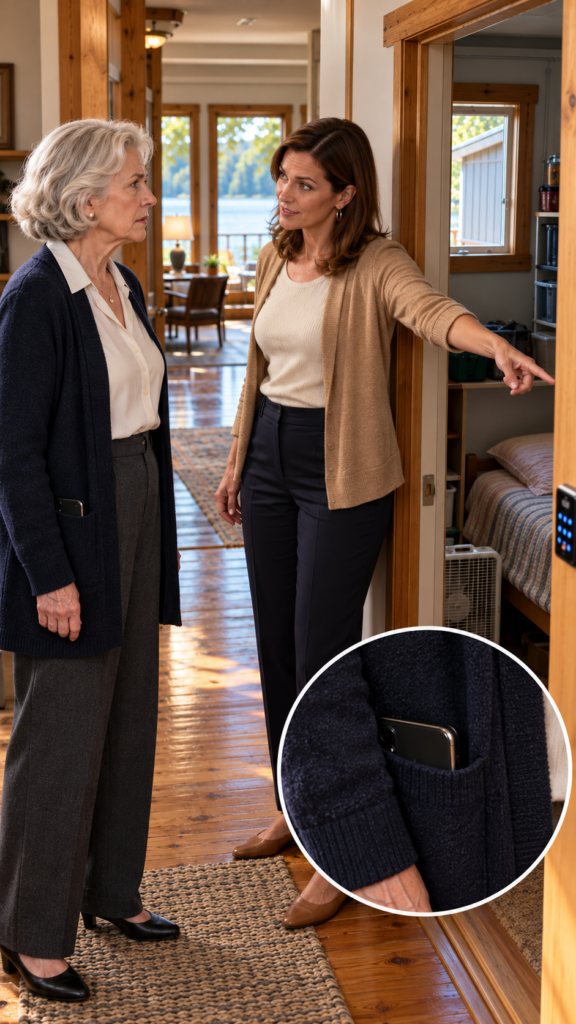
pointed toward a cramped little room beside the tool shed, and smiled as if she were doing me a favor. “That’s your room for the week.” For a moment, I honestly thought she was joking. She wasn’t. The room she had assigned me was eleven feet by nine, with a narrow daybed pushed against the wall, one tiny window overlooking the shed, and an old box fan that began rattling the moment you turned it above the second setting. It wasn’t really a guest room. It was a storage room that happened to contain a bed. And the strange part? Everyone in that house knew exactly where my real bedroom was. At the opposite end of the hall sat the corner room overlooking the lake—the room with two wide windows glowing blue in the morning, the king-size bed my late husband and I had once shipped up in separate pieces because it couldn’t make the turn in the staircase, and the reading chair where I had spent countless summer mornings with coffee in my hand. That room had been mine for twenty-nine summers. I had paid for it. I had paid for the roof over it. The deck outside it. The repairs after the upstairs leak turned into a renovation so expensive I nearly laughed when I saw the final bill. I had opened that lake house every spring and closed it every fall for years. I knew which floorboards creaked. Which cabinet doors needed an extra push. Which window latch stuck whenever the July air became too humid. I was not a confused old woman wandering through somebody else’s vacation home. This was my house. And I knew exactly what was happening. When I returned to the living room, my daughter-in-law was stretched comfortably on the couch with a glass of rosé in her hand, looking remarkably satisfied with the arrangements she had made. My granddaughter had just raced inside from the lake, leaving wet footprints across the pine floor, laughing and completely unaware of the tension settling over the room. Then my daughter-in-law looked at me and said lightly, “I just thought you’d be more comfortable closer to the downstairs bathroom.” That was the moment everything became clear. Not because she raised her voice. She didn’t. That was what made it worse. The cruelest family power plays rarely arrive sounding cruel. They come disguised as concern. “I appreciate the thought,” I said calmly. “But I’ll be taking the corner room.” Her glass stopped halfway to her lips. She blinked. “Daniel and I are already in there.” “Yes,” I replied. “I noticed.” For the next few minutes came the explanations I expected. They had already unpacked. It was only one week. Surely changing rooms would be inconvenient. Did it really matter so much? I didn’t argue. Because there was nothing to argue about. I was simply informing her. “I’m going down to the dock,” I said. Then I walked outside. The path was the same one I had taken for twenty-nine summers—the warm wooden boards beneath my feet, tall grass brushing the edges, cedar thick in the air, the lake glowing that impossible July blue-green that almost looked painted from a distance. At the end of the dock, I pulled out my phone. The house had a smart-entry system I controlled through an app. I opened it. And changed the entry code. Then I called Daniel. He answered on the third ring. “I’ve taken the corner room,” I said. Silence. “And I’ve updated the code.” Another silence. “I’ll give you the new one after we talk.” Eight minutes later, I heard footsteps behind me. Daniel came down the dock rubbing the back of his neck. He had done that since childhood whenever he knew he was about to disappoint me. “Mom,” he began, “she was only trying to be practical.” I said nothing. “It’s the first day. I just don’t want the week starting badly.” I looked across the lake. How many times, I wondered, does the person being disrespected get asked to keep the peace so everyone else can stay comfortable? Then I turned toward him. “The room is only the part you can see.” Daniel’s expression changed. He didn’t answer. “Come find me tonight after your daughter is asleep,” I said quietly. “You and I need to talk about a few things that should have been said a long time ago.” He glanced back toward the lake house. Then he looked at me again. And for the first time that afternoon… my son stopped defending the room.
His hand dropped from the back of his neck.
For several seconds, neither of us moved.
A boat crossed far out on the lake, its engine softened by distance. Water knocked gently against the pilings beneath us. Somewhere in the trees, a cicada started its sharp summer rhythm and then stopped as suddenly as it had begun.
Daniel looked at me the way he used to when he was twelve and already knew the answer to a question he was afraid I might ask.
“What things?” he said.
I slipped my phone into my cardigan pocket.
“Tonight.”
He opened his mouth, but I had spent too many years making difficult conversations easier for him before they even began. I wasn’t going to do it this time.
I walked past him toward the house.
When I reached the porch, my granddaughter was sitting on the steps with a towel around her shoulders, carefully pulling lake grass from between her toes. She looked up at me.
“Grandma, are you mad?”
The question stopped me.
Not because of what she had asked.
Because children rarely ask that unless they’ve already been told there is something they’re not supposed to notice.
I sat beside her.
“No,” I said. “I’m paying attention.”
She considered that with the seriousness only a child can give to a sentence adults would rush past.
Then she leaned against my arm.
Inside, I could hear cabinet doors opening. A suitcase zipper. My daughter-in-law’s voice, too low for me to make out.
Daniel had told her.
Good.
I wanted her to understand that quiet was not the same thing as surrender.
Twenty minutes later, I walked upstairs to the corner room.
Their luggage was still there.
Daniel stood beside the bed with one suitcase open and the other already zipped. His wife was near the window, arms folded.
She didn’t look at me.
Daniel did.
“We’re moving our things,” he said.
I nodded once.
His wife gave a small laugh that contained no humor.
“All of this over a bedroom.”
I looked at her.
“No,” I said. “That’s exactly the mistake you’re making.”
Her face tightened.
Daniel stopped folding a shirt.
I crossed the room slowly and set my hand on the back of the old reading chair. The fabric was worn smooth near the arms. My husband used to joke that the chair knew more family secrets than either of us did.
I could almost see him there.
Coffee in one hand.
Newspaper folded across his knee.
Watching people more carefully than they realized.
My daughter-in-law shifted her weight.
“So what is this about?”
I met her eyes.
“I’m talking to Daniel tonight.”
Her jaw moved.
“I’m his wife.”
“Yes.”
“Then whatever concerns him concerns me.”
“Not everything belongs to you because it’s near someone you married.”
The silence after that was immediate.
Daniel stared at the floor.
His wife looked at him as if waiting for him to correct me.
He didn’t.
That was the first crack.
Not the important one.
But the first.
Dinner was almost painfully normal.
My granddaughter talked about a fish she had seen near the dock. Daniel grilled chicken. His wife made a salad and asked whether anyone wanted more dressing as though nothing had happened.
I watched the effort it took to maintain that normalcy.
Every movement was slightly too careful.
Every plate landed softly.
Every sentence stopped before it reached anything real.
At one point, my daughter-in-law lifted her wineglass and said, “Maybe tomorrow we can all reset.”
Daniel’s fork paused.
I took a sip of water.
“Some things need to be understood before they can be reset.”
She put her glass down.
My granddaughter looked from one adult to another.
Daniel changed the subject.
That hurt more than I expected.
Not because I needed him to fight for me at the dinner table.
Because changing the subject was what he had always done.
When his wife interrupted me, he found another topic.
When she made decisions without asking, he called it efficiency.
When she joked about my age, he called it teasing.
When I grew quiet, he assumed I was fine.
He had not created the problem.
But for years, he had built the room around it.
One avoided conversation at a time.
At nine-thirty, my granddaughter hugged me goodnight.
She smelled like shampoo and lake water.
“Can I sleep in here with you tomorrow?” she asked, looking around my bedroom.
I smiled.
“We’ll see.”
She pointed toward the reading chair.
“Is that Grandpa’s chair?”
“It was.”
“You still sit there?”
“Every morning.”
She touched the armrest carefully.
Then she whispered, “Mom said you don’t really use the house as much anymore.”
My smile disappeared.
She didn’t notice.
Children do not understand when they have just opened a door.
“Did she?”
My granddaughter nodded.
“She said it’s hard for you to keep up with everything.”
A tiny pressure formed beneath my ribs.
“What else did she say?”
She shrugged.
“That Dad worries about you.”
Daniel appeared in the doorway.
He had heard enough.
His daughter ran to him, and he kissed the top of her head.
“Bed,” he said gently.
She left.
Daniel remained in the doorway.
For several seconds, neither of us spoke.
Then I pointed toward the reading chair.
“Sit.”
He did.
I stayed standing.
That mattered to me.
“I want you to tell me how long she has been talking about this house as if it already belongs to you.”
Daniel’s face went pale.
Not dramatically.
Just enough.
I had my answer before he spoke.
“Mom—”
“How long?”
He looked toward the window.
The lake beyond it had turned black except for strips of moonlight trembling on the surface.
“A while.”
“How long is a while?”
“Maybe a year.”
I felt something inside me become very still.
“A year.”
“She wasn’t trying to steal anything.”
I closed my eyes for one second.
There it was again.
Defending the intention so he wouldn’t have to confront the behavior.
I opened them.
“What was she trying to do?”
Daniel rubbed both hands over his face.
“She thinks the house is becoming too much for you.”
“She thinks.”
“Yes.”
“Did I tell her that?”
“No.”
“Did you?”
“No.”
“Did my doctor?”
“No.”
“Did anyone who actually lives my life?”
He said nothing.
I stepped closer.
“Then where did it come from?”
Daniel’s shoulders dropped.
“She started talking about what would happen eventually.”
Eventually.
Such a harmless word.
People use it when they want to discuss your absence without saying death.
“What would happen eventually?” I asked.
He swallowed.
“That the house would probably come to me.”
The room seemed to change temperature.
Not because I was surprised.
Because hearing entitlement spoken aloud is different from sensing it.
“And then?”
“She said if that was the plan anyway, maybe we should start helping more. Taking responsibility.”
I almost laughed.
“By taking my bedroom?”
He winced.
“That wasn’t how she put it.”
“How did she put it?”
He looked at his hands.
“She said if we started using the corner room, you might realize the downstairs room was easier.”
I stared at him.
There are betrayals that arrive like explosions.
And there are betrayals that arrive as a sentence spoken quietly by the person you raised.
This was worse.
Because he knew.
The room had not been an impulsive choice.
It had been a test.
A small displacement designed to teach me what my future was supposed to look like.
“And you agreed?”
“No.”
I waited.
His eyes closed.
“I didn’t stop her.”
There it was.
The truth.
Not cruelty.
Cowardice.
Sometimes cowardice does just as much damage.
I sat on the edge of the bed.
For the first time since arriving, my legs felt tired.
Daniel looked at me.
“I thought if I didn’t engage, it would blow over.”
“Things don’t blow over when silence benefits the person doing them.”
“I know.”
“No. You know now.”
His eyes filled, but I had no desire to comfort him.
Not yet.
“What else?”
He shook his head.
“Mom.”
“What else has she said?”
He stood.
“Let’s not do this all at once.”
I looked up at him.
“You had a year.”
He froze.
“I get tonight.”
A floorboard creaked in the hall.
Daniel turned.
His wife stood in the doorway.
She had changed into a white sweater and soft gray pants. Her face was composed, but one hand gripped the doorframe.
“I’m not going to stand downstairs while you talk about me.”
I rose.
“Then come in.”
She entered slowly.
Daniel stayed between us without realizing he was doing it.
She looked at him first.
“What did you tell her?”
“The truth.”
Her expression sharpened.
“What truth?”
“That you’ve been talking about taking over the house.”
Her eyes moved to me.
“I said no such thing.”
Daniel stared at her.
“You said we should start treating it like something we’d be responsible for.”
“That’s not taking over.”
“You told me she should move downstairs.”
“For safety.”
I almost smiled.
There it was again.
Concern.
The perfect costume.
I folded my hands.
“Do you know what I did this spring?”
She frowned.
“I replaced forty feet of dock boards myself with a carpenter. I drove three hours each way twice in one week because the pump failed. I climbed the attic stairs to check the insulation after a storm. I opened every window in this house, including the one you couldn’t figure out this afternoon.”
She opened her mouth.
I continued.
“So please stop using my age as evidence for a weakness you invented.”
Her cheeks flushed.
“That isn’t fair.”
“No. Fair would have been asking me.”
Daniel moved closer to the dresser.
His wife turned toward him.
“You know I’m right about the long term.”
He looked at her.
“Stop.”
She blinked.
It was the first time I had ever heard my son use that tone with her.
Not loud.
Not angry.
Final.
She stared at him.
“I’m thinking about our family.”
I said, “I am your family.”
Her gaze snapped toward me.
I stepped closer.
“And I’m still alive.”
For the first time all evening, she had no answer.
Then a small voice came from the hallway.
“Mom?”
My granddaughter stood barefoot outside the room.
Daniel’s entire face changed.
“Honey, go back to bed.”
She stayed where she was.
Her eyes went to her mother.
“Are we leaving?”
“No,” my daughter-in-law said quickly.
Daniel looked at her.
My granddaughter frowned.
“But you said we’d live here someday.”
The room went silent.
Completely silent.
Even the fan downstairs seemed far away.
My daughter-in-law’s lips parted.
Daniel did not move.
I felt my pulse in my wrists.
My granddaughter looked confused by our faces.
“You said Grandma wouldn’t need it forever.”
Her mother crossed the room.
“That is not what I meant.”
The child stepped back.
“You said the blue room would be mine after you changed it.”
Daniel turned toward his wife.
“What blue room?”
She looked at him.
Then at me.
Then back at him.
“It was hypothetical.”
My granddaughter began to cry.
Not loudly.
The frightened kind.
The kind children cry when they suddenly understand that something they repeated has hurt people.
I moved before anyone else did.
I knelt in front of her.
“You did nothing wrong.”
She wiped her face.
“I wasn’t supposed to say it?”
“You never have to keep secrets about me in my own house.”
Her little mouth trembled.
I pulled her against me.
Behind her, Daniel said his wife’s name.
Just once.
The way he said it contained an entire marriage changing shape.
She whispered, “Daniel, don’t.”
He looked at her.
“You talked to our daughter about Mom dying?”
“I did not say dying.”
“What did you think ‘won’t need it forever’ meant to a nine-year-old?”
She shook her head.
“You’re twisting this.”
“No.”
His voice broke.
“For once, I’m not.”
She looked at me then.
And something defensive hardened in her face.
“I was planning for our future.”
“That future does not include my property,” I said.
“It would have gone to Daniel.”
“You assumed that.”
She stared at me.
Daniel stared too.
That was the moment I understood something important.
Neither of them actually knew.
I had never discussed my will with Daniel.
Not once.
My daughter-in-law had built an entire future around an inheritance she had never been promised.
I stood.
“The house was never guaranteed to anyone.”
Her face changed.
It was small.
But unmistakable.
Fear.
Not grief.
Not embarrassment.
Fear.
And somehow that hurt less than I expected.
Because fear told me exactly what this had been about.
Daniel saw it too.
His eyes dropped.
His shoulders sagged.
The last excuse left him.
I walked to the nightstand and picked up my phone.
I opened the smart-entry app.
Daniel watched.
His wife did too.
I removed the guest access attached to their phones.
Two taps.
That was all.
A year of assumptions reduced to two taps.
“You are welcome here when I invite you,” I said. “You are not entitled to this house because you married my son.”
She looked at Daniel.
He did not intervene.
I continued.
“And tonight, you’re going to a hotel.”
Her mouth opened.
Daniel said, “I’ll drive.”
She turned on him.
“You’re choosing this?”
He flinched.
Then looked at our daughter.
Then at me.
Then finally at his wife.
“I’m choosing not to pretend anymore.”
The silence after that was enormous.
She packed in fifteen minutes.
No shouting.
No slammed doors.
That almost made it worse.
She moved through the room with stiff, efficient motions, folding clothes, closing cosmetic bags, pulling chargers from outlets.
My granddaughter sat beside me on the bed.
Daniel carried the suitcases downstairs.
At the front door, his wife stopped.
For one strange second, I thought she might apologize.
Instead she said, “I hope you’re happy.”
I looked at her.
“No. I hope we become honest.”
Her eyes filled.
Whether from anger or shame, I couldn’t tell.
Then she left.
Daniel took his daughter with him.
Before getting into the car, he came back onto the porch.
“I’m taking her somewhere else tonight.”
I nodded.
He looked toward the upstairs windows.
“I’m sorry.”
I held his gaze.
“Come back when sorry has something behind it.”
He nodded once.
Then drove away.
For the first time that day, the house was completely mine again.
But victory did not feel the way people imagine.
There was no satisfaction.
No rush.
Only quiet.
I walked through the rooms turning off lights.
The wet footprints my granddaughter had left earlier had dried into faint marks across the pine floor.
I could have wiped them away.
Instead, I left them.
Upstairs, I sat in the reading chair.
The lake was black beyond the windows.
My husband had been gone six years.
That night, I missed him with an ache so sharp it surprised me.
He would have known what to say.
Or maybe he wouldn’t.
Maybe he would have simply brought me coffee and sat nearby until the anger became grief.
I rested my hand on the worn fabric.
“This is the part you always handled,” I whispered.
Nothing answered.
But after a while, I realized I had handled it.
The next morning, Daniel returned alone.
He stood on the porch with two coffees.
I opened the door but did not step aside immediately.
He noticed.
“I’m not asking for the code.”
That mattered.
I let him in.
We sat at the kitchen table.
Sunlight stretched across the pine floor.
Daniel pushed one coffee toward me.
“I spent most of the night talking to her.”
I waited.
“She still thinks what she did was practical.”
I looked down at the cup.
“And you?”
“I think I let practicality become an excuse for disrespect.”
I looked at him.
His eyes were red.
“She wants me to tell you she didn’t mean anything by it.”
“Do you believe that?”
He took a long breath.
“I think she meant more than she admitted.”
That answer cost him something.
I could see it.
“I also think I knew that.”
I wrapped both hands around the coffee.
“And I didn’t want to know it because then I would have had to do something.”
There it was.
The apology with something behind it.
He looked toward the lake.
“I’m staying somewhere else with my daughter for a while.”
I said nothing.
“She and I need space.”
“That’s your marriage.”
“I know.”
“I won’t tell you what to do with it.”
“I know.”
“And I won’t become the reason you use if it ends.”
He looked at me.
“You’re not.”
His voice was quiet.
“If it ends, it’ll be because I finally stopped ignoring what was already there.”
Over the next several weeks, Daniel did something I had not expected.
He stopped asking me to forgive him.
Instead, he started changing.
He came up on Saturdays and helped replace a warped railing board without behaving as though he had rescued me.
He called before visiting.
He waited for invitations.
When he disagreed with me, he said so directly instead of hiding behind someone else’s opinion.
And when his daughter stayed with him, he brought her to the lake only after asking.
His wife did not return.
Their separation became permanent before autumn.
I learned later that Daniel had suggested counseling.
She went twice.
Then stopped.
According to him, she could admit that the room had been handled badly.
She could not admit that the house had never been hers to plan around.
That was the line she could not cross.
Eventually Daniel filed for divorce.
I felt no triumph when he told me.
Only sadness.
A marriage ending is still a marriage ending, even when the truth explains why.
But there was one consequence I did choose.
I met with my attorney in September.
Not because I wanted revenge.
Because assumptions had nearly damaged my family beyond repair.
I placed the lake house into a trust that guaranteed my right to live in it and control it for the rest of my life.
After me, it would belong to my granddaughter.
Not Daniel.
Not his former wife.
My granddaughter.
With one condition.
She could never be forced to sell it by another family member.
When I told Daniel, he smiled.
“You don’t have to explain.”
“I wasn’t planning to.”
That made him laugh.
It was the first easy laugh between us in months.
Winter came.
The lake froze at the edges.
I closed the house alone that fall, just as I had opened it.
But when spring returned, I found Daniel waiting in the driveway with his daughter.
He held up both hands before I could speak.
“We waited.”
“For what?”
“An invitation.”
I looked at my granddaughter.
She grinned.
“Can we help open the house?”
I pretended to consider it.
Then handed her the key.
She ran to the door.
Inside, everything smelled faintly of cedar and cold wood.
Dust floated in the morning light.
Daniel opened curtains.
I turned on the water.
My granddaughter followed me from room to room carrying a small spiral notebook.
At first I assumed she was drawing.
Then I noticed she was writing.
“What are you doing?”
She covered the page.
“Nothing.”
I raised an eyebrow.
She sighed dramatically.
Then handed me the notebook.
I looked down.
On the first page, in careful handwriting, she had written:
Floorboard outside kitchen squeaks.
Left cabinet needs extra push.
Upstairs window sticks when it gets humid.
Turn box fan only to two unless you want it to rattle.
My throat tightened.
Those were my details.
The tiny things I had carried in my head for twenty-nine summers.
She watched my face nervously.
“I started writing them last year.”
“Why?”
She shrugged.
“So I’ll know.”
“Know what?”
“How to take care of it.”
I could not speak.
She turned the page.
There were more.
Where Grandpa’s chair goes.
Which mug Grandma likes.
Where the extra dock rope stays.
How Grandma opens the windows first thing in the morning.
I covered my mouth.
For nearly a year, I had believed the ugliest lesson from that summer was that people could look at your life and see only what they might inherit.
But standing there with that notebook in my hands, I understood something else.
Inheritance could mean the opposite.
Not possession.
Attention.
Not waiting for someone to disappear.
Learning how to care for what they loved while they were still there to teach you.
My granddaughter touched my sleeve.
“Are you crying?”
“A little.”
“Did I do it wrong?”
I pulled her into my arms.
“No.”
My voice broke.
“You got it exactly right.”
Daniel stood in the doorway.
His eyes were wet too.
He looked away and pretended to inspect the window latch.
I let him.
Some tenderness deserves privacy.
That summer was different.
Not perfect.
Better.
Daniel still had difficult days.
Divorce papers arrived.
Schedules changed.
There were conversations with his daughter that no child should have needed, though both parents tried to make sure she never felt responsible.
His former wife eventually sent me a letter.
It contained no excuse.
That surprised me.
She wrote that she had spent years confusing security with control.
She wrote that she had looked at the lake house and seen something she could secure for her future.
She wrote that she was ashamed she had discussed that future in front of her daughter.
At the bottom, she wrote one sentence twice before apparently deciding which version to leave.
I’m sorry I treated your life like something that had already ended.
I read it once.
Then folded it.
I did not call her.
I did not owe her reconciliation.
But I kept the letter.
Not as proof.
As evidence that sometimes consequences teach what kindness could not.
By August, Daniel had stopped rubbing the back of his neck every time we disagreed.
One afternoon, I noticed that before he did.
He was standing on the deck arguing with me about whether a board needed replacing.
“It’s fine,” I said.
“It’s soft.”
“It has another year.”
“It has another storm.”
I looked at him.
He looked back.
Then we both smiled.
No avoidance.
No changing the subject.
No one keeping the peace by swallowing the truth.
Just disagreement.
Healthy, ordinary disagreement.
I had forgotten how much I missed it.
My granddaughter spent most mornings barefoot.
She still left wet footprints across the pine floor.
I stopped asking her to wipe them immediately.
One morning, I found her sitting in my husband’s old reading chair with her notebook open.
She looked guilty.
“Am I allowed?”
I handed her my coffee.
“Hold this.”
She took it carefully.
I walked to the window.
The latch stuck.
Of course it did.
July humidity.
I pressed it once.
Nothing.
My granddaughter jumped up.
“I wrote this down.”
“I know.”
She set the coffee on the table and came beside me.
“Push in first.”
“Show me.”
She placed both hands on the frame.
I placed mine over hers.
Together we pushed.
The latch released with the familiar little click I had heard for almost three decades.
The window opened.
Warm lake air entered the room.
Cedar.
Water.
Sunlight.
Somewhere below us, Daniel was laughing because he had dropped something on the deck.
My granddaughter leaned out just enough to feel the breeze.
Then she looked up at me.
“Grandma?”
“Yes?”
“When I’m old, can I still have this room?”
I smiled.
“If you remember who it belongs to while they’re still standing in it.”
She thought about that.
Then nodded solemnly.
“I will.”
I believed her.
I looked around the room—the king-size bed my husband and I had once carried upstairs in pieces, the chair worn smooth by years of mornings, the wide windows glowing blue, the lake beyond them bright and endless.
For one terrible afternoon, someone had tried to make me feel like a guest in the life I had built.
A year later, I understood why that had hurt so deeply.
Home was never just ownership.
It was memory given a place to live.
It was the people who asked before entering.
The people who listened when you said no.
The people who learned which floorboard creaked, which cabinet needed an extra push, and which window stuck in July—not because they were waiting to inherit the house, but because they loved the person who knew those things first.
My granddaughter picked up her notebook and added one final line.
I watched her write it.
Open Grandma’s window together.
Then she closed the notebook, slipped her hand into mine, and stood beside me while the morning breeze moved through the room.
Downstairs, Daniel called that breakfast was ready.
The lake flashed silver beyond the glass.
I squeezed her hand.
And this time, when we walked out of my bedroom, nobody had to ask whose home it was.






