My future daughter-in-law struck me across the face fifteen minutes before she was supposed to walk down the aisle. Then she grabbed the front of my pale blue gown and tore it open nearly to my waist while six bridesmaids stood frozen in shock. I held the fabric together with both hands, my cheek burning, and heard her say, “Now maybe you’ll be too embarrassed to walk into MY ceremony.”
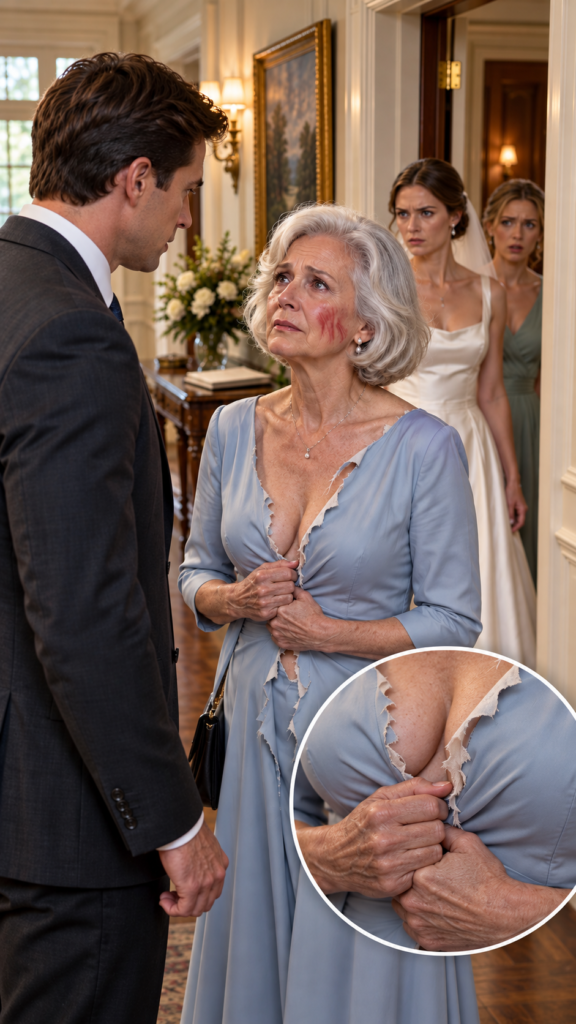
What happened next hurt far more than the slap.
My name is Claire Hale. I had buried my husband David six years earlier, retired after more than two decades as an elementary school principal, and learned how to keep moving even when grief made ordinary mornings feel impossible. I thought I understood humiliation. I had no idea my own son was about to teach me a new kind.
The argument had started over something almost laughable. Madison’s sister Lauren had rushed in because the loop on the cathedral veil had torn, and she remembered I carried a small sewing kit. I repaired it in four minutes, packed my needle away, and was heading for the door. Then Madison noticed two place cards had been moved at the family table. She immediately accused me of rearranging her seating chart.
I told her I had touched nothing but her veil. Lauren tried to confirm it. But Madison was already somewhere beyond reason.
For nine months, I had deliberately kept my distance from every wedding decision. I had chosen none of the flowers, music, food, or invitations. There was only one reason my name appeared on the venue contract at all — when Bellamy House unexpectedly became available, Ethan had called me begging me to secure the date before another couple took it. I signed the agreement, paid the deposit, and promised them a fixed contribution toward the wedding. I wanted my son to begin married life with a beautiful memory instead of debt.
Madison never seemed to see it that way.
Standing in her gown, she suddenly demanded to know what I had told Ethan about their spending the night before. I stared at her because I had said nothing of the kind. That should have been my first warning that something else entirely was going on. She looked afraid. At the time, I didn’t understand what she had to fear from me.
I told her she was getting married in minutes, and we could talk afterward. I turned toward the door because I refused to fight with a bride on her wedding day. That was when she stepped forward and hit me.
The sound cracked through the room. Before I could process it, she seized the front of my gown and pulled until the fabric split. Lauren shouted her sister’s name. I didn’t scream or strike back. I gathered the torn sides of my dress in both hands, picked up my purse, and said quietly, “I hope nobody ever treats you the way you just treated me.” Then I walked out.
And found Ethan standing in the hallway.
He looked from the mark on my cheek to the ripped dress I was clutching closed. For half a second, I saw genuine shock cross his face, and I believed my son would finally speak up. Instead, Madison rushed out behind me and started talking first — claiming I had spent the entire time criticizing her and reminding her that I had paid for the venue.
Lauren appeared in the doorway and softly said, “That’s not what happened.”
Ethan barely seemed to hear her.
“Your fiancée hit me,” I said.
He rubbed both hands across his face. “Can we deal with this after the wedding?” And then came the six words that changed something between us permanently. He lowered his voice and said, “Mom, please don’t make a scene.”
I had been the safe person for most of Ethan’s life. When his father grew impatient, I steadied things. When Ethan made mistakes, I helped him repair them. After David died, that pattern only deepened because Ethan was the family I had closest to me. I had never understood that unconditional love could quietly teach someone that hurting me carried no real consequence.
Standing in that hallway, I saw exactly what was happening. He was afraid Madison would punish him if he challenged her. He believed I would love him regardless of how he let me down. Between the woman who might explode and the mother who always forgave — he chose me as the safer one to disappoint.
“All right,” I said quietly. “I won’t make a scene.”
Relief crossed his face.
“I’m going home.”
That relief vanished instantly.
I stepped into the small family sitting room and locked the door. At the mirror, I removed the pearl earrings David had given me on our twenty-fifth anniversary and placed them carefully inside my purse. My cheek was still warm, but the humiliation was turning into something colder and far clearer.
The wedding coordinator, Natalie, knocked within minutes. When I opened the door, she was holding a thick contract folder. Madison stood farther down the hallway. Natalie opened the folder and said to Madison, without flinching: “There’s a problem. The woman you just asked to leave is the only person authorized to approve this wedding.”
For the first time that afternoon, Madison stopped smiling.
What Natalie revealed next explained everything — the slap, the fear beneath Madison’s anger, the accusation about the seating chart. Someone had contacted the venue that week and claimed I had approved nearly eighteen thousand dollars in additions I had never authorized. Premium upgrades. Extended services. Charges quietly submitted under my name without my knowledge.
Lauren was the one who finally said it aloud.
“I heard her make the call.”
Madison went completely still.
Lauren’s voice shook, but she didn’t stop. She had walked into the kitchen and overheard Madison tell the venue that I had approved whatever was needed — that there was no reason to bother me because I was older and wouldn’t understand the details anyway.
Ethan looked at Madison.
“Did you tell the venue my mother approved charges she never approved?”
Madison folded her arms. “You knew I wanted those things.” Ethan asked the question again. She kept deflecting. Then she said something that revealed exactly how she had been thinking about me all along.
“She’s retired. Her house is paid off. What exactly is she saving it for?”
The room went quiet.
I thought about David’s hospital room. About signing forms with shaking hands. About going home to his shoes, his coffee mug, his reading glasses — and forty-one years of a life that suddenly existed only in memory. Money had never felt like abundance after that. It had felt like what remained when a person did not.
Ethan lowered his head.
When he looked up, something in him had changed.
“Did you hit her?” he asked.
“She was provoking me,” Madison said.
“Did you hit her?”
A long pause. “Yes.”
Ethan’s eyes moved to my cheek. Then to my dress. Then he took one step away from her. Only half a pace. But she noticed.
“What are you doing?” she asked.
“I don’t know who I’m standing here with,” he said.
She demanded he not do this fifteen minutes before their wedding. He told her quietly that he thought she already had. And then he said the words I had been waiting to hear — the words that cost him more than anything else that day.
“I saw exactly what happened to her. And I asked her not to make a scene.”
Madison reached for him.
He stepped back.
“I’m not marrying you today.”
Her face went blank. Then the rage came — fast and loud. She pointed at me and told Ethan I had been waiting for this moment. He told her to stop blaming me. She said of course he was choosing me. He shook his head slowly. “I didn’t choose her when I should have.”
Lauren told Madison she was leaving.
Madison ordered her to stay.
Lauren said no.
And then, in a trembling voice, she said what she had been holding back for years — that she had covered for her sister’s explosions, lied to protect her, stood in that very room while Madison struck a woman who had just repaired her veil. “And I almost said nothing,” Lauren whispered.
She looked at me. “I’m sorry.”
I had spent decades working with children. I knew the difference between an apology offered because someone was caught and one offered because a person could no longer tolerate who they had become.
Lauren’s was the second kind.
Madison walked away without another word. Her heels struck the hardwood and echoed down the corridor. Nobody followed.
The ceremony was canceled. Guests were quietly told there had been a family emergency. The quartet stopped playing. The flowers remained exactly where they had been arranged — still beautiful, still expensive, still entirely indifferent to whether anyone got married beneath them.
When Ethan finally came to find me, his tie was gone and his eyes were red. He sat across from me and looked at the rough stitching Lauren had made along the front of my gown.
“I’m sorry I saw you standing there and asked you not to make a scene,” he said. His voice broke. “I’m sorry I made you the one who had to absorb everything because I knew you wouldn’t punish me.”
“You knew,” I said.
“Yes.”
“Then why?”
He answered slowly. “Because disappointing her felt dangerous. And disappointing you felt safe.”
I looked at him.
“I love you,” I said. “But I cannot go back to being the mother you can hurt because you assume I’ll still be there afterward.”
He nodded.
“No. You don’t know that yet. You’ll have to learn.”
The old version of our relationship ended in that room. Not our relationship — just the version where my love was something he could spend without accounting for it.
A month later, Lauren called. We met at a small café. She placed an envelope on the table and told me she owed me one more truth. She reached inside and removed two ivory place cards.
One said CLAIRE. One said ETHAN.
“Madison had moved you,” Lauren said quietly. “To the end of another table. She said having you beside Ethan would make the photographs look too much like your family instead of hers.”
The entire afternoon rearranged itself inside my memory.
“I moved your card back beside Ethan’s,” Lauren said.
The fight had never truly been about something I did. It had started because someone else had quietly decided I deserved a seat beside my son.
I touched my name on the card.
And for reasons I could not entirely explain, I began to cry. Not because of Madison. Because someone had seen me — before the dress tore, before the contract mattered, before anyone knew there would be consequences. Lauren had seen me being pushed aside and moved one small piece of paper six feet across a room.
It was such a small act. And it was the kindest thing anyone did for me that day.
Months passed. Ethan moved out of the apartment he had shared with Madison. He began seeing a counselor. He called when he said he would. When I said no, he didn’t negotiate. When something was uncomfortable, he didn’t ask me to make it easier for him. Trust returned the way it always does after real damage — not in declarations, but in small repetitions.
By summer, he helped me clear David’s old workshop — a room we had both avoided for years. It still smelled faintly of cedar and machine oil. Ethan picked up one of his father’s screwdrivers and turned it in his fingers.
“I kept thinking Dad would have known what to do,” he said.
“He usually didn’t,” I told him. “He was simply very good at looking thoughtful until the answer arrived.”
Ethan laughed. Then cried. Then I did too. We sat on the workshop floor and told stories about David until the light changed across the concrete.
There was no dramatic moment when I decided Ethan was forgiven. Forgiveness arrived the way trust had — in pieces, in consistency, in the absence of old patterns.
Lauren became an unexpected part of my life. She called on David’s birthday after remembering the date from a single conversation. She washed dishes even when I told her not to. She brought flowers without any production about it.
One evening she arrived with a garment bag and hung it carefully over the back of a chair. She unzipped it.
My pale blue gown was inside.
The tear was gone. Not hidden. Gone. A dressmaker had rebuilt the damaged panel with fabric matched so carefully I had to look closely to find where it had been repaired.
From a small pocket in the bag, Lauren removed two ivory place cards — the same ones from the café — now mounted together in a narrow frame. Beneath them, in her own handwriting, was one line.
Where you belonged all along.
I covered my mouth.
Ethan read it over my shoulder. He turned toward me, and his face held something I had not seen on it in a very long time — the particular look of a person who has finally stopped running from what they did wrong.
“I’m sorry you ever had to wonder,” he said.
A year earlier, those words would not have been enough. Now they didn’t have to carry everything alone. They rested on top of months of better choices, and that made them something I could actually receive.
I touched his cheek.
“I don’t wonder anymore.”
That evening, Ethan hung the little frame in my kitchen — not somewhere formal, but beside the doorway where I would pass it every morning. It took him three attempts to get it straight. On the third try, he stepped back and it was level.
We stood together in the soft kitchen light. No orchestra, no cathedral veil, no guests waiting. Just my son beside me, a framed pair of place cards on the wall, and the quiet understanding that love had survived only because we finally stopped using it as a reason to avoid the truth.
Before he left, he kissed my forehead.
That night I opened my jewelry box and took out David’s pearl earrings. I had not worn them since the day of the wedding. I had thought the sight of them would take me straight back to that hallway — the burning cheek, the torn dress, the moment my son chose the easier path at my expense. But when I fastened them into my ears, that was not what I remembered.
I remembered Lauren’s trembling hands sewing my dress closed. I remembered Natalie standing firm in the hallway with that contract folder. I remembered Ethan stepping away from Madison. I remembered two place cards moved quietly across a room by someone who thought I deserved better before she had any reason to believe it would matter.
I looked at myself in the mirror.
Still carrying grief. Still capable of being hurt. But no longer willing to disappear so someone else could remain comfortable.
I switched off the lamp and walked toward the kitchen. The small frame caught the last warm light above the doorway.
CLAIRE. ETHAN. Side by side.
Exactly where someone believed we belonged before either of us understood how much it would cost to find our way back there.
And for the first time in a very long time, I stood in my own quiet home, touched one pearl at my ear, and knew — with absolute certainty — there was nothing left to fix.






