The lemon cake hit the patio stones hard enough to scatter yellow crumbs across the warm afternoon. Sixty-five tiny blue sugar flowers rolled between chair legs. Whipped frosting smeared beneath my daughter-in-law’s heel — and when Camille looked up at me, she smiled.
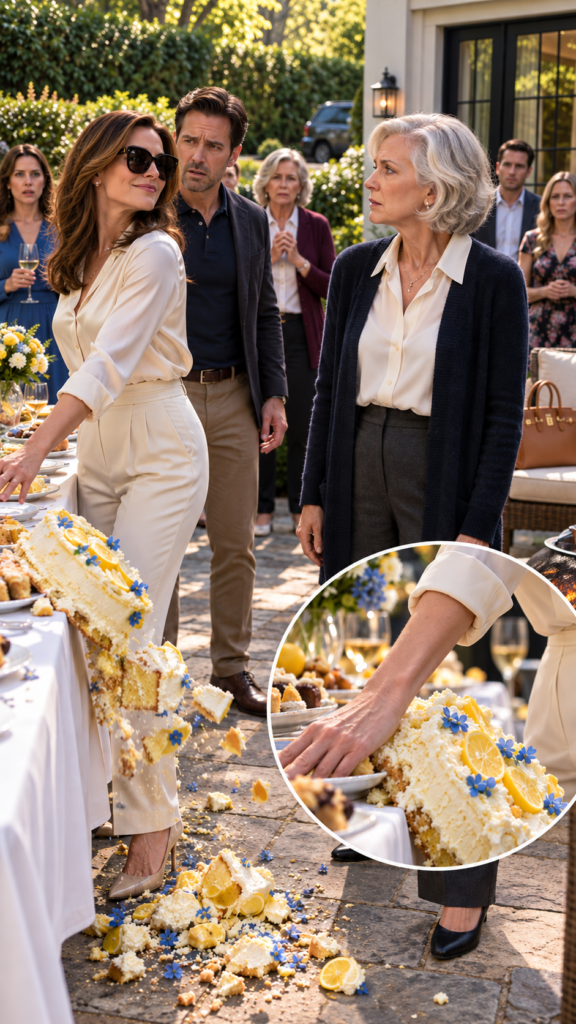
“Oops.”
It was my sixty-fifth birthday. My best friend Diane had stayed up half the night baking that cake, decorating it with candied lemon slices and delicate handmade flowers because she knew lemon had always been my favorite. Every conversation in the yard died at once.
But I barely looked at the ruined cake. I looked at my son.
Nathan wasn’t shocked. His face held something far worse — dread. The expression of a man watching the exact disaster he had been quietly afraid might happen. Before I could say a single word, he stepped beside me and whispered, “Mom, don’t make a scene.”
For a moment, I thought I had misunderstood him. His wife had just humiliated me in front of my entire family and every friend I had, yet Nathan wasn’t asking if I was all right. He wasn’t confronting Camille. He was warning me to stay quiet.
Something inside me went very still.
Camille walked toward the house without another glance. Cream-colored trousers. High heels. Oversized sunglasses still covering her eyes even in the shade. Her expensive designer bag rested on a lawn chair beside the fire pit — she had mentioned the price at least three times that afternoon. Twenty-five hundred dollars.
I crossed the patio and lifted it by the handles. I opened the fire pit screen and dropped her bag onto the glowing embers. Nothing happened at first. Then the leather darkened. One corner curled inward, orange flame climbed around the handles, and a sharp smell spread through the yard. Nathan lunged forward. “Are you insane?” The back door flew open, Camille ran outside, saw the flames consuming her prized bag, and screamed. “You’re going to pay for that!”
I lowered the fire screen and met her eyes. “Oops.”
Nathan turned scarlet. Then he shouted the sentence I would remember long after the smoke disappeared. “That bag cost more than your stupid cake!” Nobody moved. My friend Diane looked close to tears. Rebecca, my daughter, stared down into her drink. Not one person stepped between us. Nathan followed Camille toward the driveway as though I had destroyed the afternoon. Before getting into the car, he turned back. “You couldn’t just let it go for once?”
For once. Those two words stayed with me. Because they meant Nathan already knew this wasn’t the first time.
After the guests left, Rebecca told me what she had seen. Camille had approached the dessert table deliberately. Rebecca watched her look directly at the cake before her elbow struck it. My stomach tightened. Nathan’s expression suddenly made perfect sense. The cake had not simply fallen. My son had suspected what his wife was capable of — and when it happened, his first instinct had been to silence me.
When Nathan called that evening, there was no apology. His voice came through tight and angry. “You owe us twenty-five hundred dollars.” My own son was demanding I reimburse the woman who had deliberately humiliated me on my birthday.
“No,” I said. The word came out so calmly that even I was surprised.
The next afternoon, Nathan arrived alone. Camille refused to come inside unless I agreed to pay for the bag first. She stayed in the car. Rebecca was already in the living room. Diane was there too. She had earned the right to hear the truth spoken in the same house where her kindness had been treated like something disposable.
Rebecca looked at Nathan and said quietly what she had witnessed — Camille looking at me first, then at the cake, then deliberately moving her arm. Nathan swallowed. “I know.” The room went completely still. Then the front door opened. Camille walked in wearing those sunglasses again, jaw tight, announcing she was done with the “ridiculous tribunal.”
Nathan turned to her.
“I saw you walk toward the cake.” His voice shook. “I saw the way you were looking at Mom. I knew what you were about to do. That’s why I told her not to make a scene.”
Camille froze. Diane stood slowly and spoke in the softest voice I had ever heard her use. “You didn’t ruin dessert,” she said. “You took something kind and tried to make her feel foolish for being loved.” Nobody moved. Camille looked at Nathan, waiting for him to follow her as he always had. He didn’t. She grabbed her coat. He still didn’t move. “You’re choosing this?” she asked. “No,” he said. “I’m choosing not to lie anymore.”
She left. We heard her heels cross the porch, the engine start, and the sound fade down the street.
Nathan sat down and covered his face. When he finally looked up, he said, “I’m sorry.” Not to Camille. To me. To Rebecca. To Diane. He said it the way a man says something he has needed to say for years and only just found the courage.
Healing did not happen overnight. Nathan moved into a small apartment. He and Camille separated permanently. He never asked me to carry anyone else’s cruelty in silence again. The first time he came back to my house, he brought a bucket, a stiff brush, and stone cleaner. He had noticed there was still frosting in the cracks of the patio. We spent an hour on our knees scrubbing stone together, and somewhere in that quiet work, something between us began to rebuild.
Diane eventually returned with a small lemon cake — no towering layers, no elaborate decoration. Just smooth pale frosting and one tiny blue sugar flower in the center. The same flower she had picked up off the patio that night and carried home because, she said, she was sentimental. She also brought an envelope containing sixty-five handwritten cards collected from people who loved me — one memory each, one for every year of my life. Every blue flower on my birthday cake had represented one of those memories. Camille had knocked it down to make me feel small. But the thing she had tried to destroy had never actually been sitting on that plate.
We read every card aloud in the afternoon sun. Nathan cried at number twenty. Rebecca at twelve. I stopped being able to see clearly somewhere around thirty-one. When the last card was read, nobody rushed to fill the silence. We simply stayed — together, unhurried, telling the truth without being punished for it.
That is what I had been protecting all those years, without quite knowing it. Not appearances. Not silence. Not the illusion of peace bought by asking the quietest person to absorb the damage. Just this. The right to be loved without having to disappear for it.
Real peace, I finally understood, is not the absence of conflict. It is being able to tell the truth and have the people who matter most choose to stay anyway.






