Nobody teaches a child how to disappear their own hunger. That kind of thing gets learned the hard way — through too many nights of not enough, through watching faces you love go pale from need, through quietly deciding that your pain matters less than someone else’s survival. It is not a lesson any child should ever have to master. But some do. And when you see it up close, when you catch a child in the act of erasing herself for the sake of the people she loves, something inside you shifts in a way that never quite shifts back.
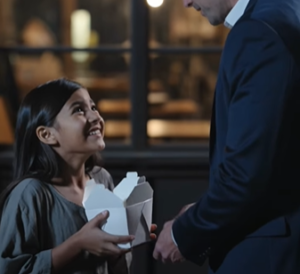
It started simply. A man had done a small kindness — the kind most people forget by the time they reach their car. He had given a young girl a meal. One meal. Nothing elaborate. Nothing that cost him much at all. He had felt good about it in the way people feel good about small gestures, and then he had moved on, the way people do.
But something pulled him back.
Maybe it was instinct. Maybe it was guilt. Maybe it was the look in her eyes when she took the food — grateful in a way that seemed too practiced, too careful, like someone who had learned to measure joy in very small doses so it wouldn’t hurt so badly when it disappeared.
Whatever the reason, he found himself standing outside a dim doorway later that evening, watching through the gap where the light spilled out thin and yellow onto the ground.
And what he saw undid him.
The girl was inside. The food he had given her — the whole of it — was in a pan at the center of the room. Around it sat smaller children, eating with the focused silence of kids who don’t take meals for granted. An older woman, clearly weak, sat nearby. The girl stood back from all of it, watching everyone else eat, her own hands empty.
The older woman tried. She pushed the food toward the girl, urging her to take some.
“I’m not hungry,” the girl said softly.
It was a lie. Anyone could see it was a lie. Her body said it was a lie. But she held it together, held her chin steady, kept her voice calm — performing a kind of strength that no child her age should have to perform.
The man outside felt something crack open in his chest.
Then one of the little ones looked up, innocent as only small children can be, and asked, “Will the restaurant man help us again tomorrow?”
The room went quiet.
The girl’s composure held, but just barely.
And then she said something that the man outside would never forget for the rest of his life.
“No. We can’t ask twice. Good people stop helping when they see how much you really need.”
She didn’t say it with bitterness. She didn’t say it with tears. She said it the way a child says something she has already accepted as permanent truth — flat, quiet, certain. The kind of certainty that only comes from being disappointed enough times that hope starts to feel dangerous.
The man stepped forward before he even realized he was moving.
The door creaked. Every head turned.
The girl spun around, startled, bracing herself the way children brace themselves when they think they’ve done something wrong and are about to find out how wrong.
But the man wasn’t angry. He was barely holding himself together.
He looked at the pan. He looked at the children. He looked at the frail woman in the corner. And then he looked at the girl — really looked at her — and when he spoke, his voice broke clean in half.
“You gave away the only meal I gave you.”
She lowered her eyes. “They were hungrier,” she whispered.
He pressed a hand over his mouth. Breathed. Steadied himself.
“Wait here,” he said.
The girl’s face didn’t light up. It did the opposite. It tightened with fear. Because children who live with that little don’t meet promises with hope — they meet them with dread, because dread has proven itself more reliable.
But less than twenty minutes later, headlights flooded the narrow alley outside.
One car. Then another.
The children crept to the doorway. The girl stood still.
The man stepped out carrying bags. Not one. Not two. More than two people could comfortably carry. The driver helped him bring it all in. Food. Blankets. Medicine. Milk. Fruit. Bread. Containers of warm soup that steamed in the night air.
The older woman started crying before she could stop herself.
The youngest child whispered, “Is all of that for us?”
But the man looked only at the girl.
He knelt down in front of her — this small, serious, heartbreaking child who had given away her dinner and told herself it didn’t hurt — and he placed one warm container directly into her hands.
“This one,” he said gently, “is yours. And tonight, no one takes your portion away. Not even you.”
She broke then. Not loudly. Not dramatically. Just the quiet, private kind of breaking that happens when someone who has been strong for too long is finally, finally allowed to stop.
The older woman looked at the man through her tears and asked the only question left to ask.
“Why would you do this for strangers?”
The man looked around the room one last time — at the children, at the food, at the girl still trembling with her warm container pressed to her chest — and he answered in a voice barely above a whisper.
“Because I thought I was feeding one child.”
He paused.
“But she was feeding an entire family with her own hunger.”
Some people walk into your life and remind you what it means to be human. Some lessons arrive wrapped in the quiet sacrifice of someone who asks for nothing and gives everything. And some children, in their small and desperate bravery, teach the rest of us more about love than we will ever be able to repay.






