Nobody on that dusty street paid much attention to the old woman anymore. She had become part of the scenery — the way a cracked sidewalk or a leaning lamppost becomes invisible when you pass it every day. She sat where she always sat, beside the crumbling brick wall, her small fire burning low, her plate mostly empty. Her hands, weathered and slow, moved with the kind of quiet dignity that only comes from years of carrying burdens too heavy for most people to imagine.
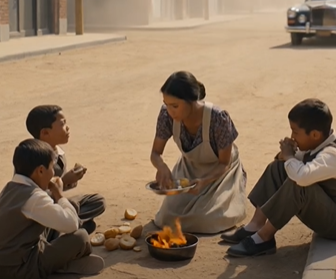
She didn’t ask for pity. She never had.
But that afternoon, something shifted in the air.
Three men in fine suits stepped onto the block. They didn’t belong there — anyone could see that. Their shoes were polished, their posture steady, their faces carrying the kind of calm that comes not from ease, but from having survived something enormous. People stopped to watch. Not because the men were wealthy, though they clearly were, but because of the way they moved — like men walking toward something they had been thinking about for a very long time.
They stopped directly in front of the old woman.
She looked up slowly, shielding her tired eyes from the afternoon light.
And one of them — the youngest — reached into his breast pocket and pulled out something small. Something folded carefully, worn soft by what must have been years and years of handling. A scrap of old fabric. Faded. Fraying at the edges. But the pattern on it — tiny flowers against a pale background — made the woman’s breath catch in her throat.
She recognized it instantly.
It was a piece of her apron. Her old floral apron, the one she had torn with her own hands so many years ago to wrap up the last bread she had. The last bread she owned. She had ripped the fabric without a second thought, tied up the loaves as best she could, and handed them to three hungry boys who had nothing — no home, no family nearby, no idea what the next day would bring.
She had never expected anything in return.
She had never thought about it as sacrifice. It was simply what you did when children were hungry and you had something — even if that something was almost nothing.
Her knees went weak beneath her.
“You kept that?” she whispered.
The youngest man nodded, and his eyes were already full of tears.
“I kept it my whole life,” he said.
The street went quiet the way streets only go quiet when something sacred is happening.
The man standing in the center — the eldest of the three, it seemed — took a slow step forward. His voice, when he spoke, was steady but thick with emotion.
“That night was the last time we ate before we were taken away from this neighborhood,” he said.
The woman raised one hand to cover her mouth.
“We thought we’d never see you again,” the man on the left added quietly. “And for years, we didn’t.”
The center man looked around — at the small fire, at the worn curb, at the empty plate still trembling in her hands.
“But we never forgot the woman who went without so that we wouldn’t have to.”
Her eyes filled completely.
“I had nothing to give,” she whispered, as if confessing something she had carried silently for all those years.
All three men shook their heads at the same moment.
“No,” said the youngest, his voice breaking. “You gave us the one thing that nobody else ever gave us.”
She looked at him through her tears, waiting.
He took a breath and answered:
“You made us feel worth saving.”
Something in her simply broke open — the way a dam breaks not from anger but from the sheer weight of what has been held back too long. She wept openly, without shame, the kind of crying that belongs only to moments when a life’s hidden meaning finally surfaces.
And the three men — grown now, successful now, standing tall in their tailored suits — they wept alongside her. Because they had once been hungry children on this very street. Because she had been the only one who stopped.
When the tears quieted enough for words again, the man in the center reached carefully into his coat and retrieved a thick folder. He set it down gently beside the boxes of food and money his team had already brought.
“These are the legal papers to the building behind you,” he said.
She turned slowly. The crumbling brick structure she had slept beside in cold seasons, cooked in front of through every season — she had never once imagined it could be hers.
Her lips parted but no sound came.
The second brother spoke. “And the bakery next to it.”
The youngest pointed farther down the block. “And the two shops after that.”
She stared at each of them, unable to breathe, unable to fully grasp what was being said.
The center man smiled through his tears.
“We bought them all,” he said softly. “Every one of them.”
She shook her head slowly, overcome. “Why?” The word came out barely above a whisper.
He looked at her empty plate one final time before he answered.
“Because you once gave three starving boys your very last meal.” He paused, letting the weight of it settle. “So we came back to make sure you never go hungry again.”
She was sobbing freely now, both hands pressed to her heart.
The youngest stepped forward and gently lifted the trembling plate from her hands. In its place, he laid a heavy ring of keys — warm from being held, real and solid and impossible to deny.
The center brother spoke again, and his words landed like something final and unbreakable.
“From today on, you don’t kneel in the dust anymore.”
He pointed to the largest key on the ring.
“That one opens your new home.”
He pointed to another.
“That one opens your kitchen.”
Then he placed his hand over hers — steady, sure, the way a son holds a mother’s hand.
“And that street?” He looked toward the block she had lived on for so many forgotten years.
She looked up at him, eyes glistening.
He smiled — slowly, warmly, with everything in it.
“That street belongs to the woman who fed us when the rest of the world had already thrown us away.”






