Nobody on that sidewalk expected the afternoon to crack open the way it did.
It started the way these things usually do — quietly, then all at once.
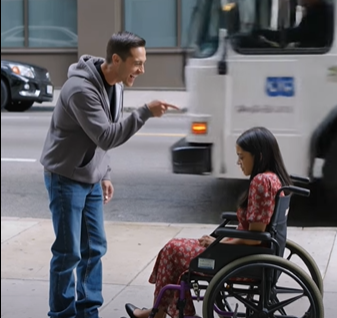
A woman in a wheelchair sat near the bus stop, minding her own business, existing in the way people in her situation learn to exist: with patience, with stillness, with the practiced invisibility that comes from years of being overlooked. She wasn’t asking for anything. She wasn’t making a scene. She was simply there, the way anyone has a right to simply be somewhere.
That wasn’t enough for some people.
The man in the gray hoodie decided she was worth mocking. His laugh was the kind that isn’t really about humor — it’s about power, about establishing a hierarchy in front of witnesses. He had an audience. He used it. The kind of cruelty that wears a casual face, that tells itself it’s just joking, that looks for eyes to mirror its amusement back.
He found no mirrors.
What he found instead was a biker standing a few feet away, watching him with the stillness of someone who has already made a decision.
The biker stepped forward.
He didn’t shout. He didn’t perform. He simply placed himself between the man in gray and the woman in the wheelchair, and the weight of his presence said everything that needed to be said without a single word raised in anger.
The bully flinched — that involuntary, revealing flinch that tells the truth about a person more honestly than anything they’ve ever said.
Other bikers near the bus shifted. Not threateningly. Just — present. Watching. The way a community watches when one of its own steps into a moment that matters.
And then the woman looked up at the biker.
Something changed in her face.
Not gratitude. People who have been through real things develop a different vocabulary for their feelings, and gratitude is too simple a word for what moved across her expression in that moment. It was something older. Something heavier. The particular look a person gets when the past walks up and stands in front of them wearing a leather jacket.
Recognition.
The biker felt it before she spoke. His jaw tightened — not from anger, but from knowing. The kind of knowing that settles in your chest and doesn’t leave.
“You were there that night,” she said. Her voice was barely above a whisper, but on that sidewalk, in that moment, it carried. “By the river bridge. When the car door opened.”
The color shifted in his face.
The other men near the bus didn’t need any more explanation than that.
The bully took one step back. He was beginning to understand that he had wandered into something much larger than a moment of casual cruelty. He had mocked a stranger. But she wasn’t a stranger to everyone standing there. And now whatever history she carried was pulling itself into the open, in front of witnesses, in the full light of day.
The biker crouched — lowered himself to her eye level, the way someone does when they want to speak to a person as an equal, when they want the words to land without the distance of height between them.
His voice came out rougher than he intended.
“I was too late,” he said.
Three words.
But they fell onto that sidewalk like a confession that had been waiting years to be spoken out loud. The woman’s breathing changed — a quiet, shaking exhale that wasn’t fear. It was the sound of someone hearing their own pain reflected back at them by another person who had been close enough to it to understand.
She had been carrying that night alone.
Until right now.
The man in the gray hoodie looked between them, increasingly desperate to understand what he had stumbled into. “What the hell is this?” he asked.
No one answered him.
Because the sidewalk had reorganized itself around something he wasn’t part of — something that had nothing to do with his cruelty and everything to do with a night by a river bridge that had clearly left marks on more than one person.
The woman looked at the bully. Then she looked back at the biker.
“He laughed like that too,” she said quietly.
The bully went still.
Those four words did what nothing else in that confrontation had managed to do — they made the connection between his laughter moments ago and something that had happened to this woman on a night that changed her life. The parallel landed like a verdict.
The biker stood again. Slowly. He turned toward the man in gray.
Not with rage — rage would have been easier to dismiss, easier to walk away from. This was something colder and more absolute.
Certainty.
The biker looked at the bully the way a person looks at something they have already fully understood and already fully judged.
And then the woman said the sentence that made every single person on that sidewalk go completely still.
“He wasn’t there to save me that night.”
A beat of silence so complete it felt physical.
“He was there when they pushed me.”
The world on that sidewalk stopped for just a moment — that suspended, airless second when a truth arrives that rearranges everything around it.
The biker had arrived that night at the river bridge. He had been close. He had not been close enough. He had carried that weight ever since, in the way good people carry the weight of moments where they almost — but not quite — made a difference.
And the man who had laughed at a woman in a wheelchair, on an ordinary afternoon, in front of strangers, was now standing inside a story he never expected to be part of.
The bully had mocked a survivor.
In front of the one witness who had never stopped thinking about that night.
Some moments reveal exactly who everyone is — all at once, with nowhere left to hide.
This was one of those moments.
And no one on that sidewalk would forget it.






