There are moments in a parent’s life that redefine everything they thought they knew. Not the loud moments — not the arguments, not the slammed doors, not the heated words spoken in kitchens at midnight. The quiet ones. The ones that arrive without warning, standing in a wet yard on an ordinary afternoon, unraveling years of love and blind trust in the span of a single breath.
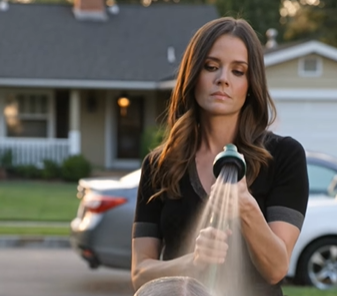
He had been watering the garden when it happened.
She was just standing there.
His daughter. The child he had carried to specialists across three states. The girl whose wheelchair he had loaded into the trunk a thousand times without complaint, whose medications he had memorized, whose limitations he had accepted as permanent truths written into the architecture of their lives.
She was standing in the wet grass, soaked to the skin, trembling — not from pain, but from the terror of being seen.
The hose slipped from his hand. Water continued to pool at his feet. He couldn’t move.
Because the knees that were supposed to have failed her were holding. The legs that doctor after doctor had described in careful, measured tones of diminishing hope were planted firmly in the earth. The body he had been told, repeatedly and with clinical certainty, could not do this — was doing it.
He whispered the only question that mattered.
“Since when?”
She began to cry.
Not the cry of someone in pain. Not the cry of relief. This was the cry of a child who had been discovered — and who understood, even in her young heart, exactly what that discovery meant.
The woman standing nearby — the one he had been planning to marry, the one his household had regarded with quiet suspicion for months — spoke before his daughter could.
“Ask her who told her to stay in the chair.”
His daughter shook her head frantically, eyes wide with a fear that had nothing to do with falling.
“Don’t,” she begged.
That single word hit him harder than anything else in that moment. Because fear has a particular texture when it has been taught. And what he heard in his daughter’s voice was not the instinctive fear of a child caught in mischief. It was something older. Something rehearsed. Something that had been carefully placed inside her.
He knelt slowly in front of her, the way you approach something fragile that you are terrified of losing.
“Who told you to stay in that chair?”
Her lips trembled. Water dripped from her chin. Her eyes searched his face for something — safety, maybe. Or permission to finally tell the truth.
“I didn’t want you to be mad,” she whispered.
Behind them, the woman exhaled — not with amusement, but with the particular exhaustion of someone who has heard an echo they recognize. Because she had heard those exact words before. From the nanny.
The nanny.
The word landed in his chest like a stone dropped into still water.
The one who had always been present. Always composed, always devoted, always the first to explain away the setbacks — the difficult days, the regression, the exhaustion, the reasons why progress was slow and hope should be measured carefully. She had been the steady, gentle hand in the background of every hard moment. The one he had trusted completely, because loving his daughter and trusting the woman who cared for her had felt like the same thing.
The woman explained what she had seen. His daughter running the day before, when she believed the house was empty. The panic when she was noticed. The way she had lowered herself back into the chair like an actor returning to a mark on a stage.
His daughter’s next words came out broken, barely above a whisper.
“She said if I got better, you’d send her away.”
He went completely still.
The shape of it emerged slowly — the way something submerged finally rises to the surface when the water clears. This had never been about illness. It had been about need. Not his daughter’s medical need, but someone else’s need for her to remain in a particular state. Dependent. Stationary. Requiring care.
A child kept fragile so that the person managing her fragility could remain irreplaceable.
His daughter’s voice broke completely when she said the last part.
“She said if you saw me walk before the wedding, you’d stop marrying her.”
He sat with that sentence for a long time.
Because it changed the entire map of the past — every specialist visit, every cautious prognosis, every morning his daughter had been lifted into that chair. Every time hope had been quietly discouraged. Every time recovery had stalled at the precise moment it might have meant someone’s role in their lives would diminish.
The wheelchair had kept someone employed, someone close, someone needed.
That is the cruelest kind of betrayal — not the dramatic kind, not the kind that announces itself with crashing cruelty. The quiet kind. The kind that disguises itself as devotion and care and selflessness. The kind that uses a child’s body as a tool for someone else’s security.
He looked at his daughter’s legs. Still standing. Still holding.
She had been carrying two weights all along — the chair she sat in, and the secret she had been told to keep.
Some truths don’t arrive loudly. They arrive the way this one did — in a wet yard, in the middle of an ordinary afternoon, in the face of a little girl who had been waiting, for a very long time, for someone to finally look closely enough to see.
The wheelchair had never only been a chair.
It had been leverage.
And now, at last, it would never be used that way again.






