She wasn’t supposed to be sitting on that bench.
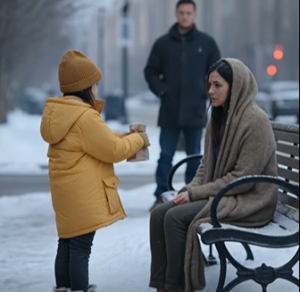
It was one of those gray winter afternoons where the cold doesn’t announce itself — it just settles into your bones like an old grief you’ve learned to carry. She had chosen that particular bench for no real reason. Maybe because it was empty. Maybe because she was tired of moving and hadn’t yet figured out where she was supposed to go next. She sat barefoot in the snow, a crumpled paper bag resting in her lap, staring at nothing in particular.
That was when the little girl appeared.
She couldn’t have been more than five or six, bundled up in layers that looked like someone had dressed her with great care and great love. She stopped a few feet away and tilted her head the way small children do when they’re deciding whether something is safe. Then she opened her mouth and said the words that would unravel everything.
“My daddy still keeps your blue scarf.”
The woman on the bench went completely still.
Children don’t say things like that. Not to strangers. Not in the middle of a Tuesday afternoon, in the middle of falling snow, in the middle of a life that had already broken once and was still trying to put itself back together. And yet here was this little girl, steady as anything, watching her with eyes that held something achingly familiar.
In the distance, a man moved. Slowly. Like someone who had rehearsed this moment a hundred times and still didn’t feel ready.
She looked past the child and saw him.
And the air left her completely.
He looked older than she remembered. More tired around the edges, less certain in his step. But it was undeniably him — the same broad shoulders, the same way he carried himself like he was always bracing for something. The years had worn him differently than she expected. Grief tends to do that.
The little girl turned at the sound of his footsteps crunching through the snow.
“Daddy,” she said softly, like she’d just done something courageous and wanted him to notice.
He stopped a few feet away, hands open at his sides, eyes fixed on the woman by the bench as if he were trying to make himself believe she was real. She looked up at him, her lips parting before she even knew what she wanted to say.
“You told her about me?”
He shook his head slowly.
“No,” he said. “I told her you were gone.”
The little girl frowned, looking between the two of them the way children do when adults aren’t making sense.
“But you cry when you hold the scarf,” she said plainly. “So I knew gone wasn’t the same as dead.”
Neither adult had an answer for that.
The woman looked down at the paper bag in her lap, then back at the child. When she finally spoke, her voice came out smaller than she intended.
“You shouldn’t say things like that to strangers.”
The little girl’s face shifted — not with embarrassment, but with something far more certain than that.
“You’re not a stranger,” she whispered.
The father closed his eyes for just a moment, like he was steadying himself against something invisible.
The woman stared at him, tears gathering at her lashes, mixing with the snow that had begun to melt against her skin.
“Why is she wearing my mother’s hat?”
He went still in the way that means everything.
Because the knit beanie sitting crookedly on the little girl’s head was old and stretched and carefully repaired near the seam — the kind of delicate, patient repair that only one specific set of hands had ever known how to make. The woman recognized it the way you recognize a piece of your own heartbeat.
Her hands began to tremble.
“That hat was in the hospital bag,” she whispered.
The little girl looked up, innocent and earnest.
“What hospital bag?”
The man’s composure finally gave way, right there in the snow, in front of both of them.
“The one they gave me,” he said quietly, “when they told me you wouldn’t wake up.”
The world seemed to hold its breath.
She sat with that sentence for a long moment — the weight of it, the years behind it, the things it explained that she hadn’t known needed explaining. She looked at the child again. At the carefully repaired hat. At the familiar shape of her small face. At the way her eyes caught the gray winter light.
And she understood.
This little girl hadn’t stumbled upon her by chance. She had been walking around for years carrying pieces of a life she didn’t know belonged to someone else — a blue scarf folded in a drawer, a knit hat stitched back together with patient hands, a father who cried over things he never explained.
The child had been living inside a story she didn’t know was hers.
And then the little girl took one small step closer — just one — and asked the question that broke the afternoon wide open.
Her voice was barely above a whisper. It trembled at the edges the way a child’s voice does when they already sense the answer is going to change everything.
“If you were gone…”
She paused.
“…why do I have your eyes?”
Some questions don’t need an answer to be the truest thing in the room.
Some moments of recognition don’t arrive with explanation or apology or careful planning. They arrive in the middle of an ordinary Tuesday, in falling snow, through the mouth of a child who was brave enough to walk up to a stranger on a bench and say exactly what needed to be said.
There are losses in this life that we carry so long, they start to feel like identity. We build our whole sense of who we are around the shape of what’s missing. And then, sometimes — not often, but sometimes — the missing thing finds its way back. Not in the form we expected. Not with the words we rehearsed. But real. Unmistakable. Standing in front of us in a repaired hat and borrowed eyes, waiting to be recognized.
She looked at the little girl.
And for the first time in longer than she could remember, she didn’t look away.






