She was just a little girl carrying a spoon.
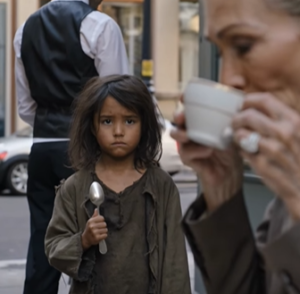
That was all anyone saw at first — a small child standing on the sun-drenched terrace of one of the city’s most exclusive cafés, clutching a tarnished silver spoon against her chest like it was the most precious thing in the world. Maybe it was. She didn’t fully understand why her mother had told her to find the lady with the ring. She only knew she had to.
The waiter noticed the spoon first.
He’d been working that terrace for years, had seen everything from marriage proposals to quiet breakdowns, had learned to read a situation before it fully unfolded. But nothing had prepared him for what he saw when the child held out the spoon and the afternoon light caught the engraving on its handle.
For Isabelle.
Beautiful letters. Old money. The kind of craftsmanship that spoke of a family who commissioned things like this — who marked their possessions, their people, their legacy in silver and gold.
But it was what was scratched inside the bowl of the spoon that stopped him cold.
Not engraved. Scratched. Rough, hurried, desperate — the kind of marking someone makes when they don’t have much time and everything depends on this one act of truth.
Not Isabelle. Mara.
He looked up at the old woman seated at the corner table. She had been watching the child approach from the moment she stepped onto the terrace. Her hands, folded in her lap, were perfectly still. Only her eyes betrayed something — a recognition so deep it had no name.
“You know what this is,” the waiter said.
It was not a question.
The old woman opened her eyes slowly, the way people do when they’ve been waiting a very long time for something they both dreaded and needed.
“Yes,” she said.
The little girl stepped closer, her voice barely above a whisper. “Who is Mara?”
The silence that followed was the kind that swallows a room whole. No clinking glasses, no murmur of polished conversation, no sound of the city beyond. Just the child. The spoon. And a secret that had been buried in silver for more years than this little girl had been alive.
The old woman looked at the child’s face for a long moment — long enough that even the waiter held his breath — and then she spoke.
“The baby who was supposed to leave with your mother.”
The little girl froze.
The waiter felt the air shift around them. “Then Isabelle—”
“Was the child everyone believed had survived,” the old woman said quietly.
The child’s lips trembled. “I don’t understand.”
The old woman’s voice, when it came again, carried something ancient and painful — not fear exactly, but the weight of a truth that had been carried too long by someone who should never have been asked to carry it alone.
“There were two baby girls,” she said. “One born into wealth. One born into hardship. One expected. One… inconvenient. And that night, in that clinic, someone made a choice that changed everything for both of them.”
The waiter had gone pale.
The child clutched the spoon harder against her chest, her knuckles white.
“My mom told me to find the lady with the ring,” she whispered again. “Why?”
The old woman looked down at the ring on her own finger with an expression that could only be described as hatred — the quiet kind, turned inward, the kind that has nowhere left to go.
“Because your mother didn’t steal you,” she said. “She switched the proof.”
And suddenly, horribly, it all made sense.
The spoon had never been a simple keepsake. It had never been a sentimental heirloom passed down with love. It was evidence. Documentation of which child had been fed first, claimed first, named first. Proof of identity scratched into silver by hands that were shaking, by a woman who knew she might not get another chance.
The little girl’s eyes filled with tears. “Then who was my mom?”
The old woman’s face, composed for so many years through so many hard things, finally broke open.
“The woman who raised you loved you completely,” she said softly. “Never doubt that. Not for one second.”
She paused.
“But the woman who gave birth to you… she was sitting in a café not so different from this one when someone came to tell her that her daughter had died.”
The child stopped breathing.
The waiter turned the spoon one more time in the light, almost without thinking — and saw it then. A tiny date scratched beside the second name. Small enough to miss. Easy enough to overlook if you didn’t know what you were looking at.
He knew the date.
Everyone in the city had known it once. The fire at the private maternity wing. The tragedy that had claimed records, evidence, and — as the official story told it — one infant girl who never made it home.
He looked up at the old woman, and the horror of understanding settled over him completely.
This was never just the story of a switched child. It was the story of a cover-up. A deliberate, sustained, carefully maintained lie — one that had allowed the wrong family to grieve, the wrong child to grow up with the wrong name, and the wrong people to sleep peacefully in their beds for over a decade.
And the old woman’s silence — her long, complicit, agonizing silence — had helped keep every last part of it buried.
She knew it. The waiter knew it.
And now, holding a tarnished silver spoon in her small hands, so did the little girl.






