The wife was the first one to speak.
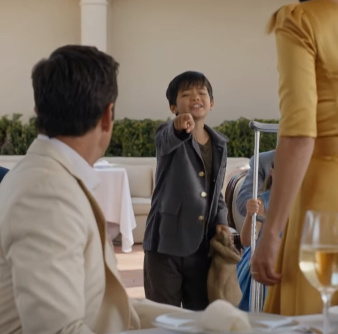
She moved too fast, and her words came out thin — already hollow before they even landed.
“He’s lying.”
But nobody believed it. Not even her.
Because the father had stopped looking at her. His eyes had shifted — first to the small glass bottle in his hand, then to his daughter standing quietly nearby, then back to the boy who had just spoken. And this time, he wasn’t looking at the boy like he was an intruder. He was looking at him the way a man looks at the only honest person left in the room.
The terrace fell completely silent.
Even the guests — the polished, well-dressed guests who had been pretending not to listen — stopped pretending.
The father knelt down slowly beside his daughter. His voice dropped, careful and quiet, the way you speak when you’re terrified of the answer but more terrified of never asking.
“What does she mean, sweetheart?”
The little girl’s fingers tightened around her crutch.
The wife stepped forward immediately. “She repeats things when she’s anxious — you know how she gets—”
The father raised one hand without even turning around.
He didn’t say a word. He didn’t have to.
That single gesture was enough to stop her cold.
He kept his eyes on his daughter. Soft. Waiting.
“When does Mommy give it to you?”
The child’s mouth trembled. Her small shoulders pulled inward, like she was bracing herself against something invisible.
“At breakfast,” she whispered. “Sometimes in my tea.”
The father went completely still.
Every person on that terrace heard it. Every single one of them felt the weight of what a child of that age should never have to say.
The boy steadied himself and kept talking, because someone had to.
“I sleep near the back of the property,” he said. “Behind the restaurant wall, close to the service gate. I heard her talking to the nanny one night. She said — she said the drops keep the girl sleepy. That they keep her eyes unfocused.”
The wife closed her eyes.
Just for one second.
But one second was all it took.
The father saw it. Every guest saw it. The silence confirmed what words hadn’t yet fully said.
The boy pointed at the bottle still in the father’s hand. “She dropped that near the planters last week. She came back to look for it later — she was wearing gloves.”
No one moved.
No one breathed.
The father looked down at the bottle. Then he looked at his daughter — truly looked at her, the way a parent looks when they’re suddenly seeing something they should have seen a long time ago.
And then he asked the question that had lived quietly in the back of his mind for months. The question he had been too afraid to ask even himself.
“Can you see me right now?”
The little girl didn’t answer immediately.
The pause stretched out long and aching.
And then — slowly — she turned her face. Not toward his voice. Not toward the sound of him.
She turned and looked directly at his face.
His eyes. His expression.
Him.
The father’s face emptied completely.
Every emotion drained out at once — the confusion, the hope, the denial — all of it gone, replaced by something that had no name but that every person watching understood instantly.
The wife whispered, “Please…”
He stood up.
He rose slowly, like a man carrying something that had just become unbearably heavy, and when he turned to face her, her expression did the rest. The fear written across her face told every person at that table what no confession ever could.
But it was the child who delivered the most devastating words of all.
Before either adult could speak, before the silence could be filled with excuses or explanations, the little girl looked up and said what she had clearly been holding inside for far too long.
“Mommy told me I have to stay like this,” she whispered. “Until you sign the birthday papers.”
The father stared at her.
Her birthday was next week.
And the trust amendment — the legal document that would restructure his daughter’s inheritance — was scheduled for next week as well.
In that moment, standing on that terrace with a bottle of drops in his hand and his daughter looking clearly up at him for the first time in months, the father understood everything.
The visits to the specialist that led nowhere. The conflicting reports. The way his daughter always seemed worse after spending time at home, and better when she was away. The explanations that never quite added up but that he had accepted because he loved his wife and because the alternative was something no man wants to believe.
It had never been about treating the child.
The drops were never medicine.
They were a tool — carefully calculated, quietly administered — designed to keep a little girl dependent, confused, and unable to tell her father what she could see and what she could not.
Because a child who couldn’t see clearly couldn’t testify clearly.
And a father who believed his daughter was deteriorating would be far more likely to sign documents quickly, emotionally, without the careful scrutiny those papers deserved.
The lie had a deadline.
And the deadline was one week away.
The father set the bottle down on the table. He didn’t slam it. He didn’t raise his voice. He simply placed it down, very carefully, and in that quietness there was something far more frightening than anger.
There are moments in life that divide everything into before and after.
This was one of them.
And everyone on that terrace knew it.






