She was not the kind of child who cried for attention.
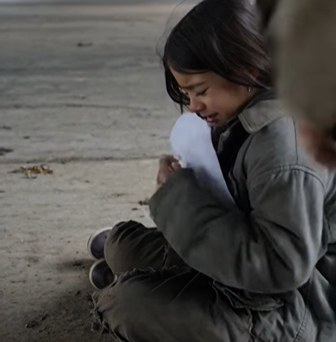
That was the first thing he noticed. Most lost children cried. They wailed or froze or called out for someone familiar. This one sat completely still beneath the bridge overpass, her small back pressed against the cold concrete, both arms wrapped tightly around a folded piece of paper like it was the only thing in the world she had left to protect.
He almost drove past her.
He told himself later that he wished he had.
The drawing she clutched was done in crayon — the kind a young child makes when they are trying to say something their mouth doesn’t know how to form yet. Three stick figures. One small. One taller. One crossed out in heavy, violent red. A house with no windows on the lower floor. A door drawn low to the ground, the kind that led somewhere dark and underground.
He crouched down slowly so she wouldn’t be startled.
Kind strangers usually filled silence with questions. Where are your parents? Are you hurt? Do you need food? He asked none of those things. He just stared at the drawing — quietly, carefully — like a man who had seen that house somewhere before in a place he had spent years trying to forget.
The girl pulled the paper back toward her chest.
“Who drew it?” he asked, his voice barely above a whisper.
“My brother,” she said.
The word landed differently than she expected it to. Not like a small detail. Like a key turning in a lock he hadn’t known was there.
He looked again at the three figures. He looked at the crossed-out one in red. He looked at the basement door drawn with such precise detail that no child could have imagined it — only remembered it.
“Where is he now?” he asked.
Her lips trembled. “Mom said don’t say.”
He nodded once. But his eyes had shifted. Less gentle. More focused. The kind of focus that belongs to someone who is calculating something against a clock only they can hear.
That was when she noticed the engine.
It had been running the entire time, low and patient, somewhere just beyond the far row of concrete pillars. Hidden. Waiting. The sound did not belong to a passing vehicle. It belonged to something that had arrived and chosen to stay out of sight.
The man glanced toward it.
Just once. But she saw it.
And in that single glance, something her mother had tried to explain without ever fully explaining clicked into place inside her young mind. The paper she was holding — the drawing her brother had made — was not a message meant to be found by just anyone. It was a set of instructions. Quiet, careful instructions about what to do if the right person never came. If someone else arrived instead.
The man reached into his coat.
She flinched hard enough to scrape her shoulder against the concrete.
He stopped immediately. Raised one hand. Then reached back in slowly and pulled out a wallet. Old leather, worn thin at the corners. He opened it with deliberate care and reached behind a faded ID card to remove a photograph so old the edges had turned soft and white.
He held it up beside the child’s drawing.
The girl’s breath left her body.
It was the same house.
Same crooked roofline. Same front tree bent sideways like it had been growing away from something for decades. Same low door at the base of the wall. Same darkness implied in every line.
“My sister drew this house,” he said.
His voice was barely holding together.
She stared at the photograph for a long moment. Then she watched him turn it over. On the back, in handwriting that looked almost identical to the messy letters in the note her mother had sewn into her coat lining, were three words written in faded blue ink:
Don’t trust Daniel.
The color drained from his face slowly, the way water pulls back from a shore before something large arrives.
Because Daniel was his name.
She looked at the silver cross hanging at his throat. The one she had noticed first and thought meant safety.
Then she looked past him.
Between the concrete pillars, a dark car had begun to creep forward. No headlights. No hurry. The kind of approach that belongs to someone who already knows exactly where they are going and exactly what they expect to find when they get there.
Her voice came out in pieces.
“Then my mom wasn’t waiting for you.”
The man turned toward the car.
His shoulders changed. His posture changed. The careful gentleness that had surrounded him like a second coat fell away entirely.
And for the first time since he had crouched down beside her on that cold concrete ground, he looked exactly the way she felt.
Afraid.






