He built an empire from nothing.
No inheritance. No safety net. No one handing him anything on a silver platter. Just raw determination, sleepless nights, and a vision that most people told him was impossible. By the time he reached the peak of his career, he was one of the most powerful real estate developers in the city — the founder of a billion-dollar company that stood as proof of what one man could build with his bare hands.
He had everything a man could want. Three sons who carried his name. A beautiful wife who stood beside him through every storm. More wealth than most families could spend in three lifetimes. And a legacy that seemed untouchable.
But success, as many people learn too late, has a way of attracting the wrong kind of attention.
The more powerful he became, the more dangerous his world grew. Rivals watched from the shadows. Partners smiled to his face and whispered behind his back. And when his wife passed away suddenly — the woman who had been his anchor, his compass, his greatest source of peace — the cracks in everything around him began to split wide open.
Her death changed him. But more than that, it changed the people around him.
Within months, the vultures circled. The people he had trusted most — lawyers, business partners, men who had sat at his table and broken bread with him — began positioning themselves to take what he had built. Documents vanished. Signatures appeared on papers he had never signed. And one by one, the trusted pillars of his inner circle revealed themselves to be anything but loyal.
Then came the discovery that shook him to his core.
Someone inside his own circle — someone who had looked him in the eye and called him a friend — had forged legal documents with the intent to strip his company from his children. His sons. His blood. The inheritance he had spent a lifetime building for them.
He made one decision that would cost him everything: he let the wrong person know that he had found out the truth.
A week later, his car went off the road and burst into flames.
The city mourned. The newspapers ran his photo. His sons buried an empty coffin. And the men who had conspired against him quietly divided the spoils of the empire they had stolen.
But he did not die.
He survived — barely, and at a cost that would break most people completely. Burned. Injured. His identity stripped away by both circumstance and necessity. Before he could recover enough to speak, to fight, to tell anyone what had happened, he understood one terrifying truth: if those men discovered he was alive, they would finish what they had started.
So he disappeared.
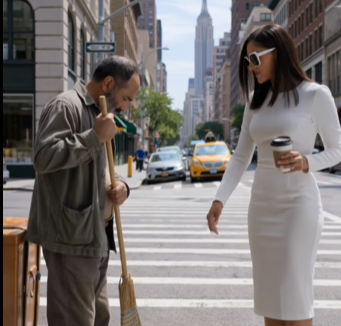
Not into a comfortable hiding place. Not into some quiet corner of the world where money could keep him safe. He had no money. He had no documents. He had no name anyone would believe. He moved from shelter to shelter, taking whatever work he could find — odd jobs, manual labor, the kind of work that kept his hands busy and his face out of sight. He watched the city he had once shaped and commanded slowly forget that he had ever existed.
He watched his empire carry another man’s name.
He watched his sons grow older without him.
And somewhere deep inside, he must have wondered if it would have been better to simply let the world keep believing he was gone.
What he did not know — what no one had ever told him — was that his youngest son had never accepted the official story. Had never stopped searching. Had spent years following cold trails and asking questions that made powerful people uncomfortable, driven by a quiet, unshakeable conviction that his father was still alive somewhere.
That son never found him.
But his sons did.
The three young men standing before the old street cleaner were not strangers passing by with a kind gesture and a spare burger. They were his grandsons — grown men with his blood in their veins and their father’s stubbornness written into every line of their faces.
The one who had offered the food had noticed something small. Something that most people would have walked past without a second glance. A crescent-shaped scar near the old man’s temple — faint with age, but unmistakable to someone who had grown up staring at an old family portrait hanging on the wall of their father’s office.
He called his brothers over quietly.
One of them was already crying before a single word was spoken.
The third reached into his jacket with trembling hands and pulled out a photograph — worn at the edges, soft from years of handling. It showed the same old man, decades younger, dressed in a dark suit and smiling in front of a tower that bore his name. A tower that now bore someone else’s.
The old man looked at the photograph.
Then he looked at their faces.
And something behind his eyes — something that had been sealed away for years — began to crack open.
His lips trembled. He could not speak.
One of the grandsons stepped forward and said the words that no amount of time could have prepared him to hear:
“Grandfather… Dad died still trying to find you.”
The broom slipped from his hands and clattered against the pavement.
For a long moment, no one moved.
Then the grandson holding the crushed burger turned and looked in the direction the white sports car had sped away — the car that had nearly struck the old man — and asked the question that would set everything back into motion:
“Do you know who that woman was?”
The old man slowly shook his head.
The grandson’s jaw tightened, and his voice dropped low and deliberate.
“She’s the daughter of the man who stole your empire.”
Some stories do not end with the grave. Some debts do not stay buried. And some men, no matter how hard the world tries to erase them, are simply not finished yet.