The little shop had always been the kind of place people walked past without a second glance — tucked between a dry cleaner and a flower stall, its gold chandelier the only thing that made it worth noticing at all. Most days, the old jeweler sat alone behind his glass counter, polishing things that no longer belonged to anyone he loved. But that afternoon, everything changed the moment a small girl pushed open the door.
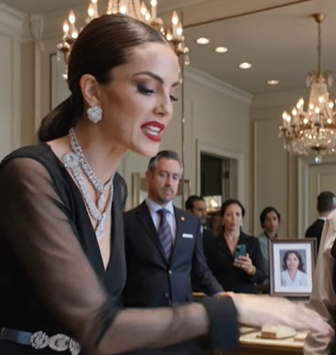
She couldn’t have been more than seven or eight years old. Her coat was too thin for the weather, and her eyes were red from crying. She wasn’t browsing. She wasn’t lost. She walked straight to the counter with the focused determination of someone who had been given very specific instructions and was terrified of forgetting them.
In her small fist, she clutched a pendant.
A woman standing nearby — dressed in the kind of clothes that made other people feel underdressed just by being in the same room — glanced over and immediately stiffened. She had been in the middle of examining a bracelet, but her attention snapped to the child like a moth to flame. Something behind her polished expression shifted. Something uneasy.
The little girl held up the pendant.
“My mother told me to bring this here,” she said quietly. “She said to show it only to the man who remembers the lullaby.”
The rich woman laughed — a short, brittle sound. “That proves nothing,” she said, shaking her head with the practiced confidence of someone used to being believed.
But no one in the shop was looking at her anymore.
They were all staring at the old jeweler.
His hands trembled so badly he nearly dropped the frame. He looked from the child to the pendant, then back to the child again, with the expression of a man watching twenty years of grief suddenly rearrange themselves into something he couldn’t yet name. The color drained from his face. His lips parted, but no words came out.
The little girl stood in place, confused and frightened, tears still wet on her cheeks.
The old man stepped closer, slowly, as if approaching something fragile.
“What was your mother’s name?” he asked. His voice barely held together.
The girl swallowed hard. She’d clearly rehearsed what came next.
“She said that if I was ever hungry… I should find the shop with the gold chandelier. And show this only to the man who remembers the lullaby.”
The jeweler stopped breathing.
Somewhere near the back of the shop, a woman quietly burst into tears.
The pendant hung in the air between them — small, tarnished at the edges, and carrying the weight of something enormous.
“What lullaby?” the old man asked, his voice now barely above a whisper.
The child looked down. She pressed her lips together, steadying herself the way children do when they’re trying very hard to be braver than they feel. Then she whispered the first line.
Just one line.
The old jeweler made a sound that didn’t belong to ordinary grief — a low, broken exhale that seemed to come from somewhere deep and long-sealed inside of him. He reached for the counter to steady himself. His knees buckled anyway.
It was the lullaby he had written himself. The night his daughter gave birth. A song composed in a cold hospital room, sung once, shared with no one. There were no recordings. No written copies. No one alive on earth should have known those words.
No one.
He sank to his knees on the shop floor, right there in front of everyone, tears running freely down his weathered face.
“My daughter used to sing that,” he whispered, “to her baby. To my granddaughter.”
The boutique erupted. Murmurs became gasps. Someone knocked over a display stand and didn’t bother picking it up.
The glamorous woman backed away so quickly she collided with the glass counter behind her. Her bracelet clattered to the floor. She didn’t reach for it.
The little girl stared at the old man on his knees, trembling from head to toe, unsure whether to run or to stay.
Then the jeweler reached behind the backing of the pendant’s frame — slowly, carefully — and pulled out a folded note that had been tucked there for years. The paper was soft with age. His fingers shook as he opened it.
It was his daughter’s handwriting.
He recognized every curve of every letter.
His voice cracked as he read the first line aloud:
“If this pendant ever returns, the child wearing it is mine.”
The room went absolutely silent. The kind of silence that settles when something irreversible has just been understood.
He looked up at the little girl. She was watching him with wide, searching eyes — the eyes of a child who had been carrying a secret she didn’t fully understand, across distances she couldn’t measure, to a place she’d only been told to trust.
And behind them, the well-dressed woman — now pale, now cornered, now stripped of every layer of composure she’d walked in with — whispered three words that confirmed everything:
“That’s… impossible.”
But her voice told a different story.
Because she had seen that pendant before.
She had seen it the night the little girl’s mother disappeared — and she had never once believed it would find its way back.
Some things, it turns out, are not lost. They are only waiting. Waiting for the right child to carry them home, to the only man who would know the song, in the only shop with a gold chandelier, on the day the truth finally ran out of places to hide.