Nobody moved.

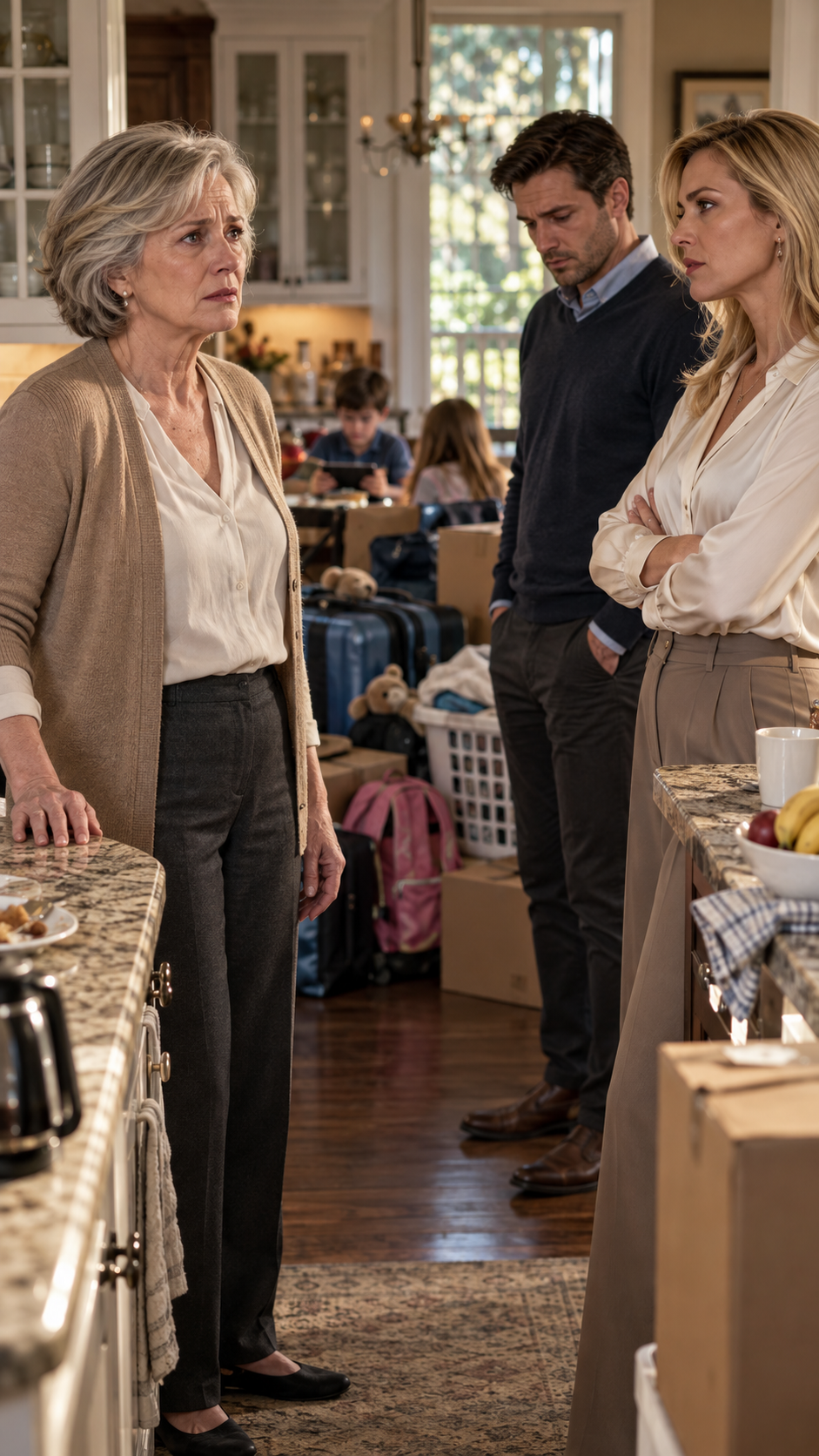
The room held its breath like it knew something the rest of them didn’t. The fiancée stood near the doorway with her arms crossed, chin tilted upward, the kind of posture that belongs to someone who believes they’ve already won. The property officer sat quietly at the table, a thick folder resting beneath his steady hands. And the old woman — the one who had just been kneeling on the cold floor, sobbing, asking permission to remain in the house she had lived in for decades — slowly pressed her palm against the wall and began to push herself upright.
Her legs trembled. Her cheeks were still wet.
But something in her eyes was beginning to shift.
The fiancée stared at the papers the officer had placed on the table as if they couldn’t possibly be real. Her jaw tightened.
“That’s impossible,” she said. “This house was supposed to go to my fiancé after the wedding. That was always the plan.”
The property officer gave her a slow, measured look. Not unkind. Just certain.
“It was the plan,” he said quietly. “Until the owner filed a final amendment before his passing.”
The son, who had been standing off to the side in silence, swallowed hard. His face had gone pale.
“My father changed everything?” he asked.
“Yes,” the officer said. “He did.”
The folder opened. Papers were arranged with quiet precision on the table, and the atmosphere in the room changed completely — the way a sky changes just before a storm arrives and you finally understand what all that stillness was about.
The officer spoke evenly, without drama, which somehow made every word land heavier.
“There was also a private instruction attached to the property transfer,” he said. “It was written to be read only in the event that anyone ever attempted to remove this woman from her home.”
The fiancée’s confidence flickered for the first time. Just a crack. But it was there.
“Read it,” she said, though her voice had lost some of its edge.
The officer unfolded the page carefully, like it deserved respect.
“I leave this home — every room, every key, and every legal right connected to it — to my wife, and to her alone. No future marriage, no promise made in my absence, and no claim through my son shall ever override her full and permanent ownership of this property.”
The old woman covered her mouth with both hands.
Her son looked as though the floor had shifted beneath him.
But the officer continued reading, and his voice didn’t waver.
“If the day ever comes when my wife is made to kneel, to beg, or to feel like a burden inside the home she gave her entire life to, then let this document immediately restore what was always hers — her dignity, her safety, and her right to remain.”
The fiancée took one slow step backward. Then another.
“No,” she whispered.
The officer turned the page.
“There is one final clause,” he said.
The son looked up sharply.
“What clause?”
The officer met his eyes with a steady gaze that carried no judgment, only the weight of the words he was about to deliver.
“If my son stands by and watches his mother be humiliated inside this house without defending her, then he too forfeits all right to remain on this property.”
The sentence landed like something physical.
The son’s mouth opened. Nothing came out. He looked at the fiancée, then at his mother, then back at the floor — a man caught between two worlds, suddenly belonging to neither.
The fiancée turned to him with wide, desperate eyes.
“Do something,” she said sharply. “Say something.”
But there was nothing left to say. The law had already spoken. The husband — quiet, gone, and apparently far wiser than anyone had given him credit for — had seen this moment coming long before any of them had. He had prepared for it the way a man prepares a shelter before the rain, quietly, without anyone noticing, out of love rather than anger.
The old woman, still breathing unevenly, straightened her back. She wiped her face with the back of her hand. And when she finally looked at the fiancée, the pleading that had been there just minutes before was completely gone.
What remained was something much quieter, and much more powerful.
“You stood in my kitchen,” she said, “and told me I needed to ask permission to stay in my own home.”
The fiancée said nothing.
The old woman turned to her son.
“And you let her say it.”
Her voice didn’t rise. It didn’t need to. There is a kind of grief that speaks most clearly in a steady tone, and every person in that room felt it.
She turned toward the door, then looked back one final time.
“This house held my husband’s last breath. It raised my child. It was the walls around every important moment of my life.”
She stood fully upright now, no trembling, no tears.
“You will both be gone before the sun goes down.”
No one argued. No one had any ground left to stand on. The fiancée gathered her things in stunned silence. The son followed, unable to meet his mother’s eyes as he passed her.
The property officer quietly closed his folder.
And the old woman stood alone in the center of her home — the home that had always been hers — and for the first time in a very long time, the room around her felt exactly like it was supposed to feel.
Safe. Hers. Still.